Why Is the Quality of Custom Bags So Poor?
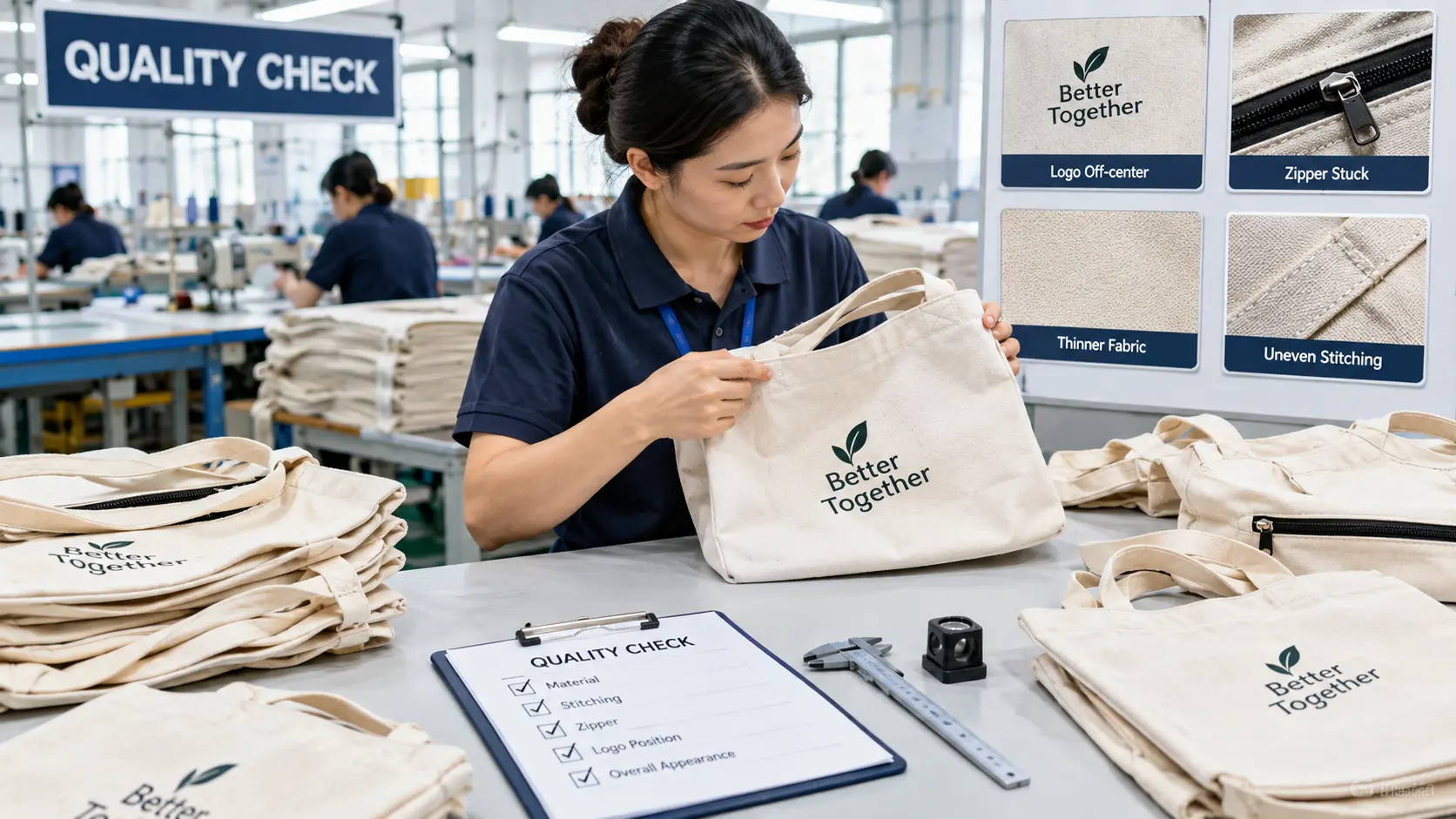
The approved sample looked fine. The payment was made, a full container arrived, and then problems showed up: the canvas was thinner, zippers stuck, and logos were off-center. Many buyers immediately assume the factory cut corners or used less material than agreed. In reality, quality deviations can come from a combination of material changes, production conditions, gaps in document handover, and weaknesses in production-line management.
Understanding what is quality control
Many buyers never fully clarify what is quality control. They put all their trust in one final inspection before shipment. But what is quality control actually covers the whole process: checking incoming materials before production, conducting in-process inspections, approving semi-finished goods, and carrying out pre-shipment sampling. Final inspection is only one part of it. Understanding what is quality control means looking at the entire production process rather than treating the final inspection as the only safeguard.
Relying on a final quality check is often too late. By then, a batch defect may already have been reproduced across hundreds or thousands of pieces, leaving no practical way to recover the order loss. A proper quality check should not start only after every bag is finished. Verification points should be built into incoming materials, cutting, sewing, and other key production stages.
Why canvas bags manufacturers Lose Quality
Some canvas bags manufacturers can produce an excellent sample but struggle to maintain the same standard in mass production. With many canvas bags manufacturers, the sampling team and the mass-production line are effectively two different teams. Sampling may be done without strict labor-hour pressure and with carefully selected materials, while mass production is driven by delivery deadlines. Worker turnover and fabric-lot variation can magnify small defects.
Some factories also outsource production after taking the order. Not all canvas bags manufacturers have enough in-house control to keep the approved standard consistent from sampling through mass production. When production is outsourced, the agreed standards can get lost between the sales team, the factory, and the subcontractor, while the buyer-facing team may have little visibility into the actual production line. Many suppliers in the market are good at making samples but lack a complete internal verification system for the full production cycle.
XINHUI, for example, keeps its sampling team and mass-production lines under unified internal control and does not subcontract custom bag orders. This reduces the risk of specifications being lost during handover. The factory has passed BSCI social responsibility audits and ISO 9001 quality management system audits, and has long served overseas brands and cross-border sellers with custom canvas bags and other soft-bag products.
Quality check for Material Changes
Material changes are one of the most common sources of quality problems. Different dye lots of canvas can have visible color differences. When a supplier runs out of the agreed fabric, some factories fail to notify the buyer and directly switch to a lower-weight canvas.
Zippers and other hardware can vary by production lot as well. Even under the same model number, different batches may differ in smoothness, plating, and overall finish. Writing the material specifications into a document is not enough. Without retained physical color swatches and fabric samples, it becomes difficult to determine responsibility when the mass-produced goods do not match the approved sample.
Quality check in Production Conditions
The sample room and the mass-production workshop operate under different conditions. In a sampling room, temperature and humidity may be relatively stable, and the curing conditions for glue and ink can be controlled. During mass production, workshop temperatures can fluctuate between day and night. Inadequate ink curing can cause prints to peel, while humidity can weaken adhesive bonding and cause seams or panels to come apart.
These issues are not necessarily the result of intentional corner-cutting, but they can still show up directly in the finished product. That is why production-stage control matters just as much as checking the final bags.
Documentation Gaps Create Batch Problems
Weak buyer documentation can also create defective mass production. Sending only reference images without specifying dimensional tolerances, fabric weight, or the acceptable range for logo placement leaves too much room for interpretation.
The factory then follows its own understanding of the requirement, and the finished goods may not match the buyer's expectations. Many buyers approve only the appearance sample but do not approve the actual materials that will be used for mass production. A sample may be made with premium materials, while the bulk order uses a substitute material. If that difference is not caught during the approval stage, the risk passes straight into production.
Quality check in Production Processes
Missing internal controls at the factory can magnify the problem. Some production lines have no mid-production inspection and wait until all products are finished before sorting out defects. When the shipping deadline is close, workers may also skip or shorten certain process steps just to get the goods out.
Repeat orders have their own risks. Even when a factory has produced the same design before, changes in trims, workers, or suppliers can alter the result. If the first piece is not rechecked, quality can gradually decline from one repeat order to the next.
For canvas products, several category-specific risks deserve extra attention. Check the actual fabric weight rather than relying only on the written specification. Confirm whether the fabric has been pre-shrunk, because noticeable size changes after washing are a common source of disputes. For screen printing and heat-transfer printing, confirm the ink-curing process to reduce the risk of fading or peeling later.
A Practical quality check Process
Below are practical inspection steps buyers can add directly to their purchasing process:
- Incoming materials: Check the fabric, hardware, and accessories against the approved physical samples, and record the fabric lot number.
- Pre-production: Require a pre-production sample made with the actual bulk-production materials. Only release the order for cutting and mass production after the sample has been reviewed and signed off.
- In-process inspection: When production reaches about 5–10%, inspect semi-finished bags. Check stress points in the stitching, logo placement, and zipper operation.
- First-piece approval: For every repeat order, require a first-piece sample to be approved before continuing with full-scale production.
- Pre-shipment sampling: Conduct finished-goods sampling based on the AQL standard, checking appearance, dimensions, function, packaging, and shipping marks.
A complete control process can reduce the probability of batch defects, but it cannot eliminate every minor individual imperfection. Buyers can also write these inspection points into the purchase contract and define the rework and dispute-handling rules for batch-level quality problems. Whether a supplier is willing to cooperate with the full process can be a practical factor in supplier evaluation.
A manufacturer with a strong internal control system will build these checkpoints into daily production instead of treating them as optional inspections. XINHUI has integrated incoming-material checks, pre-production sample approval, in-process inspections, and first-piece approval for repeat orders into its internal operating procedures. Customers and third-party inspection agencies are also welcome to conduct on-site inspections.
FAQ: what is quality control for Small Custom Orders?
Q1. Do orders of only 200–300 custom canvas bags still need pre-production sample approval?
Yes. Small orders should still go through pre-production sample approval. Small quantities are rarely large enough to justify dedicated material purchasing, so factories often use leftover warehouse stock. Skipping the approval step makes it easier for the actual production materials to differ from those used for the original sample.
Q2. The contract only says “bulk production must match the sample” and gives no detailed tolerances. How are disputes usually handled?
A statement that the goods must “match the sample” is often too vague because it does not define written tolerances. The factory may treat a product as acceptable as long as no obvious difference can be seen by eye, while the buyer may want to hold the supplier responsible for smaller deviations.
For custom orders, it is better to attach measurable tolerances for dimensions, print position, and other key points to the contract.
Q3. Some finished bags have workmanship defects, and the factory offers a discount. Should the buyer accept it?
First determine whether the defects are isolated and scattered or are a common problem across the batch. A discount can be a practical way to handle a small number of isolated defects. But when the same defect appears throughout the batch, accepting the discount may still leave the buyer with customer complaints and returns after the goods enter the market. The total loss can end up exceeding the supplier's compensation.
Think private labeling Is Just Adding a Logo?
Related Article