
Are Fabric Shopping Bags Really Better for Every Trip?
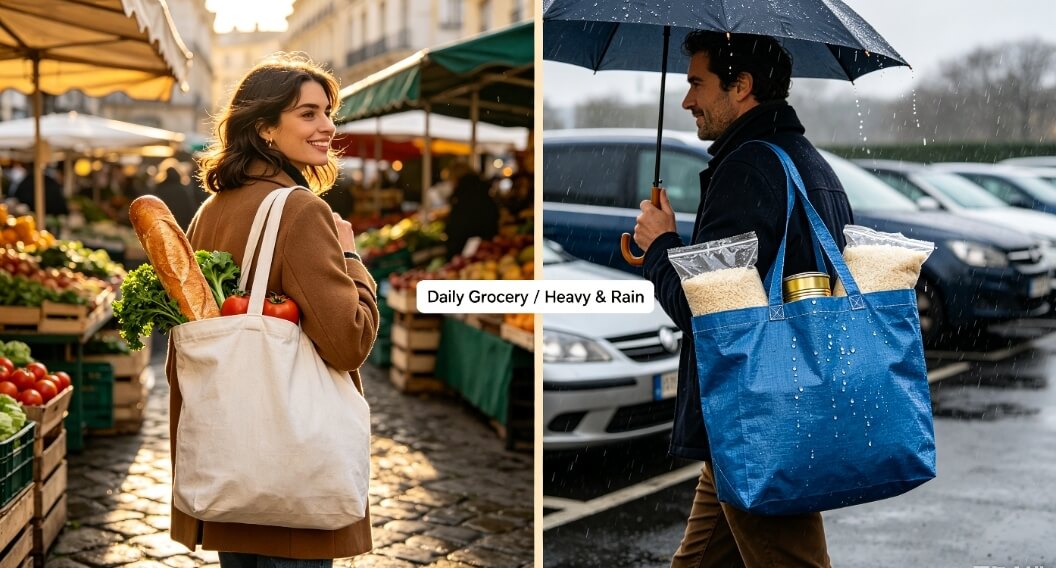
You’re standing at the checkout when the plastic bag suddenly tears, sending eggs rolling across the floor. So you switch to fabric shopping bags, only to find that the fabric gets heavy after soaking up rain, crushing your bread in the process. Then you try a canvas shopping bag, and the handles give out when you load it with 10 kg of rice. Thinking a woven shopping bag will solve everything, you take one home—only to discover that it’s breathable and lacks structure, turning your tomatoes into sauce.
The problem isn’t you. The problem is that the word “fabric bag” lumps three very different products together.
Three Types of Fabric Shopping Bags
Canvas: Sturdy and Structured

Canvas is a tightly woven, heavyweight cotton or cotton-blend fabric, commonly around 8–12 oz (about 271–407 GSM). It holds its shape, lasts well, and takes printed designs nicely. However, it doesn’t handle water or prolonged overloading particularly well.
A 10 oz cotton canvas bag has a production carbon footprint of roughly 272 kg CO₂e and needs to be reused around 170 times to break even with a single-use plastic bag in terms of carbon emissions. At one grocery trip per week, that’s about 3.3 years. A good-quality canvas bag typically lasts 3–5 years.
Woven: Built for Heavy Loads and Rain

A PP woven bag is made by weaving polypropylene plastic flat yarns together. It isn’t “fabric” in the traditional sense—it’s a material made by weaving plastic film.
A typical 80 GSM PP woven bag can carry around 15–30 kg, while reinforced versions can handle 50 kg or more. It’s waterproof, resistant to acids and alkalis, and lightweight. The trade-offs are its more industrial appearance, limited breathability, and lack of home compostability.
Fabric: The Broadest Category
“Fabric” shopping bags can include almost any textile, including cotton, linen, polyester, recycled polyester (rPET), and jute. In other words, fabric shopping bags is the umbrella term, while canvas and woven bags can fall within that broader category. In everyday use, however, “fabric bag” often refers to a softer cotton or linen-style bag.
💡 The simple rule: Choose canvas when you want structure and appearance, woven when you need heavy-duty performance and rain protection, and remember that fabric is the broad category—you need to check the actual material before buying.
If you’re sourcing fabric shopping bags in bulk for a brand or retail store, XINHUI’s manufacturing setup in Guangdong covers both canvas and woven production. Its cotton canvas line ranges from 4–24 oz and supports flexible orders starting at 300 pieces, while its PP woven production operates at an annual capacity of around 18,000 tons. Using one supplier for multiple materials can be more consistent than managing separate factories.
Choose by Use, Not by Looks
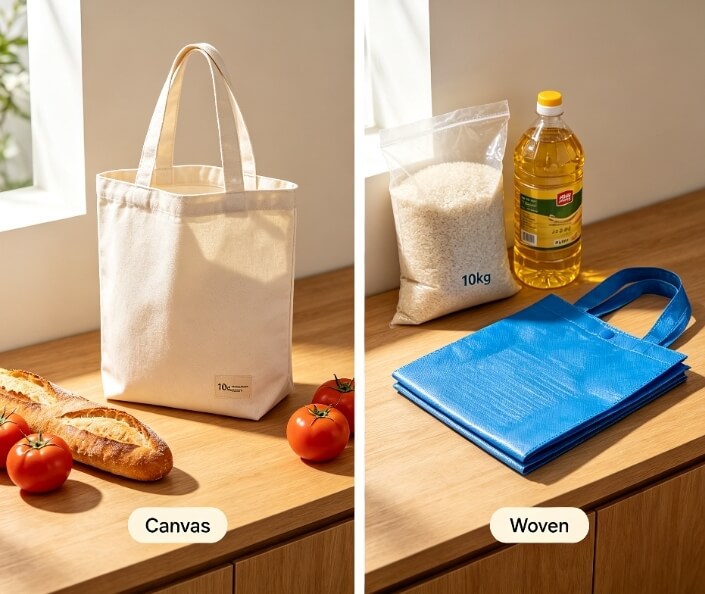
Most people buy the wrong bag because they choose based on what looks good rather than where they’ll actually use it. Here’s a more practical match:
Everyday Groceries, Bread, Fruit, and Books → Canvas Shopping Bag
An 8–12 oz cotton canvas bag is usually enough. It’s structured enough to stand on its own and breathable enough to keep leafy greens from getting stuffy.
A standard 10 oz canvas bag can withstand an average of about 47 lb (21 kg) before the handle stitching fails in load testing. For everyday use, keeping the load below 35 lb (16 kg) will help extend its lifespan.
Organic cotton canvas is a greener choice, but it takes more uses to offset its environmental impact—around 375 uses according to the UK Environment Agency.
Rice, Cooking Oil, Rainy Days, and Heavy Loads → Woven Shopping Bag
A 10 kg bag of rice, a 5-liter bottle of cooking oil, and a bag of cat litter are more than most ordinary cotton bags should be asked to carry.
The woven structure of a PP bag distributes the load across the material instead of concentrating it at individual stitching points. For everyday shopping, 60–120 GSM is a practical sweet spot. A 10–25 kg load is well within its range, and the material itself is waterproof. You can walk from the supermarket to the garage in the rain without worrying about the dry goods inside.
Gym, Pool, and Sweaty Environments → Polyester Woven or Lightweight fabric shopping bags
Cotton canvas absorbs moisture and can take a while to dry, which can lead to unpleasant odors. A water-resistant PP woven bag can be a better option, or choose a lightweight polyester bag that folds neatly into the side pocket of your gym bag.
Sustainability First → Organic Cotton Canvas or Hemp Canvas
Conventional cotton is water-intensive. Producing 1 kg of cotton can require around 20,000 liters of water.
GOTS (Global Organic Textile Standard) certification requires at least 70% organic fibers, restricts toxic dyes, and includes requirements for wastewater treatment and fair working conditions. OEKO-TEX Standard 100, by contrast, tests finished products for harmful substances such as heavy metals, formaldehyde, and pesticide residues, but it does not verify whether the fibers are organic.
The two certifications address different concerns: choose GOTS when you want “organic + ethical,” and OEKO-TEX when your priority is chemical safety.
Why Your Canvas Bag Falls Apart After Six Months
It’s not necessarily because you use it too hard. Many cheap canvas bags cut corners during production:
- Misrepresented fabric weight: A bag labeled 10 oz may actually use 6 oz fabric, significantly reducing its load capacity.
- Single-line handle stitching: Quality bags should use X-shaped or double-line reinforcement, with handles at least 2.5 cm wide.
- No box stitching at the bottom: A flat-bottom canvas bag can deform badly when fully loaded. A rectangular reinforced base provides much better support.
- Bleached cotton sold as natural cotton: Natural 100% cotton canvas is typically off-white or slightly yellowish and may contain small cotton-seed flecks. Bright white fabric may have undergone heavy chemical bleaching.
⚠️ A useful rule of thumb: If an A4-sized canvas bag is advertised as “thickened” but sells for only RMB 9.90, the stated fabric weight is worth questioning.
XINHUI’s canvas shopping bag uses 12 oz 100% cotton canvas with double X-reinforced handle stitching. Options range from 4 oz lightweight fabric to 24 oz heavyweight canvas. Sampling takes 3–7 days, with mass production delivered within 30 days. The more clearly these construction details are specified in a purchasing contract, the less likely you are to end up with a bag that “breaks after six months.”
The Hygiene Problem Nobody Talks About
This is something many articles leave out, but the New York State Department of Health has specifically warned about it: reusable shopping bags that aren’t cleaned properly can harbor bacteria such as E. coli and Salmonella.
Data from Colorado State University’s Food Smart program is even more striking: only 15% of U.S. consumers regularly wash their reusable shopping bags, while regular cleaning can reduce bacteria by 99.9%.
Here’s what to do:
- Keep raw meat, seafood, produce, and ready-to-eat foods in separate bags rather than mixing them.
- Put raw meat in a disposable plastic bag before placing it inside a reusable bag to prevent leaks.
- Machine-wash cotton canvas bags in cold water and air-dry them. Tumble drying can cause 3–5% shrinkage and may crack printed designs.
- Wipe PP woven bags with a damp cloth instead of machine washing them. Hot water can deform the plastic.
- Wash any bag used for raw meat immediately. Don’t leave it in the trunk and tell yourself you’ll clean it “later”—a warm, enclosed space is an ideal environment for bacteria.
- Let bags dry completely before storing them. Folding damp fabric is an easy way to end up with mold.
The Environmental Cost: Have You Done the Math?
Buying a canvas bag doesn’t automatically make your shopping more sustainable. The environmental benefit comes from actually using it.
- A standard 10 oz cotton canvas bag: about 170 uses to break even on carbon emissions.
- An organic cotton canvas bag: about 375 uses.
- A PP woven bag: petroleum-based and not home-compostable, but extremely low-cost per use and capable of being reused hundreds of times.
- A quality canvas bag can last 3–5 years. At one grocery trip per week, it can replace roughly 260 single-use plastic bags.
But there’s one catch: you have to actually use it. Five canvas bags sitting unused in your wardrobe can be less sustainable than simply using one bag consistently.
The Best Setup: A 2–3 Bag Combination
Instead of searching for one “universal” bag, build a small collection around your actual needs:
- 2 × 10 oz cotton canvas bags — everyday groceries and books; keep them by the door.
- 1 × 80 GSM PP woven bag — rice, cooking oil, heavy loads, and rainy-day shopping; fold it into the trunk.
- 1 × lightweight foldable fabric bag — keep it in your everyday bag for unexpected purchases.
This combination covers around 95% of typical shopping situations. Keep the total cost under RMB 200, and it should easily serve you for three years or more.
For retailers and brands looking to customize this combination, XINHUI can handle fabric weaving, cutting, sewing, screen printing, digital printing, and embroidery within the same manufacturing site, with MOQs starting at 300 pieces. Ordering a woven shopping bag and canvas shopping bag together can also make quality control and delivery schedules easier to manage.
FAQ
Can I still use a canvas bag if the printed design starts cracking?
Yes. The print is a decorative layer, so cracking doesn’t normally affect the strength or durability of the canvas itself. However, if the fabric is also deteriorating or the handles are coming loose, it’s time to replace the bag.
Small cracks can be touched up with fabric paint in a matching color. If a large area has peeled, you can embrace the distressed look, continue using the bag, or cut it into pieces for cleaning cloths.
Can printing on a PP woven bag transfer color onto food?
A properly manufactured PP woven bag typically uses BOPP laminated printing or suitable eco-friendly inks, with the ink layer positioned on the outside of the film rather than in direct contact with the contents.
Cheap, poorly made bags may use solvent-based inks or place the printed layer on the inside, creating a greater migration risk with hot or oily foods.
For food use, choose a BOPP-laminated version and keep food in its original packaging before placing it inside the bag. XINHUI’s BOPP woven bags can be supplied with ink-migration test reports and relevant compliance documents for export food-contact applications.
I have both canvas and woven bags. What’s the most space-efficient way to store them?
Canvas bags can develop permanent creases when folded, so rolling them rather than folding them is a better option. Roll them up and store them upright in a hanging organizer behind the door or in a storage basket.
PP woven bags are lightweight and resistant to creasing, so they can simply be folded into a small bundle and kept in your car’s storage compartment or an entryway drawer.
The key is accessibility. If your bags are easy to grab from the front door or car, you’re much more likely to use them consistently.
For bulk orders, you can also ask XINHUI to individually pack each canvas shopping bag in a PE bag before boxing. This helps minimize creasing during transportation and allows the bags to be hung or put on display immediately after unpacking.
Is shopping bag nylon Really the Best B2B Choice?
Are Your Non Woven Bags Wearing Out Too Soon?
Related Article


