
Vinyl or PVC Bag Turning Cloudy? Here’s How to Fix It
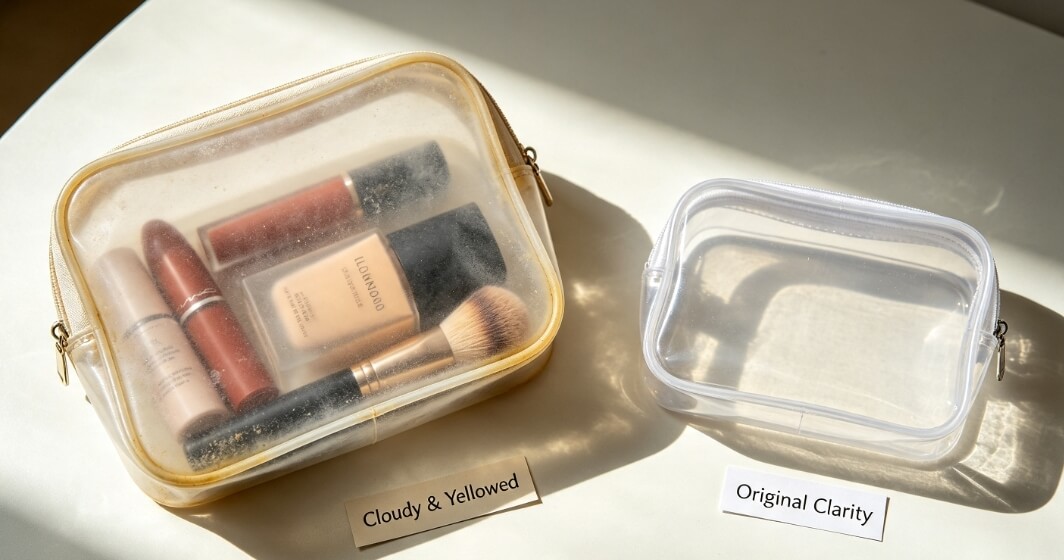
Have you ever opened your makeup bag and found a yellow patch on the inside? You’ve barely used it, yet the clear bag has turned cloudy, almost like it’s covered in a greasy film. You wipe it with a damp cloth, but once it dries, it’s still cloudy. You wipe it again—and somehow it looks even worse.
This isn’t because you didn’t clean it well enough. You cleaned it the wrong way.
The whole vinyl or pvc bag issue is something most people misunderstand from the start. You think you’re buying vinyl, but check the label and there’s an 80% chance it says PVC. Retailers call PVC “vinyl” because “vinyl” sounds a little more premium. So when you search for vinyl or pvc bags to compare which one is better, there’s actually not much to compare—the cloudy bag in your hand is PVC.
The real question isn’t“Which one should I choose?” It’s this: Can clear plastic vinyl or pvc bags that turn yellow and cloudy after just six months actually be saved?
The answer is: half can be saved, and half can’t.
The key is knowing the difference: yellowing and cloudiness are two completely different problems.
Yellowing and Cloudiness Are Different
A lot of people treat yellowing and cloudiness as the same problem and use the same cleaning method for both. That can actually make things worse.
There are three main causes of cloudiness, and only the first two can usually be improved with cleaning.
Soap residue: You didn’t rinse the bag thoroughly enough the last time you cleaned it. A thin detergent film remains on the PVC surface and turns cloudy once it dries. The giveaway is simple: “It looks clear when wet, but turns cloudy again when dry.”
Oil and makeup residue: Foundation, essential oils, and makeup remover can penetrate the surface layer of the plastic. The plasticizers in PVC can interact with these oils, creating a sticky, hazy film on the surface. In the industry, this is called plasticizer migration.
Fine scratches: Wiping the bag with a dry paper towel or using an abrasive cleaner can create microscopic scratches. These scratches scatter light and make the plastic look cloudy. Cleaning won’t fix this. You’ll need a plastic polish to fill in the tiny scratches.
Yellowing is a tougher problem and is usually irreversible.
UV exposure: Ultraviolet light in the 280–400 nm range can break PVC molecular chains, creating conjugated double bonds and carbonyl chromophores. The material gradually changes from clear to yellow.
Heat and oxidation: Long-term exposure to high temperatures—such as inside a car trunk in summer or next to a radiator—can cause PVC to lose HCl from its main chain. This triggers a chain reaction known as dehydrochlorination, with the color progressing from off-white → pale yellow → dark yellow → brown-black.
Plasticizer oxidation: Phthalate-based plasticizers can migrate to the surface and oxidize, which can also cause yellowing.
⚠️ The rule of thumb is simple: if your bag has localized yellowing, stickiness, and an odor, you’re probably dealing with plasticizer migration and chemical damage. Cleaning may improve it, but won’t reverse it. If the entire bag has turned evenly yellow, the material itself is aging. Washing won’t bring it back. Your best options are to replace it or keep it away from light and heat to slow further deterioration.
The Fixable Half: A Cleaning SOP
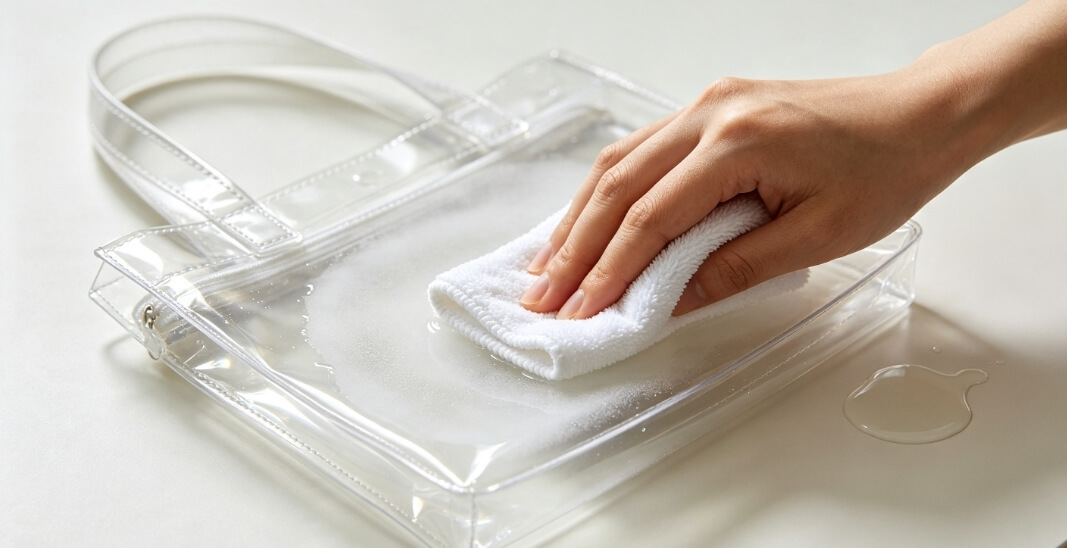
The following process is designed for cloudiness caused by soap residue or makeup/oil residue. It won’t fix fine scratches or yellowing caused by material aging.
Step 1: Cool Water + Mild Dish Soap
Use lukewarm water—not hot water, which can soften and deform PVC—with one drop of mild dish soap. Dip a microfiber cloth into the solution and gently wipe both the inside and outside of the bag.
❌ Don’t use paper towels. They may feel soft, but trapped dust particles can create fine scratches.
❌ Don’t use laundry detergent, bleach, or abrasive powders.
❌ Don’t use nail polish remover, acetone, or high-concentration alcohol. These are organic solvents that can attack the PVC surface and cause plasticizers to migrate out more quickly, leaving the bag stickier and yellower.
Step 2: Rinse Thoroughly
This is the most important step.
Take a clean microfiber cloth and repeatedly wipe the bag with clean water until there is absolutely no soap residue left.
This is the real reason many people say their bag gets “cloudier the more they wash it.” The original haze may not be dirt at all—it may be a new layer of soap film you just added.
General care guidance for vinyl or pvc bags also recommends spot cleaning and air-drying in the shade rather than machine washing, which is generally considered an unintended use.
Step 3: Treat Stubborn Stains
| Stain | Treatment | Important Note |
|---|---|---|
| Foundation / lipstick | Make a paste with baking soda and water, then gently rub in circles with a soft cloth | Use very light pressure to avoid micro-scratches |
| Essential oils / makeup remover residue | Treat the area with a small amount of mild dish soap | Rinse thoroughly afterward |
| Water spots / mineral rings | Spray a 1:1 mixture of white vinegar and water, leave for 3–10 minutes, then wipe | Never scrub hard while the surface is dry |
| Mold spots from high humidity | Treat with diluted white vinegar solution | Air-dry thoroughly and place a silica-gel desiccant nearby if needed |
Step 4: Air-Dry Upside Down
Stuff the bag with a clean white towel to help it hold its shape, then hang it upside down somewhere cool and well ventilated.
❌ Don’t leave it in direct sunlight. UV exposure is one of the biggest causes of PVC yellowing.
❌ Don’t use a hair dryer or place it on a radiator. Heat accelerates plasticizer migration.
❌ Don’t zip it up and store it while it’s still damp. Moisture trapped around the seams can encourage bacterial growth and create a musty smell.
💡 Here’s the counterintuitive part: when a PVC makeup bag gets cloudy after washing, 90% of the time the bag itself isn’t ruined. The problem is leftover soap residue. Give it another thorough rinse with cool water, and in many cases the haze will disappear.
The Unsalvageable Half: How to Slow It Down
If your bag has already turned yellow throughout, become stiff, or developed a sticky surface, it has entered the aging stage. Cleaning won’t reverse the damage, but you can slow it down.
Keep it out of the light: Store it away from direct sunlight through windows. UV light in the 280–400 nm range is particularly damaging to PVC.
Keep it cool: Don’t leave it in a car trunk or next to a radiator. As a general rule, oxidation speeds up significantly as temperature rises.
Avoid prolonged pressure: Long-term compression can cause uneven plasticizer migration and lead to localized yellowing.
Keep it away from dark fabrics: Dark denim and printed fabrics can transfer dyes into clear PVC when they remain in prolonged contact. This can create permanent yellow or pinkish stains. Even strong solvents usually won’t fix them and may only make the damage worse.
Use a desiccant: Place a small packet of silica gel near the bag and keep relative humidity below 60%.
Buying a New Bag: Stop Asking “Vinyl or PVC”
If you decide to replace your bag, don’t just ask which vinyl or pvc bags are better. Ask about two specific things.
1. Thickness
Clear PVC makeup bags commonly use material around 0.2–0.35 mm thick (manufacturers may describe this as 20–35 “silk” or丝).
Below 0.2 mm, bags tend to feel flimsy, wrinkle easily, and be more prone to plasticizer migration. At 0.3 mm and above, the material generally feels more structured and tends to hold up better over time.
Ask the seller directly: “What’s the material thickness?” If they can’t answer, that’s a warning sign that you may be looking at a very thin, lower-quality product.
2. Does It Have UV Stabilizers?
PVC bags made with UV stabilizers have significantly better resistance to yellowing. Sellers don’t always mention this, so ask whether the material is UV-resistant or look for terms such as “anti-UV” or “weather resistant.”
If you’re buying a bag for stadium or concert entry, remember that NFL policies and many U.S. venue policies allow clear plastic, vinyl, or PVC bags only within specific size limits. A common limit is 12" × 6" × 12" (about 30.5 × 15.25 × 30.5 cm), with the exterior required to be clear.
The search intent behind clear platic vinyl or pvc bags is often tied to concerts and sporting events. In China, subway and airport security systems are also accustomed to inspecting clear bags. As long as there are no metal layers and the contents are visible, they can usually be checked quickly. However, bags with severe clouding or scratches may be subject to additional inspection.
Three Clear Bags Worth Considering
Not all clear plastic vinyl or pvc bags are created equal. The three options below are designed for three very different situations, so choosing based on the use case matters.
XH-GL04291: Holographic Laser Clear Tote — The Spotlight Bag

This one is all about making an entrance.
It uses a holographic laser finish on the PVC surface that reflects rainbow-like colors from different angles. The clever part is that the holographic effect doesn’t just make the bag look better—it also softens the outlines of the items inside. People can tell you have things in the bag without being able to make out every item clearly, giving you a subtle layer of visual privacy.
For venues that require clear bags—such as stadiums, concerts, and some workplaces—this bag combines quick visual inspection with a more eye-catching look.
It uses PVC combined with synthetic leather panels and is designed to resist tearing, wear, and scratches.
Best for: People who regularly visit stadiums or concert venues with clear-bag policies, anyone who likes to stand out at dates, parties, or vacations, and bridesmaid or party-gift buyers.
Not ideal for: Anyone who prefers a quiet, minimalist look. This bag is designed to be noticed.
XH-BK03: 20L Clear PVC Sports Travel Bag — The Heavy Lifter

What does 20 liters actually mean?
A typical 20L backpack is roughly 45–50 cm tall, 30–35 cm wide, and 15–20 cm deep, making that capacity suitable for a one- or two-day trip, gym session, or swim outing.
The XH-BK03 measures 44 × 25 × 20 cm and holds 20 liters. Its adjustable, detachable straps allow it to be carried by hand, over the shoulder, or crossbody.
The thick, waterproof PVC construction is designed for durability, while metal zippers and hardware provide support. Smoothly finished edges help prevent snagging.
It can hold workout clothes, swimwear, a water bottle, towels, and other essentials. The clear design also lets you spot what you need without digging through your gym locker.
Best for: Gym-goers, swimmers, yoga enthusiasts, weekend travelers, campers, hikers, and sports-gift buyers.
Not ideal for: Daily commuters who need to carry a laptop. There’s no dedicated laptop compartment, and the clear construction leaves your electronics visible.
XH-G041: Holographic Makeup Bag — A Shiny Little Organizer

This is the most makeup-focused option of the three.
It is available in PVC or TPU. The TPU version is waterproof, reusable, easy to clean, and generally more resistant to aging than PVC.
The holographic finish creates shifting colors from different angles, while the transparent body keeps the practical advantage of being able to see your contents immediately.
It can hold makeup brushes, sunglasses, eyebrow pencils, mascara, lipstick, cushion foundation, loose powder, and more.
For anyone who prioritizes easy cleaning, the TPU version has a smooth, water-resistant surface that can simply be wiped clean with a damp cloth. That fits perfectly with the cleaning principle above: prevention is better than restoration.
Best for: Makeup lovers, long-distance travelers, makeup artists, and anyone who wants better everyday organization.
Not ideal for: Someone who already has an old makeup bag that has turned badly yellow and cloudy and is showing obvious signs of aging. If the material is already deteriorating, replacing it is more practical than trying to restore it.
📌 What all three have in common: They’re all part of the vinyl or pvc bag family, they offer transparent or semi-transparent construction, and they serve the same basic purpose: quick security checks or quick access to your belongings.
The real differences are thickness, material (PVC vs. TPU), dimensions, and holographic finishing. That’s exactly why you shouldn’t stop at asking “vinyl or PVC?” You should ask for the actual specifications.
One Thing We Haven’t Fully Covered
The cleaning method above works for roughly 80% of cloudy makeup bags, but there’s one important exception.
If your bag developed severe yellowing and stickiness just three months after you bought it, the problem may not be your maintenance at all. The factory may have used a poor-quality PVC formulation—for example, low-purity fillers or insufficient stabilizers.
In that situation, no amount of cleaning or maintenance can stop the material from continuing to age.
You have two realistic choices: accept that it will gradually look worse, or choose your next bag based on material thickness and manufacturer quality.
That means the real pain point behind the clear plastic vinyl or pvc bags search term isn’t necessarily “Which material is better?” It’s “How do I avoid low-quality PVC?”
That’s the part retailers are least likely to tell you.
FAQ
Q1: Why does my clear PVC makeup bag look cloudy after washing? Can I fix it?
The most common reason is leftover soap residue from the previous wash. A thin layer of detergent remains on the plastic surface and makes it look hazy.
The fix is simple: rinse the bag thoroughly with cool water, then gently buff it with a dry microfiber towel.
If there’s mild cloudiness combined with fine scratches, a dedicated plastic polish may help fill the microscopic scratches. But if the cloudiness comes with overall yellowing, stiffness, or stickiness, the PVC is likely aging due to plasticizer migration and photo-oxidation. Cleaning can’t reverse that damage.
At that point, switching to a TPU makeup bag, such as the TPU version of XH-G041, is a more practical option.
Q2: What’s the best way to clean foundation, lipstick, or essential oils from a makeup bag?
Different stains need different treatments.
For foundation and lipstick, mix baking soda with water into a paste, apply it with a soft cloth, gently rub in circles, and rinse clean.
For essential oils and other greasy residue, use a small amount of mild dish soap on the affected area and rinse thoroughly afterward.
For water spots or mineral rings, spray a 1:1 mixture of white vinegar and water, leave it for 3–10 minutes, then wipe clean.
Avoid bleach, abrasive cleaners, nail polish remover, and high-concentration alcohol. These can attack the PVC surface or cause excessive plasticizer migration, leaving the bag sticky, dull, and potentially more yellow.
TPU makeup bags such as XH-G041 generally perform better in this area because their denser surface makes it harder for oily residue to penetrate.
Q3: Can I put a clear PVC bag in the sun to kill bacteria or dry it faster?
Strongly not recommended.
UV light in the 280–400 nm range can break down PVC molecular chains, creating chromophores that cause yellowing. Heat can also accelerate plasticizer migration, making the bag sticky and brittle and eventually causing cracking.
The correct approach is to hang the bag upside down and let it air-dry naturally in a cool, shaded, well-ventilated area.
When storing clear plastic vinyl or pvc bags, keep them away from direct sunlight, heating vents, and hot enclosed spaces such as car trunks. Keeping a silica-gel desiccant nearby and maintaining relative humidity below 60% can also help slow yellowing.
If you’re using a clear stadium or concert bag such as XH-GL04291, hang it up to dry in the shade after each event as well. That helps prevent prolonged sunlight exposure from prematurely aging the holographic layer.
Moving bag buying guide: How Many Do You Really Need?
How to Choose a Truly Stadium-Approved Clear Bag
Related Article


