
Is Your Nurse Bag Ready for a 12 Hour Clinical Shift?

An Amazon nurse bag with a 4.7-star rating and more than 5,000 reviews succeeds for a clear reason: its pocket layout and compartment design are built around the way nurses actually reach for things during a shift. According to industry buying guides, nurse tote bags typically range from $23.99 to $61.95, covering everything from entry-level options to feature-rich models.
What truly affects the user experience of a nurse bag is often hidden in the details that product listings do not emphasize: the bag’s empty weight, how well the base holds its shape, how securely the water-bottle pocket holds a bottle, and how the shoulder strap interacts with a scrub uniform.
These details can determine whether a nurse can keep personal items organized throughout a 12-hour shift or ends up repeatedly digging through a bag in front of the locker. Choosing a nurse bag should start with real clinical needs rather than appearance or marketing claims.
Based on frontline user feedback and supply-chain purchasing standards, this guide provides a practical framework for choosing a nurse bag, with three representative XINHUI products included as references across key criteria.
Core Nurse Bag Buying Criteria
Empty Weight vs. Capacity
Empty weight is one of the easiest specifications to overlook. Some rigid bags advertised as “large capacity” weigh nearly 2 kg before anything is packed inside. Once fully loaded, the total weight can become significant, making them less suitable for nurses who walk to and from work.
For nurses working 12-hour shifts and commuting on foot, keeping the empty weight below 1 kg is recommended. A weight of 1 to 1.5 kg is generally acceptable. Anything over 1.5 kg should be considered carefully unless the additional weight is clearly justified by the bag’s structural support.
The XINHUI XH-AMZ145-G Mini Canvas Tote offers a different approach. Weighing approximately 380 g and measuring 9.75 × 8.97 × 6.24 inches, it comes with a detachable, adjustable shoulder strap with a 19.5-inch drop.
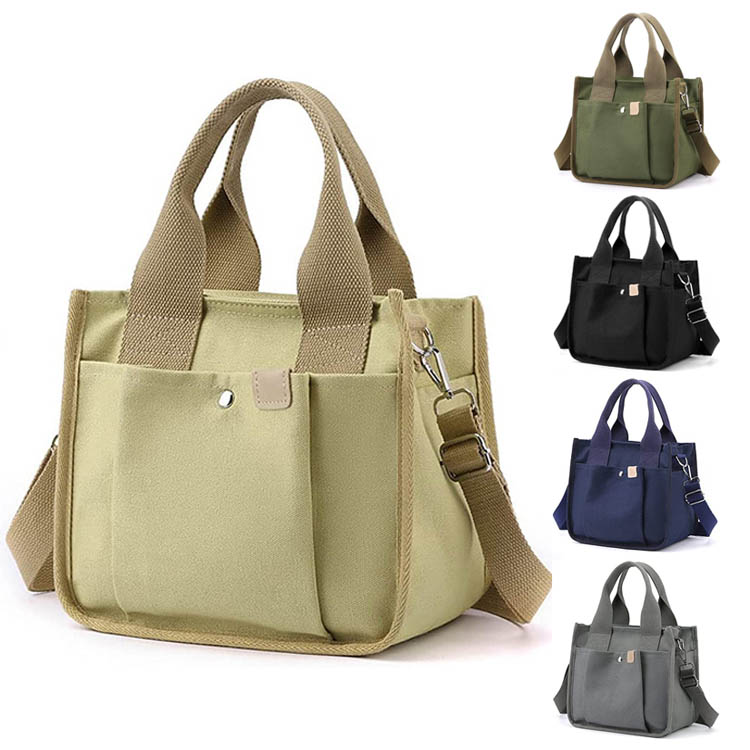
It is not designed to replace a primary nurse bag for carrying uniforms and a large water bottle. Instead, it works well as a lightweight personal bag that stays with the nurse throughout the shift, holding essentials such as an access card, phone, pens, hand sanitizer, and scissors without adding noticeable weight.
Its simple solid-color square design combines a high-quality canvas exterior with a softer, more durable lining in the main compartment. It can be carried over one shoulder or worn crossbody.
Base Structure and Stability
Nurses often have limited space in break rooms, so bags are frequently placed on the floor. A soft, collapsible bag can easily tip over, leaving the zipper opening facing upward and allowing dust to fall inside. This affects both accessibility and hygiene.
When evaluating nurse bags and totes, check whether the base has reinforcement, metal feet, or a rigid insert. A well-structured base helps the bag stay upright and makes it easier to access items without having to pick the bag up first.
Practical Exterior Pocket Layout
A well-designed nurse bag typically follows a “grab-and-go” pocket layout. For example, three slip pockets can hold pens and thermometers, a small mesh pocket can store loose items, two medium pockets can hold a phone and wet wipes, two side pockets can accommodate an umbrella and water bottle, and a zippered rear pocket can keep documents secure.
This type of layout balances organization with quick access. It is far more useful in a clinical environment than simply adding as many pockets as possible.
The XH-Z091304 Extra-Large Business Tote provides a comprehensive example. Measuring approximately 15.7 × 5.9 × 12.6 inches, it features a large main compartment with two separate padded sections that can safely hold a 15.6-inch laptop and a tablet while helping protect them from dust and scratches.

It also includes six open interior pockets for office supplies or cosmetics. The large zippered front compartment has four elastic loops and two pockets for securing smaller items such as pens, rulers, and notebooks. Exterior flap and zippered pockets are designed for smaller essentials such as a phone and wallet, while the side water-bottle pocket and front key ring make commuting more convenient.
For nurse managers or clinical educators who need to carry a laptop between shifts or take notes during case reviews, the professional organization of this nylon tote makes it well suited to the high-frequency access demands of a busy workday.
Water-Bottle Pocket Design
Large 40 oz water bottles are increasingly common among nurses, making the design of the bottle pocket directly relevant to the safety of electronic devices.
When evaluating this feature, pay attention to three details:
- Does the elastic opening fit the bottle securely?
- Is there a separate waterproof layer?
- Does the bottom have a drainage hole or waterproof lining?
The XH-K007 Large Women's Tote offers another useful feature beyond being water-bottle friendly: it folds down for easy storage.

This pink tote measures 16.5 × 6.3 × 12.6 inches when open and folds down to just 7.9 × 3.1 inches. It is made from water-resistant fabric.
For nurses, its use case is very specific: it works as a backup bag for a primary nurse bag. If a day shift requires carrying extra items or a nurse wants to stop for groceries after a night shift, the folded pink tote can be pulled out and opened in seconds.
When not needed, it takes up very little space in a locker. Ergonomic handles, an easy-to-clean surface, and a lightweight yet durable construction give it a distinct position within the nurse bags and totes category.
Not every bag needs to be carried every day, but every bag should be ready to step in when it is needed.
Fabric Quality and Shoulder-Strap Hardware
600D polyester is a basic durability standard for a nurse bag, while 1680D ballistic nylon offers better resistance to abrasion and tearing.
For custom applications, antimicrobial-treated fabrics may also be considered. Some materials can achieve a bacteria-reduction rate of 99.9% when supported by third-party testing, although antimicrobial performance can decline after repeated washing.
Shoulder straps should generally be at least 2 inches wide, with padding and reinforced stitching at stress points. Metal zippers should be considered the baseline requirement. Plastic zippers may be more vulnerable to failure under prolonged heavy loads.
For canvas bags, a weight of 12 oz or more generally provides better shape retention. Standard plastic buckles can crack after several weeks of frequent use, so metal or high-strength POM engineering-plastic hardware is preferable.
Custom Nurse Bags Supply-Chain Review

Bulk purchasing custom nurse bags requires a different evaluation process from buying a personal nurse bag. Procurement teams should pay close attention to the following hard requirements.
Compliance and Certifications
For healthcare institutions, ISO 9001 for quality management, ISO 13485 for medical-device-related quality processes, REACH for EU chemical compliance, OEKO-TEX for textile safety, and BSCI for social responsibility auditing are key credentials.
These documents are often required when products are reviewed by infection-control or hospital procurement teams.
MOQ and Sampling Lead Time
Mainstream manufacturers typically have MOQs of 200 to 500 units. The XH-AMZ145-G has an MOQ of 300 units.
Sample production generally takes around 7 to 10 days, while bulk production typically requires 30 to 45 days.
Completing a sample approval before placing a full production order is strongly recommended. It helps prevent problems with pattern, sizing, construction, or workmanship from appearing after a large shipment has already been produced.
Customization Options and Quality Standards
Customization options can include:
- Fabric: 4 oz to 24 oz canvas, 600D/1680D nylon, antimicrobial treatment, and PU coating
- Decoration: screen printing, sublimation, heat transfer, and embroidery
- Construction: color combinations, dimensions, interior dividers, and transparent PVC pockets
Printing and embroidery can be customized based on AI or PDF artwork files.
Quality requirements written into the purchase contract should clearly define the following:
- Zipper opening and closing test: at least 5,000 cycles
- Load test: 150% of rated load maintained for 24 hours
- Seam strength: at least 200 N
- Water resistance: IPX4
For healthcare organizations with 200 to 500 employees, XINHUI can produce different bag configurations on the same production line, including the large professional XH-Z091304, the foldable backup XH-K007, and the lightweight everyday XH-AMZ145-G, while maintaining consistent logo embroidery and fabric specifications.
Nurse Bags and Totes for Different Work Needs
In clinical settings, one bag rarely covers every need. A more practical configuration is to use different bags for different situations.
Primary Bag
A large tote or backpack can store uniforms, lunch, and a water bottle while staying in the locker.
The XH-Z091304’s extra-large capacity and clearly organized compartments make it well suited to this role.
Everyday Carry Bag
A lightweight bag stays with the nurse throughout the shift and carries essentials such as an access card, phone, pens, scissors, and hand sanitizer.
At approximately 380 g, the XH-AMZ145-G and its detachable shoulder strap make it a practical choice for this role.
Backup Bag
A foldable bag can remain in the locker and be used for grocery shopping, carrying extra items after overtime, or handling unexpected schedule changes.
The XH-K007 folds down to only 7.9 × 3.1 inches but expands to 16.5 × 6.3 × 12.6 inches, making it a practical backup option.
Customized Team Bag
For departments ordering custom nurse bags, a unified design with an embroidered hospital logo and each nurse’s name can serve as both a practical tool and an identification item.
The Right Nurse Bag Starts With the Use Case
The quality of a nurse bag ultimately comes down to how well it responds to real-world use.
Six factors form a practical evaluation framework: empty weight, structural stability, exterior pocket layout, water-bottle pocket design, fabric quality, and shoulder-strap width.
For individual buyers, compare these criteria against product specifications and the actual construction of the bag. For institutional procurement, also review certification documents, sample quality, and inspection reports.
From the professional organization of the XH-Z091304, to the foldable backup concept of the XH-K007, to the lightweight solid-color design of the XH-AMZ145-G, the three products address different needs within a nurse’s daily routine.
Together, they demonstrate one important principle: there is no single universal nurse bag. There is only the nurse bag that best matches a specific use case.
Understanding how and where the bag will be used, as well as how much weight it will regularly carry, should always come first. When selecting bags for an entire department, there is also plenty of room for deeper discussions with the source manufacturer about certifications, MOQs, sampling schedules, and quality inspection reports.
FAQ
Should I Repair a Broken Zipper or Replace the Nurse Bag?
Plastic zippers are a common failure point when nurse bags and totes are used under heavy loads. Once the teeth become misaligned or the slider breaks, repair costs can approach half the original bag price, while reliability may still be reduced after repair.
For clinical use, replacement is generally the safer option.
During everyday use, avoid pulling the zipper aggressively with one hand. Do not overfill the main compartment to the point where the zipper remains under excessive tension.
What Is the Difference Between Floating and Fully Sewn-In Compartments?
A floating divider is attached to the bag only along the top edge, leaving the bottom open. Small items such as phones, keys, and power banks can slide underneath the divider and end up at the bottom of the bag, meaning you still have to dig around to find them.
A fully sewn-in divider is attached along the left, right, and bottom edges, creating a genuinely separate compartment.
Because nurses frequently reach for small items such as pens, scissors, hand sanitizer, and access cards, fully sewn-in compartments keep items in place and make them easier to find. This feature should be considered a purchasing requirement when ordering custom nurse bags.
In the XH-Z091304, the two padded compartments use an independently sewn construction and work together with six open interior pockets to create a more organized storage system.
Is Embroidery or Screen Printing More Durable for a Custom Logo?
Embroidery stitches the logo directly into the fabric, making it highly resistant to abrasion and washing. Even after two or three years of regular use, an embroidered logo can remain clear.
The tradeoff is that embroidery creates a raised texture, adds a small amount of weight, and is not ideal for large graphics on lightweight bags.
Screen printing, including heat transfer and sublimation, generally costs less and can reproduce complex colors and small text. However, repeated washing can eventually cause cracking or fading. This is particularly relevant in clinical environments where the bag may frequently come into contact with disinfectant.
For custom nurse bags, embroidery is recommended when the logo is relatively small and placed in a fixed location, such as the upper-right corner of the front panel.
For complex, colorful, or large graphics, screen printing may be more appropriate, but buyers should confirm the ink’s resistance to alcohol-based cleaning before production.
Build a Better Home First Aid Kit From the Inside Out
Can an Organic Cotton Bag Be Saved After Mold and Stains?
Related Article


