Get More From Non-woven tote bags With the Right Print Position
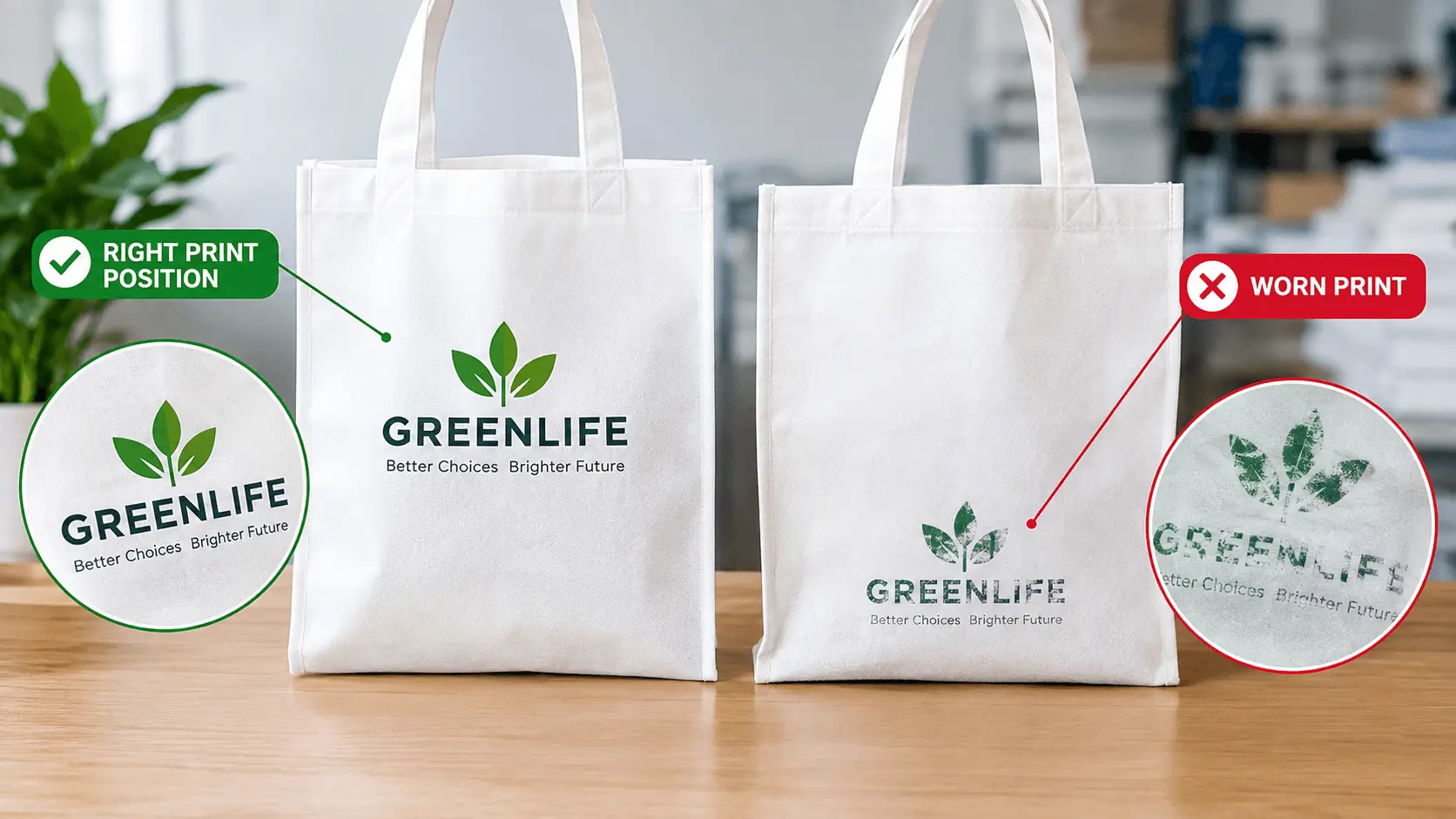
We ordered a large batch of non-woven tote bags , but it wasn’t until the shipment arrived and we opened the boxes that we realized the logo had been printed on the bottom of the bags. After six months of use, the artwork on the bottom was so worn that it was barely recognizable. The printing position was wrong. Even if the unit price was low, the money was still wasted.
When ordering non-woven tote bags, most buyers ask about price and lead time first. Printing position is often overlooked. But these bags are carried, put down, and folded every day, and different areas experience very different levels of wear.
XINHUI Bag Factory has worked with many purchasing clients, and in many cases, the need for rework had nothing to do with ink or fabric quality. The real problem was that the printing position had not been confirmed in advance. During the sampling stage, the factory marks recommended printing areas and areas where printing should be avoided, helping prevent issues such as cracked artwork and premature wear.
Non-woven tote bags Need the Right Printing Area
When looking for a non woven bag custom manufacturer, don’t rush to compare prices. First, ask three simple questions: Where will the artwork be printed? How many colors will be used? And how will the finished bags be inspected?
There are two main areas worth printing on a bag: the center of the front panel and the area just below the handles. When customers carry a bag, these are the areas they naturally see first.
There are also three areas to avoid: the center fold line, the side seams, and the bottom of the bag.
If artwork sits directly on a fold line, repeated bending can cause cracks. Fabric around the seams tends to wrinkle, which can make the artwork look distorted. The bottom of the bag constantly rubs against tables and floors, so artwork printed there will usually show wear first.
The same non-woven tote bags can have artwork on the front that stays clear for a long time, while artwork on the bottom becomes worn much sooner.
Match the Printing Method to the Position
The printing method should also match the artwork and the printing area. For a single-color logo, screen printing is a practical and cost-effective choice for large quantities. For colorful artwork, heat transfer printing works well and is also suitable for smaller batches.
If you are printing a light-colored design on a dark bag, confirm with the manufacturer whether a white base layer is needed.
Check Colors Before Making Non-woven tote bags
When making custom non woven tote bags with logo, don’t judge the color based only on what you see on a computer screen. Screen colors and printed colors are based on two different systems.
Before placing the order, ask the manufacturer for a physical color sample. It is much more reliable than judging the color from a digital mockup alone.
For custom non woven tote bags with logo , the inspection process should include two simple tests: wipe the printed area once with a dry cloth and once with a wet cloth. If the color comes off, the product should not pass inspection.
According to the relevant national standard for color fastness to rubbing, dry rubbing should reach Grade 4 or above, while wet rubbing should reach Grade 3 or above. When the shipment arrives, inspect a sample of the bags rather than waiting until everything has been distributed.
Before bulk goods leave the factory, XINHUI Bag Factory carries out a full set of rubbing fastness spot checks and keeps samples for comparison, making it easier for customers to verify the goods upon arrival.
Choosing Non-woven tote bags for Eco-Friendly Use
Many businesses are looking for logo eco-friendly non woven tote bags. But before calling a bag eco-friendly, first ask whether the material can actually be recycled.
Non-woven bags are generally made from PP, which is plastic No. 5 and can technically be recycled. However, laminated bags are often not accepted by recycling facilities.
If you want to promote an environmentally friendly message, check the material first before printing environmental claims on the bag.
When ordering logo eco-friendly non woven tote bags , you should also ask what type of ink will be used. Water-based ink is more environmentally friendly and has little to no noticeable odor, while oil-based ink tends to have a stronger smell. If the bags will be used to carry food, water-based ink is generally the safer choice.
Confirm the Details Before Ordering
A professional non woven bag custom order should include a layout proof and a physical sample. Without both, misunderstandings can easily arise later.
Choose the fabric weight based on how the bags will be used. An 80-gram bag is suitable for trade show giveaways, while a 100-gram bag feels sturdier and works better for gift or promotional items.
For standard orders, the minimum quantity is usually several hundred pieces, and the typical lead time is around 4 to 5 working days.
Before placing the order, lock down three things: the printing position, the colors, and the inspection requirements. Get these details confirmed in advance, and your non-woven tote bags can go straight into use when they arrive instead of ending up in rework.
As for how to make customers keep using the bag and turn an environmentally friendly tote into a long-term advertising tool, we’ll save that topic for next time.
FAQ
Q1: Can photos, gradients, and other colorful designs be printed on non-woven bags?
Yes. Single-color logos can be printed using screen printing, while colorful designs or photo-quality artwork can be produced with heat transfer or digital printing.
The more complicated the artwork, the higher the unit cost is likely to be, and the minimum order quantity may also vary depending on the process.
Before placing an order, send the artwork to the manufacturer, ask which printing method they recommend, and request a digital proof.
Q2: How much weight can a non-woven bag hold?
A standard 80- to 100-gram bag can generally carry around 8 kg, which is enough for several books or a week’s worth of groceries.
For heavier loads, choose a bag weighing 100 grams or more and reinforce the handles with stitching. If the bag is overloaded, it can tear around the handle attachment points.
Q3: Can I print ‘biodegradable’ on the bag?
A standard PP non-woven bag should not be described as biodegradable, so environmental claims need to be accurate.
Materials such as PLA can be genuinely biodegradable, but they are considerably more expensive. If you want to highlight the bag’s environmental benefits, ‘reusable’ is generally a safer and more accurate claim than ‘biodegradable.’
Q4: Can the sampling fee be refunded after placing the bulk order?
This depends on the factory’s policy.
At XINHUI Bag Factory, the sampling fee can be credited toward the final order after the customer confirms bulk production reaches the agreed quantity, subject to the agreed terms.
It is recommended to include the sampling-fee credit policy in the order confirmation before production begins.
Q5: Can I send a screenshot of my design file to the factory?
Screenshots usually do not have enough resolution for printing. When enlarged, the artwork may look blurry.
It is best to send a vector PDF or AI file. If you only have a raster image, make sure its resolution is at least 300 DPI.
Q6: Can the factory store the finished goods and ship them in batches?
Yes. Batch shipping and warehouse storage services can be arranged.
Confirm the storage period and packaging requirements with the factory in advance to prevent moisture damage to the fabric or pressure damage to the printed artwork while the bags are being stored.
Related Article