
Can a canvas tote bag manufacturer Scale Without Costly Errors?
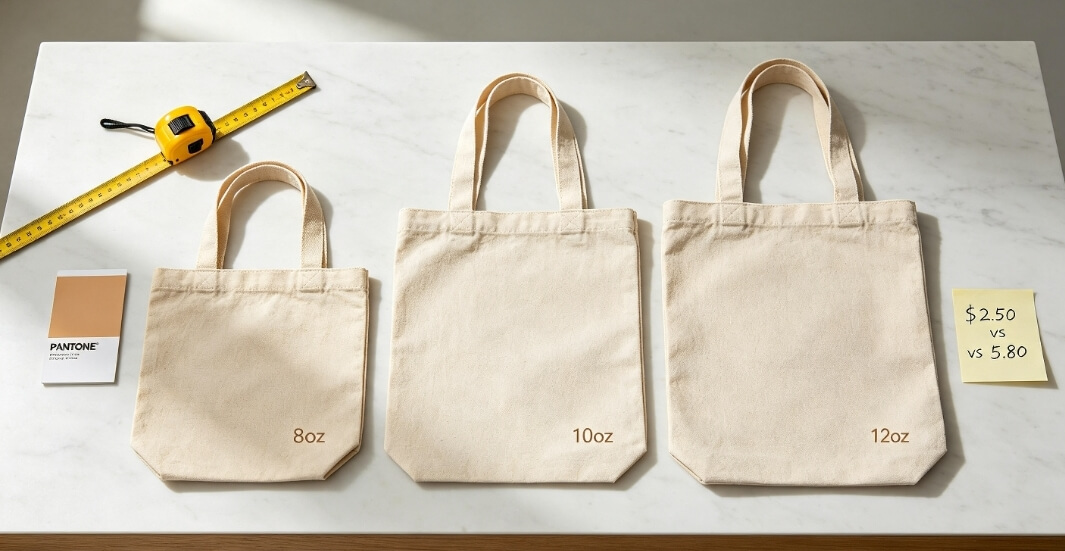
The biggest trap for European and American brands isn't "not being able to find a factory." It's finding a factory that does a great job on the first 200 pieces, only to have the next 2,000-piece order go completely off track.
Same factory. Same artwork. Same specs. Yet the finished bags come out 1.5 oz lighter, with the logo shifted by 3 mm.
The problem isn't necessarily that the factory is bad. The problem is that you didn't lock down three critical numbers in the contract.
For canvas bags with logo, the actual 2026 market rate for logo application is around $0.30–$1.50 per piece. Screen-printing setup costs are typically $30–$80 per color as a one-time fee, while embroidery digitizing usually costs $30–$60 as a one-time fee.
If you're only ordering 200 pieces and choose a three-color screen print, that $60–$240 setup fee works out to as much as $1.20 per bag. That's how a "low unit price" can suddenly become an expensive order.
How a canvas tote bag manufacturer Uses 4 Fabric Weights
For a canvas tote bag manufacturer, fabric weight isn't just a technical specification. It directly affects your product positioning, retail price, and margin.
Here is one factory's 2026 FOB price range for orders of 500+ pieces:
| Fabric Weight | FOB Price per Piece | Best For | Approx. Load Capacity |
|---|---|---|---|
| 8oz | $1.80–$3.50 | Promotional giveaways, event bags | 3–5 kg |
| 10oz | $2.50–$5.00 (100 pcs minimum) | Mainstream retail, everyday bags | — |
| 12oz | $2.80–$6.00 | Grocery shopping, branded retail | 6–8 kg |
| 16oz | $4.50–$8.00 | Premium brands, heavy-duty bags | 10 kg+ |
For canvas tote bag custom projects, choosing the right fabric weight at the beginning can prevent unnecessary cost and quality problems later.
The 500-Piece Threshold Determines Your Logo Method
When your order is below 500 pieces, screen-printing setup fees can make the unit cost unnecessarily high. DTG (direct-to-garment printing) or heat transfer can be more economical.
Once you reach 500+ pieces, the marginal cost of screen printing drops sharply. A one-color screen print can cost as little as $0.30 extra per piece.
Embroidery sounds premium, but it isn't ideal for gradient artwork and works best for relatively small logos, generally no larger than about 5 × 5 cm.
If you want to print a 15 cm-long slogan across the front of a canvas tote, screen printing is usually the better choice.
A 5-Minute Video Factory Audit
Open a WeChat video call and check these four areas in order:
1. Sample room — Are there bags hanging that are similar to the style you're looking for?
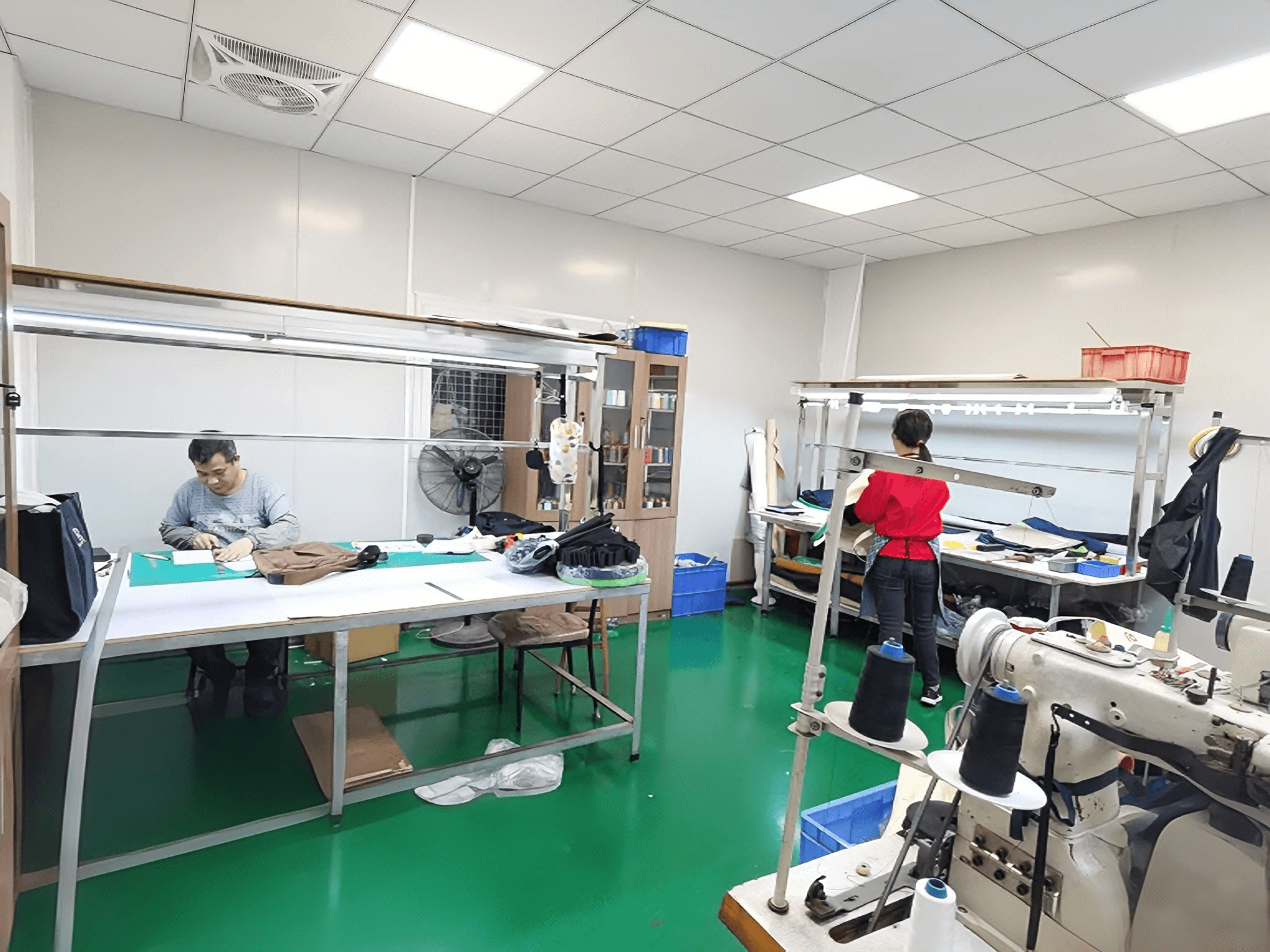
2. Fabric warehouse — Are there rolls of canvas clearly labeled with fabric weights, such as 8oz or 12oz?
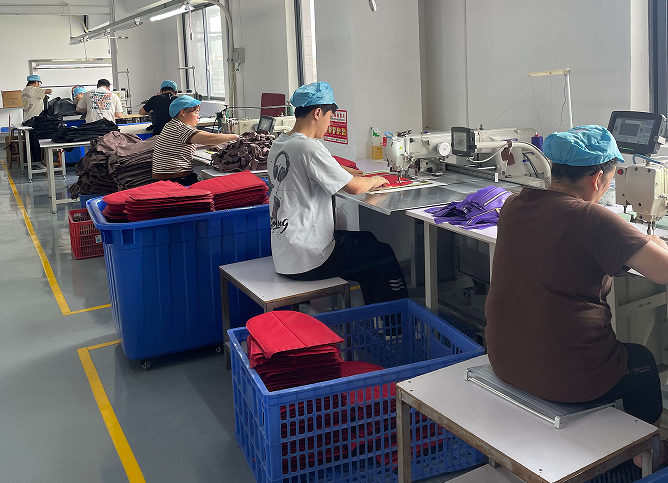
3. Sewing lines — At the point where the handles connect to the bag body, is there X-box reinforcement stitching? This is critical for load-bearing performance.
4. Quality-control station — Is someone actually measuring finished bags with a ruler or measuring tape?
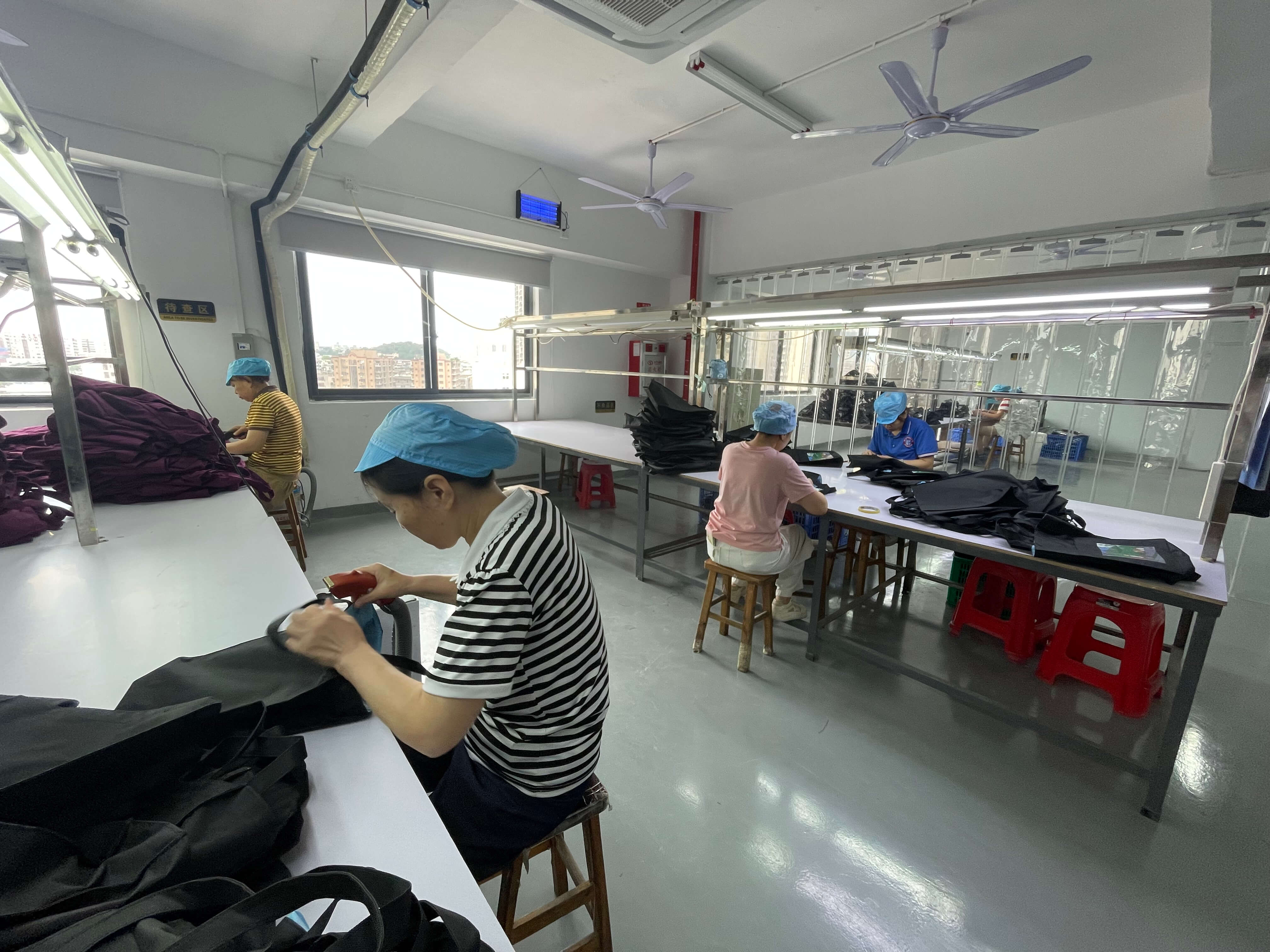
If the supplier says, "The boss isn't here" or "We can't film inside the workshop," there's a very high chance you're dealing with a trading company rather than a factory.
A real factory will usually be happy to show you the production floor, especially the QC area. Factories such as XINHUI, which hold CE, ISO, and BSCI certifications, not only accept video factory audits but also allow customers to send representatives for on-site production inspections. That's one of the clearest signs you're dealing with a genuine manufacturer.
3 Specs Every canvas tote bag manufacturer Contract Needs
1. Actual Fabric Weight
Write the specification into the contract as:
"12oz ±0.5oz"
Also require a GSM test report. For reference, 12oz is approximately 406 GSM.
2. Logo Position Tolerance
Specify the exact position, for example:
"2 cm from the top edge of the bag ±2 mm"
Also keep a signed approval sample as the production reference.
3. Load-Bearing Test Records
Require AQL sampling inspections and load-bearing tests before shipment, with photos of the test results included in the inspection records.
Factories such as Dongguan XINHUI take this one step further. During sampling, they keep an A4-sized piece of the actual fabric and attach the corresponding Pantone color code. When you place a repeat order, the new fabric can be compared directly against the approved swatch.
This small step can improve repeat-order consistency from around 70% to over 95%.
XINHUI's Full Production Service

If you don't want to coordinate separately with four or five suppliers for fabric, accessories, printing, and packaging, a factory such as XINHUI can manage the entire production chain.
You send them the bag design and logo. They handle fabric sourcing, sampling, sewing, screen printing, embroidery, embossing, foil stamping, digital printing, reactive printing, full-panel printing, quality inspection, packaging, and shipping.
In other words, you provide the design and logo, and the factory handles the rest.
For canvas bags with logo, this kind of integrated service can significantly reduce supplier coordination and communication costs.
On the quality-control side, the factory follows AQL-based sampling inspections. Raw materials are inspected before production, semi-finished goods are checked during production, and finished products are sampled before shipment. Packaging and labels are also inspected.
If required, they can even arrange on-site supervision during container loading to reduce the risk of problems during transportation.
FAQ
Q1: I'm a new European or American DTC brand owner making canvas tote bags for the first time. My supplier asked how many ounces I want, and I have no idea. What's the simplest way to decide?
A: Start with your retail price.
- Under $15 → 8oz
- $15–$30 → 10oz
- $30–$60 → 12oz
- Over $60 → 16oz
This rule of thumb reflects the actual 2026 pricing structure quoted by factories in Quanzhou.
An 8oz bag typically runs around $1.80–$3.50 FOB per piece, a 12oz bag around $2.80–$6.00, and a 16oz bag around $4.50–$8.00.
Work backward from your retail price. If your bag sells for $28 on Shopify, 10oz or 12oz is generally the sweet spot. Keeping fabric costs around 10%–20% of the retail price gives you a healthier gross margin.
If you're working with a canvas tote bag manufacturer for the first time, this is a much easier starting point than trying to choose fabric weight based purely on technical specifications.
Q2: My first order was 200 pieces and the quality was great. Now I want to reorder 2,000 pieces. How can I make sure the second batch is exactly the same as the first? I've heard this is where many brands get burned.
A: Before the first order ships, ask the factory to do three things:
① Keep an A4-sized piece of the actual production fabric, attach the Pantone color code, and have both parties sign off on it.
② Keep one approved production sample, photograph it, archive the photos, and record the batch number.
③ Obtain the GSM test report for the fabric, such as 406 GSM for 12oz canvas.
For the repeat order, state clearly in your purchasing contract:
"Production must follow the approved sample and fabric swatch dated XX/XX/XXXX, with a fabric-weight tolerance of ±0.5oz."
Factories such as Dongguan XINHUI typically establish this reference system during the sampling stage. When evaluating a canvas tote bag manufacturer, simply ask: "Can you keep an approved fabric swatch for repeat orders?"
A factory that understands the importance of this process knows how to manage repeat production.
Q3: I've seen factories online advertising "1-piece MOQ" or "No MOQ." Can I trust them? And what about those $0.38-per-piece quotes? Are they scams?
A: There are two different situations.
"1-piece MOQ" usually means a dropshipping model rather than genuine OEM customization. The supplier is typically selling an existing bag style with your logo applied by heat transfer. There may be no sampling, structural modification, or fabric customization involved.
If you want to create a genuinely custom bag from scratch, this type of supplier may not be able to meet your needs.
As for the $0.38-per-piece quotes, these are often extreme low-price lead-generation offers on Chinese manufacturing platforms. They typically refer to lightweight promotional cotton bags, orders of 5,000+ pieces, and basic one-color printing.
The actual price can easily double once you upgrade the fabric, logo application, and accessories.
For a genuine 10oz canvas tote with a 100-piece MOQ, the realistic industry FOB range is around $2.50–$5.00 per piece. If a quote comes in significantly below that, check carefully whether the supplier has quietly changed the fabric specification.
For brands looking for canvas tote bag custom production, the cheapest quote is rarely the cheapest option after all the hidden costs and quality issues are factored in.
A reliable canvas tote bag manufacturer should be able to give you clear specifications for fabric weight, logo placement, production tolerances, testing, and repeat-order consistency before you place the order.
Why Does a makeup brush cosmetic bag Make Brushes Smell?
Why Does Your Bulk Order Feel Different?
Related Article


