Why branded shopping bags Are More Than Advertising
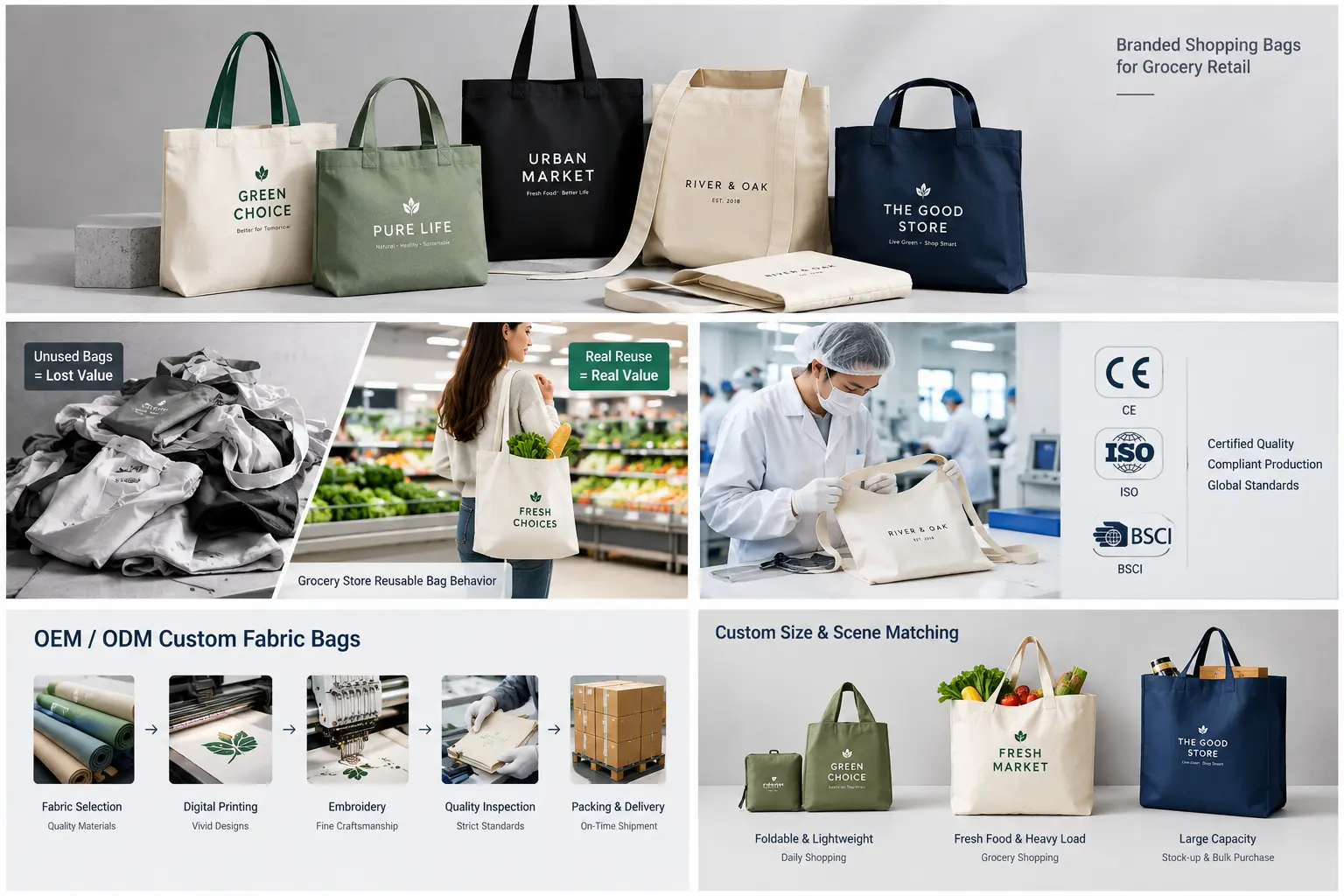
The industry often treats branded shopping bags as nothing more than a mobile advertising surface. That mindset is one of the biggest blind spots in retail—and a major reason many stores invest in custom bags without seeing a meaningful return.
Many retailers focus only on the promotional appeal of a fabric bag and overlook what actually determines whether it delivers business value: a reliable custom supply chain, consistent quality control, and designs built around real shopping situations. Choose the wrong manufacturing partner, and even a flawless marketing plan can be difficult to execute.
With 20 years of manufacturing experience, XINHUI Bag Factory specializes in custom fabric bags for retail brands. Backed by a mature production system and recognized compliance credentials, XINHUI helps retailers move beyond ineffective customization and unlock more of the operational value these bags can provide.
How branded shopping bags Shape Customer Behavior
Real-world grocery store reusable bag behavior data and hands-on industry experience show that the biggest benefit of branded retail bags is not a one-time glance from a passerby. It is long-term customer habit formation combined with lower packaging costs.
Many businesses get the priorities backwards. They focus on logo visibility while overlooking practical value. On the market, custom fabric bags vary widely in quality. Some have poor proportions, rough workmanship, or designs that simply do not fit everyday retail use. The underlying issue is often a lack of standardized quality control and limited experience with real supermarket and store environments.
Branded shopping bags That Customers Actually Reuse
The problem with large numbers of unsold or unused custom fabric shopping bags is usually not the fabric or printing. It is that the bag was never designed around real shopping behavior.
A bag that is too heavy, poorly sized, or difficult to fold and store is unlikely to be reused, no matter how polished the brand design looks.
How branded shopping bags Build Reusable Habits
The core value of high-quality branded shopping bags is their ability to shape repeat customer behavior.
When a store’s custom fabric bag fits real grocery, snack, household, and everyday shopping needs, customers are more likely to get into the habit of bringing their own bag. Consistent reusable-bag behavior can directly reduce a store’s ongoing spending on single-use packaging materials, creating a clear and measurable cost benefit.
XINHUI integrates fabric and accessory sourcing, sewing, precision printing, quality inspection, and final delivery within one supply chain. Retailers do not need to coordinate multiple suppliers for different steps. One partner can manage the full customization process, saving stores time, labor, and communication costs while allowing retail teams to stay focused on core operations.
How branded shopping bags Build Customer Loyalty
Ongoing tracking of grocery store reusable bag behavior also shows another long-term effect: when customers repeatedly use the same store’s custom fabric bag, they can develop a stronger sense of familiarity and connection with that store.
This kind of subtle psychological association is difficult to reproduce through one-off marketing campaigns. It can help a store stand out from nearby competitors.
Consistent bag quality and practical, well-matched designs are the foundation for maintaining that positive customer experience, and they are also a key reason XINHUI has built long-term relationships with repeat retail buyers.
How branded shopping bags Drive Local Growth
Understanding grocery store reusable bag behavior helps retailers design bags around real customer habits. Well-designed, precisely deployed custom fabric shopping bags can be one of the most cost-efficient customer-acquisition tools within a retailer’s owned channels.
There is no need for paid media or complicated promotions. By becoming part of customers’ everyday shopping and commuting routines, the bags keep the brand visible and help strengthen local market presence over time.
How branded shopping bags Create More Retail Value
Retailers do not need to chase huge order volumes or prioritize appearance above everything else. The real focus should be matching user needs and fitting the actual shopping context.
A smaller, well-targeted order of high-quality custom fabric shopping bags can deliver more value than a large batch launched without a clear use case. With the customization expertise and service system of a direct manufacturer, every bag distribution can be planned around a specific customer need and retail scenario.
The long-term retail value of branded shopping bags still has plenty of room to grow. Many stores use only about 10% of the promotional function of a branded bag while overlooking the other 90%—its operational value in driving repeat use, customer retention, and cost savings.
Choosing the right customization partner is what turns branded bags from a simple marketing item into a long-term retail asset.
FAQ
1. Can attractive branded shopping bags automatically increase store revenue?
Not necessarily. Visual appeal can increase the willingness to pick up a bag for the first time, but continued reuse—and the value that comes from it—depends on practical factors such as size, weight, and load-bearing capacity. A great-looking bag that is inconvenient to use will eventually be left at home or remain unused.
2. How should chain supermarkets and independent stores approach customization differently?
Chain supermarkets generally prioritize standardized specifications, a consistent brand image, and suitability across a wide range of shopping occasions. Independent stores often benefit more from lightweight, compact bags designed for short local trips and everyday purchases. The goal is to keep customization costs under control while increasing actual reuse.
3. How can a store quickly tell whether its branded shopping bags program is working?
Track two numbers directly: the monthly change in single-use plastic bag consumption, and the percentage of transactions where customers bring and use the store’s own reusable bag. When both metrics improve steadily, the program is delivering a measurable effect.
Related Article