
Is Your wine gift bag Strong Enough for a Full Bottle?
You buy a bottle of wine, carry it in a wine gift bag, and before you've even walked 50 meters, the handle tears right at the stitching. The bottle hits the ground and shatters.
A standard 750ml wine bottle weighs around 1.2–1.5 kg. When the bottle swings as you walk, the instantaneous load on the handle can exceed 5 kg. Many wine carrier handles are simply sewn onto a single layer of fabric at the bag opening, which is nowhere near strong enough to handle that kind of force.
The same problem applies to a wine present bag. Most gift wine bags on the market use 157gsm white cardboard with satin ribbon handles. They look great hanging still, but once the recipient carries one for 200 meters, the chance of the bottom coming unglued can exceed 30%.
4 Things to Check in a wine gift bag
1. How is the handle stitched?
The handle shouldn't be sewn only onto the top edge of the bag. On a high-quality wine gift bag , the load-bearing points should extend down along both sides of the bag, with X-shaped or triangular reinforcement patches to distribute the weight.
There's a simple way to check: turn the bag inside out and look at the handle attachment. If you see nothing more than a single straight line of stitching, don't use that bag for carrying multiple bottles.
Webbing handles are one of the most cost-effective reinforcement options. Even for a single-bottle bag, the webbing should ideally be at least 2 cm wide. For two or more bottles, X-shaped or box-style reinforcement stitching (bartack) is essential. This is standard practice in professional wine bag manufacturing.
2. Does the bottom have rigid support?
The bottom of a single-bottle wine carrier should have a PP board or rigid cardboard insert so the bag can stand upright without collapsing.
For multi-bottle versions, such as 4- or 6-bottle bags, a structured base is even more important. UPS and similar shipping packaging standards require double-wall corrugated cartons for shipping wine bottles, with a minimum burst strength of 275 PSI. A hand-carry wine bag isn't a shipping carton, of course, but glass bottles still need a rigid structure underneath them for reliable weight support.
3. Does it actually fit the bottle shape?
This is the detail 90% of people overlook.
Bordeaux bottles have straight sides and defined shoulders. Burgundy bottles have sloping shoulders and a wider body. Champagne bottles have thicker glass and a larger diameter, while magnums are roughly twice the volume of standard bottles.
Many bag manufacturers advertise a "universal 750ml" size, but in practice, a Champagne bottle may not even fit.
Before ordering a custom wine present bag, measure the actual bottle you're going to use. You need three measurements: maximum height, widest diameter, and base dimensions.
If you only tell the factory "750ml," the finished bag is very likely to be either too loose or too small.
4. Which material should you choose?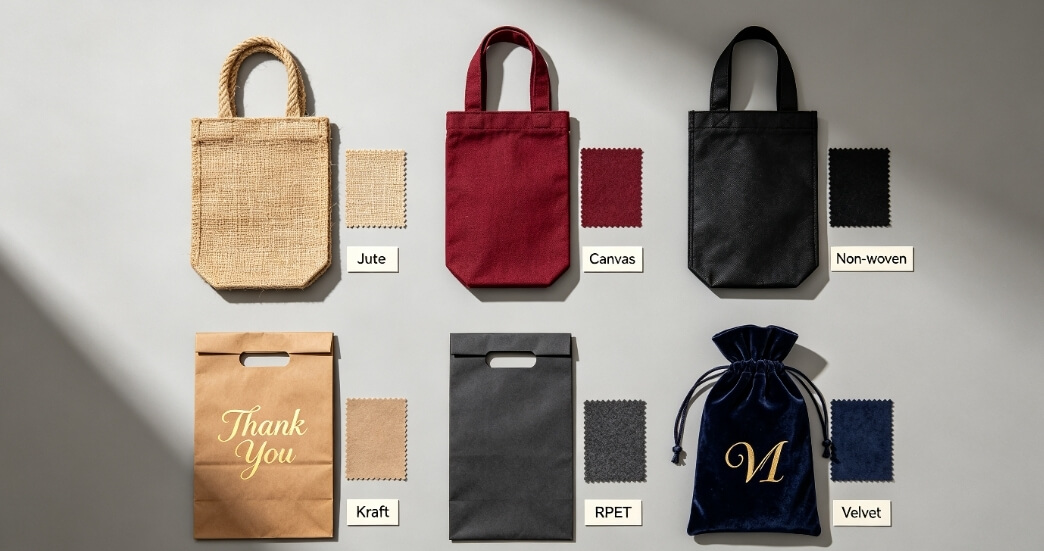
Different applications call for different materials. There is no single "universal" material.
- Jute/hemp fabric: Natural-looking and structured, making it ideal for wineries, weddings, and rustic-style gifts. However, the surface is relatively coarse, so fine logos may not print clearly. It's better for bold lettering and simple graphics.
- Cotton/canvas: Canvas weighing 12 oz or more is durable and reusable, and works well with screen printing, heat transfer, and embroidery. It's a top choice for corporate customization and wine clubs.
- Non-woven fabric: Lightweight and inexpensive, making it suitable for large promotional runs and trade show giveaways.
- Kraft paper: Offers excellent print quality and can be FSC-certified and recyclable, but it softens when exposed to moisture and is generally intended for one-time use.
- Recycled cotton/RPET: Strong sustainability appeal. In 2025, personalized customization and eco-friendly materials drove a segment of the global packaging and gift market to a 9.8% CAGR, with growth reaching 12.3% in the Asia-Pacific region.
What to Look for in a Multi-Bottle wine carrier
If you're customizing a 4- or 6-bottle wine carrier, things get more complicated.
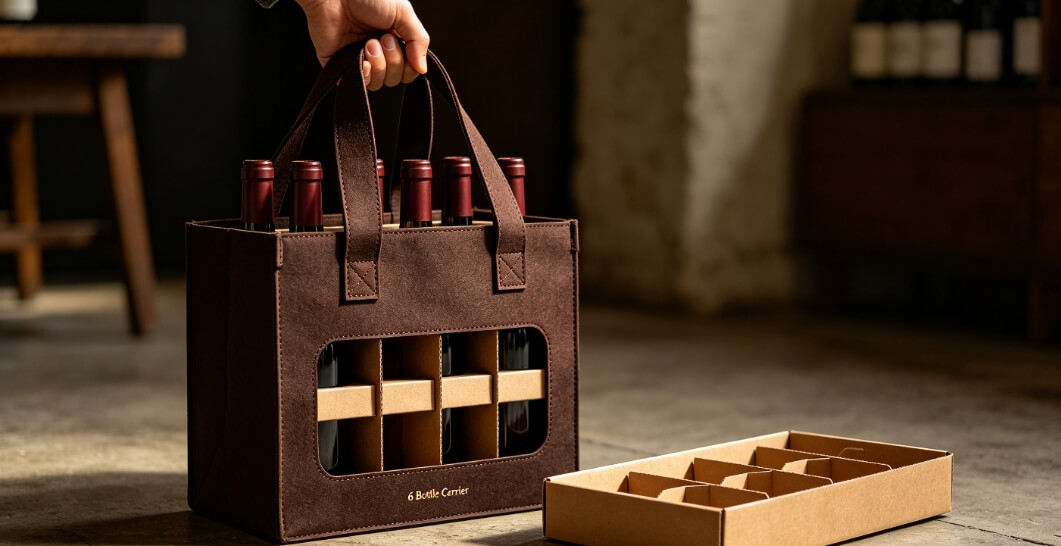
The interior should have individual dividers to keep the bottles from hitting one another. During transportation, breakage caused by bottle-to-bottle impact can reach 8%–14% when standard corrugated cartons with generic void fill are used. With die-cut corrugated dividers or molded-pulp inserts, the breakage rate can drop below 0.5%.
A fully loaded 6-bottle wine bag can weigh around 8–10 kg, so the handles need to be wider and thicker. A width of at least 2.5 cm is recommended.
You can also choose removable dividers. Take the dividers out, and the 6-bottle carrier becomes a general-purpose shopping bag, potentially extending the bag's usable life by more than three times.
Give Your wine present bag a Second Life
According to the 2026 Global Packaging and Gifts Market Report, modular reusable packaging has already exceeded an 18% penetration rate in European and North American markets. Among Gen Z consumers, 78% say packaging sustainability and reusability directly influence their purchasing decisions.
That means your custom wine present bag shouldn't be something that's simply "pretty once." Good design makes the recipient want to keep it instead of throwing it away.
Consider these features:
- Make the bag about half a centimeter larger so it can hold A4 documents or an iPad and double as a commuter bag.
- Add an interior phone pocket or hidden zippered pocket.
- Make the handles long enough to carry the bag crossbody.
- Avoid making the design overly wine-specific, so it doesn't look out of place when used for everyday shopping.
5 Factory Capabilities That Matter
When choosing a wine gift bag supplier, looking at physical samples is only the first step. What really determines whether an order goes smoothly is the factory's five core capabilities.
1. Sampling speed
Completing a customer-designed sample within 3–5 business days is considered a fast response time in the industry. A factory that takes much longer may have a distant supply chain or too many coordination steps.
2. Production lead time
The fastest factories can deliver bulk orders within 30 days. If the promised lead time is significantly shorter, check whether quality inspection is being compromised. If it's much longer, the factory may have capacity or supply-chain issues.
3. Production capabilities
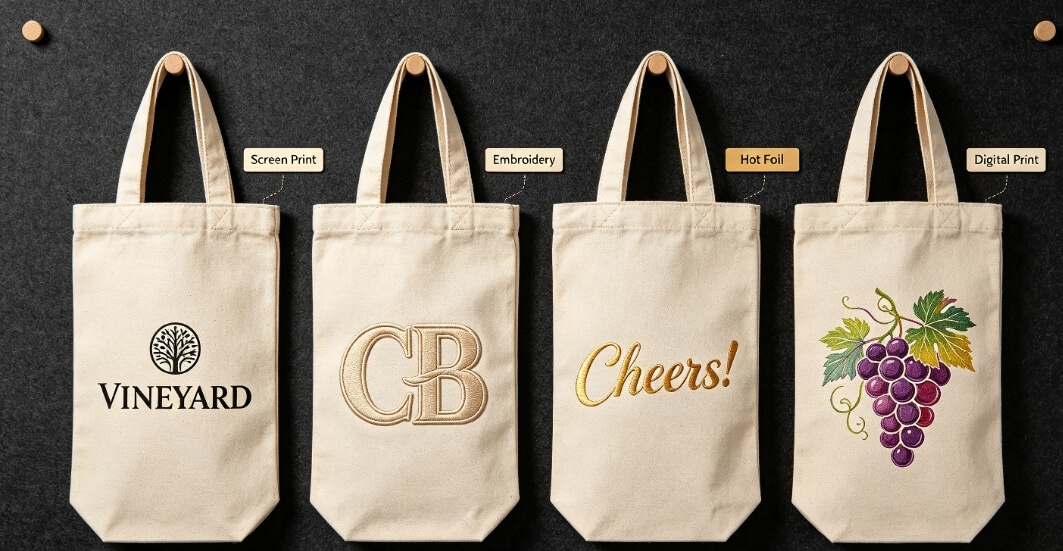
A mature wine bag factory should be able to handle multiple processes in-house, including sewing, screen printing, embossing, foil stamping, digital printing, embroidery, reactive printing, and full-coverage printing.
The broader the range of available processes, the more freedom you have when designing your logo. You won't need to find a second factory just to handle one particular technique.
4. Certifications and factory inspections
CE, ISO, and BSCI are the basic three certifications. More importantly, the factory should be willing to undergo factory audits and customer production inspections.
Being able to send someone to the production line to check stitching density, handle reinforcement, and the thickness of the rigid bottom board is far more useful than any marketing brochure.
5. Flexible MOQ
Traditional wine bag factories typically have MOQs of 500–1,000 pieces. Factories that offer low-MOQ customization are much more flexible for small trial orders, holiday gifts, and new product testing by wineries and other customers.
3 Key Specifications to Know Before Customizing
When communicating with the factory, give them these three sets of specifications upfront. They'll immediately know you're serious about the project.
Load-bearing requirements: A single-bottle wine gift bag should safely support at least 5 kg; a two-bottle bag should support at least 8 kg; and a 4–6 bottle bag should support 12–18 kg.
Print files: Logos should be provided in vector formats such as AI, EPS, or CDR. Printing directly from a JPG can result in blurry edges.
MOQ and lead time: Non-woven and paper bags typically start at 500–1,000 pieces. Because canvas involves more production processes, the MOQ may be 300–500 pieces. For smaller runs, look for factories that accept mixed orders. Quotations and digital mockups should be provided within 24 hours.
How to Choose the Right wine gift bag
Whatever wine gift bag you choose, remember one principle: first determine what kind of bottles the bag needs to hold, and how the recipient might dispose of it afterwards.
Heavy bottle + long walking distance + frequent reuse: Choose 12 oz or heavier canvas, X-shaped handle reinforcement, a PP rigid bottom board, and removable interior dividers.
One-time holiday gift: Choose FSC-certified kraft paper with cotton cord handles and a foil-stamped logo.
Long-term corporate use + logo printing: Choose jute or non-woven fabric with simple graphics and bold lettering. Start with 500 pieces to bring down the unit cost.
All you need to provide is the style and logo. XINHUI's professional designers and team can assist with the rest, including design, dimensions, colors, materials, logos, labels, and packaging, providing one-stop support from sourcing through finished-product delivery.
There's one more detail that determines whether your wine bag becomes a "mobile brand advertisement" or just another piece of disposable waste. We cover that detail in the FAQ below.
FAQ
Q1: What printing techniques does XINHUI offer for custom wine bags? How do different processes affect MOQ and pricing?
A1: XINHUI offers a complete production chain covering sewing, screen printing, embossing, foil stamping, digital printing, embroidery, reactive printing, and full-coverage printing.
Screen printing is ideal for one- to four-color logos, with relatively flexible MOQs and the lowest unit cost. Embroidery creates the strongest premium look and works particularly well for badges and letter combinations, although both the unit price and MOQ are slightly higher. Foil stamping is suitable for limited-edition premium gift wine bags. Digital printing works well for complex full-color designs and small trial orders.
Because XINHUI covers the full range of processes, customers don't need to find a second factory for a particular printing technique, which reduces overall coordination and communication costs.
Q2: If I'm concerned about the quality of XINHUI's bulk production, can I inspect the goods? What does the inspection process look like?
A2: Yes. XINHUI accepts both factory inspections and customer production inspections.
There are two common approaches. First, the customer can specify key tolerances in the purchase contract, such as usable internal dimensions of ±1 cm, the required handle reinforcement method, and the thickness of the rigid bottom board. Once production is complete, the customer can send a QA representative or appoint a third-party inspection company to conduct sampling based on AQL standards.
Second, the customer can schedule an in-process inspection during production to check stitching density, handle reinforcement, print registration, and other key details. Any problems can then be corrected immediately.
XINHUI holds CE, ISO, and BSCI certifications and maintains formal quality-control procedures and records, giving customers a clear basis for inspection.
Q3: I want to start with a 200-piece trial order. Can XINHUI handle low-MOQ customization? How long do sampling and delivery take?
A3: Yes. XINHUI supports low-MOQ customization. Customer-designed samples can typically be completed within 3–5 business days, bulk production can be delivered in as little as 30 days, and quotations and digital mockups are provided within 24 hours of inquiry.
For a 200-piece trial order, XINHUI's professional design team can assist with the entire process, from design, dimensions, colors, and materials to logos, labels, and packaging. Customers don't need to coordinate multiple suppliers themselves.
If the order volume increases to a standard MOQ later, the unit cost can be reduced further, making the overall solution even more cost-effective.
Is Your canvas bag crossbody Really Built to Last?
Could the Wrong takeout bag Size Be Costing You Sales?
Related Article


