
Tote Straps Slipping or Hurting Shoulders How to Fix It

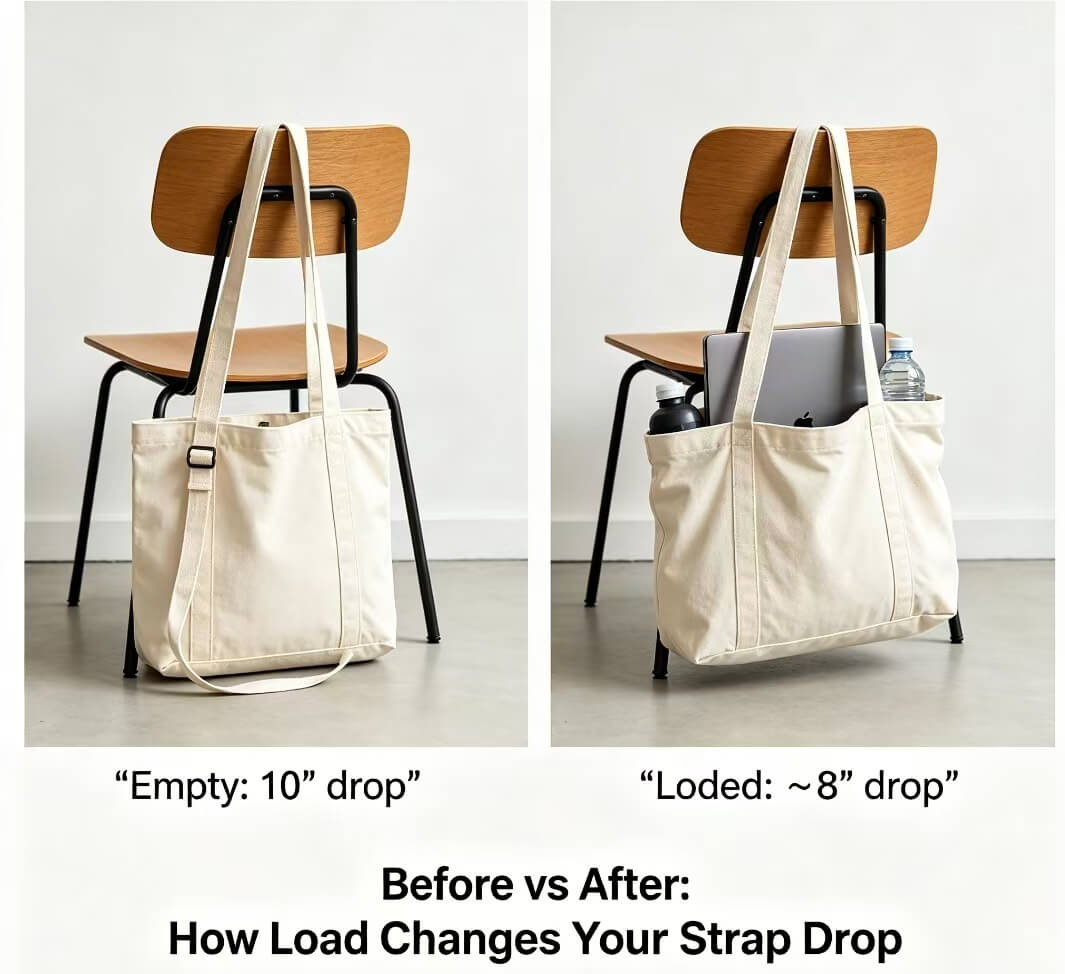
The shoulder strap length figure you pay most attention to when buying a tote bag is most likely wrong. That number on the product page is measured with the bag empty—once you put in your laptop, water bottle, and lunch, the bag stretches, and the shoulder strap gets stuck under your arm. It's not that you're carrying it wrong; two parameters are mismatched from the start: tote straps and tote handles. This article will cover three things: what to look for before buying, how to try it on after receiving it, and which measurements to confirm with the factory when customizing. After reading this, you'll at least avoid making the same mistake again.
tote straps Width and Spacing
Width: Wider Means More Comfort
| Daily Load | Recommended Strap Width | Reason |
|---|---|---|
| Light load (<2kg) | 1–1.5 inch (2.5–4cm) | Sufficient support and a slimmer look |
| Medium load (2–5kg) | 1.5–2 inch (4–5cm) | Balanced pressure and better comfort |
| Heavy load (5kg+) | 2–3 inch (5–7.5cm) | Distributes weight across a larger surface area |
Real-world example: Many wholesale and custom tote bags use 1.5-inch (about 3.8cm) webbing as the standard. This width offers the best balance between cost and comfort. If you're ordering bags for employees or clients, choosing straps that are at least 1.5 inches wide can help prevent complaints about shoulder discomfort.
Strap Spacing: The Overlooked Factor
Very few people talk about this measurement, but it has a direct impact on whether a bag stays on your shoulder.
- Spacing that is too narrow (less than 40% of the bag opening width) makes the bag harder to open and can cause it to press against your arm.
- Spacing that is too wide (more than 55% of the bag opening width) causes the bag opening to flare outward and makes the straps more likely to slip off.
Simple test: Measure the distance between the centers of the two attachment points and divide it by the bag opening width. A ratio between 0.4 and 0.55 is generally ideal.
When shopping online, check the product photos. If the attachment points sit very close to the edges of the bag opening, the spacing is probably too wide, which often leads to shoulder slippage.
tote handles Reinforcement
The attachment point of tote handles is the area that experiences the most stress. Many inexpensive tote bags use only a single straight stitch. After carrying heavy items a few times, the stitching may start to wrinkle, loosen, or break.
A stronger method is the box-X stitch:
- A rectangular box is stitched around the attachment point.
- An X is stitched inside the rectangle.
This design spreads the force across four sides and two diagonal lines, making it much harder for the material to tear around the needle holes.
How to Check Before Buying
Look at the back side of the handle attachment area inside the bag, or examine the stitching pattern from the outside.
If you can clearly see a rectangle with an X inside, the manufacturer has invested in structural reinforcement. If there is no box-X stitch, look for at least two rows of reinforced backstitching.
tote straps and Shoulder Slipping
Many people assume shoulder slippage is caused by excessive tote bag strap length , but the real cause is often a combination of factors:
- The strap surface is too smooth, such as glossy PU or nylon.
- Strap spacing is too wide.
- The bag body is too soft and lacks a structured base.
- Clothing fabrics are slippery, such as silk or polyester.
How to Diagnose the Problem
Start by wearing a cotton T-shirt.
- If the bag no longer slips, the issue is your clothing.
- If it still slips, check the width and spacing of the tote straps.
The simplest solution is to switch to textured cotton webbing, such as herringbone webbing, or apply a silicone anti-slip strip to the inside of the strap.
tote bag strap length for Custom Orders
If you're a buyer or sourcing custom tote bags, don't just ask the factory, "How long is the strap?" Ask these questions instead:
- What is the drop measurement? Is the quoted number the total strap length or the vertical drop?
- What is the webbing width?
- Is the attachment point reinforced with a box-X stitch?
Most factories provide total strap length rather than drop, so you'll often need to convert the measurement yourself.
Industry Reference Sizes
| Tote Type | Common Total Length (inch) | Approximate Drop | Recommended Width |
|---|---|---|---|
| Short-handle tote | 12–16 | 6–9 | 1–1.5 inch |
| Everyday shoulder tote | 24–28 | 10–12 | 1.5–2 inch |
| Long shoulder or crossbody tote | 28–32 | 12–14 | 1.5–2 inch |
FAQ
A: Five pounds falls into the medium-to-heavy range. Choose tote straps that are at least 1.5 inches (about 4cm) wide, with 2 inches being even better. Cotton webbing or padded nylon webbing is more comfortable than thin leather straps. Avoid narrow straps under 1 inch wide, as they can become uncomfortable very quickly.
A: Shoulder slippage is not always caused by length. Check the following:
- Is the strap surface too smooth?
- Is the spacing between attachment points too wide?
- Is the bag body too soft and unsupported?
- Are your clothes made from slippery fabrics?
The easiest fix is to switch to textured cotton webbing or add an anti-slip strip to the inside of the strap.
A: tote bag strap length refers to the full length of the strap from one end to the other, including the curved section. Drop is the vertical distance from the highest point of the strap to the top edge of the bag.
Drop is a more useful measurement because it predicts where the bag will sit on your body.
A simple estimate:
Drop ≈ (Total Strap Length − Bag Opening Width) ÷ 2
For example, if the total strap length is 26 inches and the bag opening width is 12 inches, the drop is approximately 7 inches. That's suitable for hand carrying rather than shoulder carrying.
A: A safe choice is an everyday shoulder tote configuration:
- Total strap length: 26–28 inches
- Drop: 10–12 inches
- Width: 1.5–2 inches
- Textured cotton webbing
- Box-X reinforced attachment points
This setup works well for about 95% of everyday use cases while keeping costs reasonable.
A: Check three things:
- Whether the attachment point uses a box-X stitch.
- Whether the webbing edges are finished or raw.
- Whether the hardware is metal or plastic if the straps are adjustable.
Also pay close attention to how the straps connect to the bag. If you only see a single straight stitch, the bag may start coming apart within months of carrying heavy items.
A: Both are important. tote straps determine carrying comfort, while tote handles affect durability and long-term performance. Combined with the right tote bag strap length, they create a tote bag that can handle everyday use for years.
Summary
Choosing the right tote straps, tote handles, and tote bag strap length is far more important than focusing only on colors or prints.
Remember these three essentials:
- Leave enough drop for comfortable carrying.
- Choose a strap width that matches the load.
- Reinforce the attachment points.
Whether you're buying a tote bag for yourself or ordering custom bags in bulk, these details will help ensure your tote remains comfortable, durable, and reliable for years to come.
Your grocery tote bag May Be Dirtier Than a Plastic Bag
Totes wholesale problems? Fix your tote city bag fast
Related Article


