
Why Most tote bag pocket Designs Fail Users?
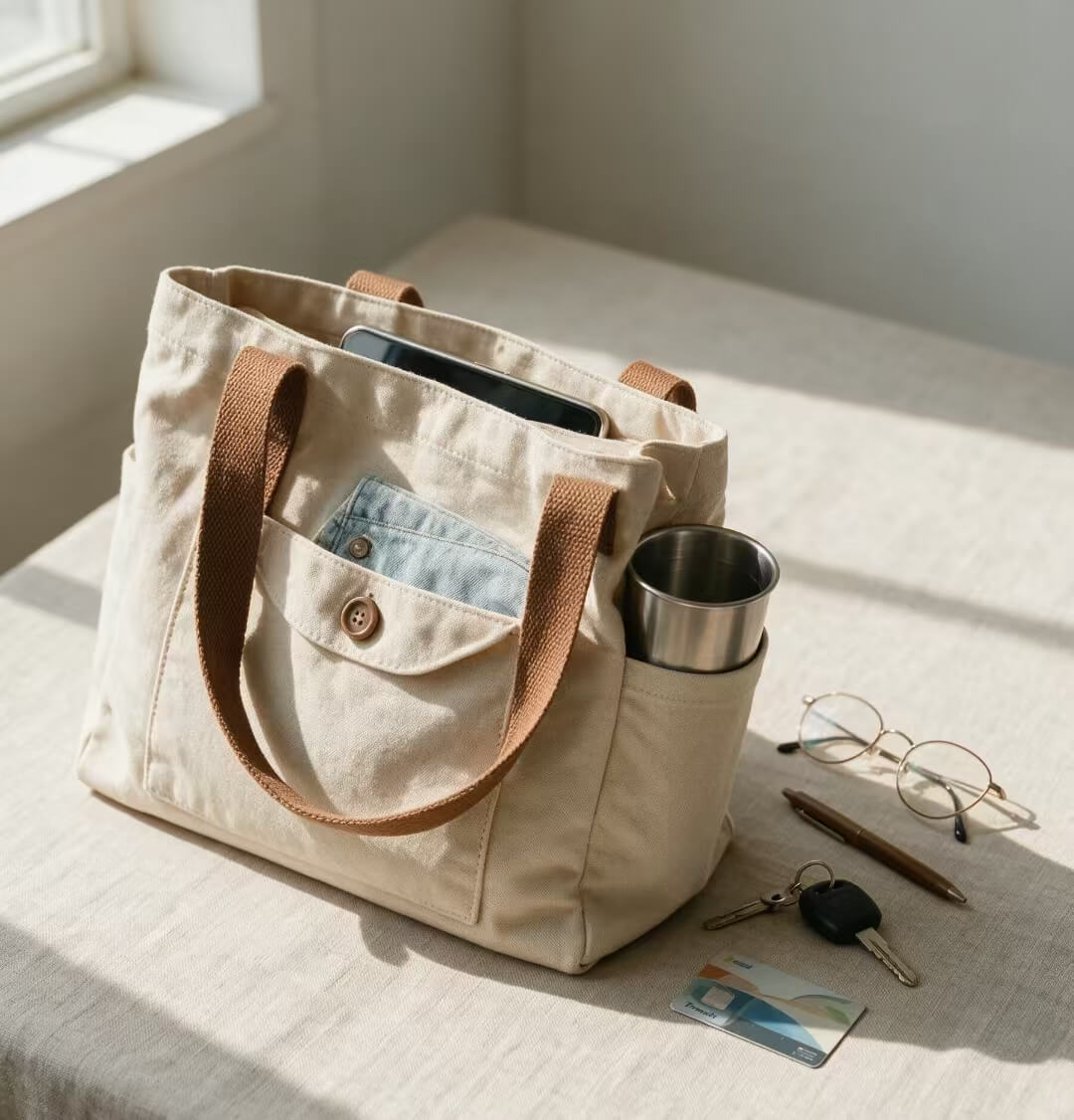
Many brands assume that designing a daily multi pocket tote bag simply means adding more pockets. But more pockets do not automatically make a bag more practical.
A truly functional tote bag pocket system gives every item its own place. Your phone, keys, transit card, water bottle, and laptop should all be easy to organize and easy to reach with one hand. That is what makes a well-designed tote stand out.
Tote Bag Pocket Types and How to Choose Them
Choose pockets based on function, not quantity. Every tote bag pocket should have a clear purpose.
| Pocket Type | Difficulty | Best For | Common Location |
|---|---|---|---|
| Pocket Type | Difficulty | Best For | Common Location |
| Patch Pocket | ★☆☆☆☆ | Quick-access items, transit cards | Exterior |
| Slip Pocket | ★★☆☆☆ | Phones, notebooks, pens | Interior |
| Zipper Pocket | ★★★★☆ | Wallets, passports, keys | Interior |
| Elastic Pocket | ★★★☆☆ | Water bottles, umbrellas, baby bottles | Interior sides |
| Padded Compartment | ★★★★☆ | Laptops, tablets | Main compartment |
Tote Bag Inside Pockets That Actually Work
The real value of tote bag inside pockets is organization. Every compartment should have a dedicated job.
- Security zone: One centered zip pocket for your wallet, ID, and USB drive.
- Quick-access zone: Two open slip pockets. One for your phone and one for your transit or access card.
- Device zone: One padded laptop compartment with an inside width 1–2 cm wider than the actual laptop.
- Key holder: A D-ring or key leash keeps your keys from disappearing into the bottom of the bag.
Felissimo's stadium tote is a great example of this concept. The upper interior zipper pocket stores tickets, while the lower divided pockets organize small essentials. Elastic side pockets hold an umbrella, binoculars, or a PET bottle upright. A large interior sleeve fits A4 documents, and a zippered bottom compartment stores a foldable seat cushion or picnic mat. Making use of every part of the bag is becoming a major trend for the daily multi pocket tote bag market in 2025.
Best Layouts for a daily multi pocket tote bag
Different users have different routines. A single layout cannot meet every need. A successful daily multi pocket tote bag should be designed around real-life use.
Commuter Tote Layout
Recommended size: approximately 33 × 35 × 15 cm. Fits A4 files, tablets, and laptops up to 15 inches.
Pocket layout:
- Front magnetic pocket for phones, transit cards, and access cards.
- Two open side pockets for a 40 oz bottle or umbrella.
- Main compartment with a separate padded laptop sleeve.
- Interior zipper pocket for valuables.
- Two interior slip pockets for chargers, business cards, or lipstick.
Key design details:
- Raise the laptop compartment 2–3 cm above the bottom to prevent impact.
- Laptop compartment widths:
- 13-inch: 33–35 cm
- 14-inch: 35–37 cm
- 15-inch: 39–41 cm
- Use 4–5 cm wide shoulder straps with foam padding for better comfort.

Product Example: The XINHUI 2409051 Canvas Tote is built for commuters. The beige version features brown webbing handles, a zippered main compartment, a front button pocket for quick access, and side pockets for extra storage. The black version includes a front snap pocket and side bottle pockets. Its wide shoulder straps, durable canvas construction, and versatile style make it ideal for commuting, campus life, and weekend shopping.
Mom Tote Layout
Recommended size: approximately 38 × 15 × 28 cm. Keep the center of gravity low and the empty bag under 0.9 kg.
Pocket layout:
- Hidden front baby-care pocket for wipes, diapers, and tissues.
- Large main compartment for clothes, toys, and lunch boxes.
- Two elastic side pockets for baby bottles and insulated bottles.
- Mesh pocket for wet wipes or dirty clothes.
- Zipper snack pocket.
- Interior zipper pocket for mom's wallet and phone.
- Hidden bottom zipper pocket for a foldable mat.
Key design details:
- The baby-care pocket should face the body and open easily with magnetic or snap closures.
- Bottle pockets should have waterproof lining.
- Place heavy items close to the center seam for better balance.

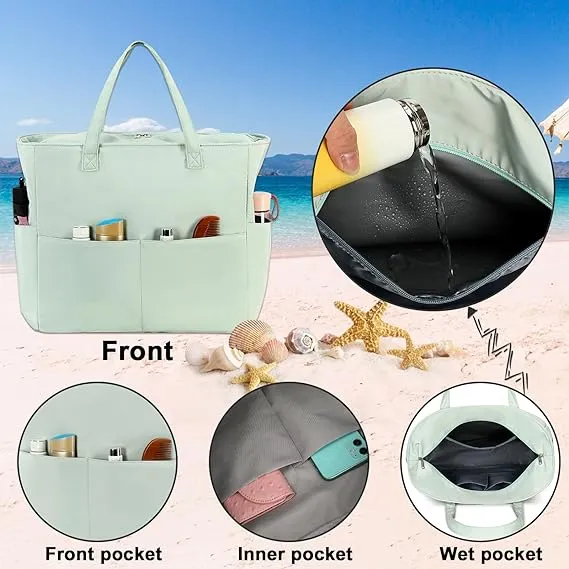
Product Example: The XH-K047 XINHUI Large Capacity Multi-Pocket Tote is designed for travel but also works perfectly as a mom bag. Two large front slip pockets provide quick access to daily essentials. An interior pocket secures valuables, while a hidden rear pocket keeps frequently used items within reach. A waterproof bottom compartment separates wet towels or swimsuits from dry belongings, making it especially useful for trips to the beach or swimming pool. Water-resistant nylon, reinforced stitching, foldable storage, and an adjustable shoulder strap complete the design.
Student and Office Tote Layout
Recommended size: approximately 35 × 28 × 12 cm with an A4-friendly rectangular shape.
Pocket layout:
- Exterior transit card pocket.
- Main A4 document compartment.
- Padded laptop compartment.
- Dedicated pen slots.
- Tablet or notebook sleeve.
- Interior zipper pocket.
- Side bottle pocket.

Key design details:
- Use a hidden vertical transit card pocket for quick scanning.
- Pen slots should be about 2.5 cm wide.
- Shoulder straps should be about 4 cm wide with memory foam padding.


Product Example A: The XH-Z091304 XINHUI Extra-Large Business Tote is designed for professional office use. It features two padded laptop compartments that fit a 15.6-inch laptop and tablet, six open interior pockets, a large front zip compartment with elastic loops and organizer pockets, exterior flap and zip pockets for daily essentials, a side bottle holder, and a front key ring for added convenience.
Product Example B: The XH-Z0907 XINHUI Laptop Tote offers a streamlined solution for everyday commuting. It fits 14- to 15.6-inch laptops, uses water-resistant fabric, and includes a built-in USB charging port for connecting a power bank without opening the bag.
Common tote bag pocket Design Mistakes
One of the biggest mistakes when developing a daily multi pocket tote bag is forgetting about seam allowance.
A phone pocket that measures 9 cm on the pattern may end up with only 8 cm of usable width after sewing. Add a phone case, and the phone no longer fits.
Use this formula:
Pattern Size = Actual Item Width + 1.5 cm Allowance
Recommended tolerances:
- Phone pocket: phone width + 1.5 cm
- Pen slot: 2.5 cm wide
- Transit card pocket: at least three-quarters of the card height
- Laptop compartment: laptop width + 1–2 cm
Another overlooked factor is hardware quality. Smooth zippers and strong magnetic closures affect the user's experience every day. High-quality lightweight hardware, such as YKK or equivalent, should always be specified and tested during sampling.
XINHUI supports OEM and ODM manufacturing for daily multi pocket tote bag projects. Everything from tote bag inside pockets dimensions and hardware specifications to foam thickness in laptop compartments can be customized to match your brand requirements.
Tips for Brand Buyers
- Never send only reference photos. Provide detailed technical drawings with pocket dimensions, placement, opening methods, and hardware specifications.
- Raise the laptop compartment 2–3 cm above the bottom to protect devices from impact.
- Position side bottle pockets close to the center seam. Large water bottles can weigh over 1 kg, so balanced placement improves stability. Dual side pockets also help balance the appearance and weight distribution.
FAQ About tote bag pocket
Q1: Is it always better to have more pockets?
A: No. One popular canvas tote includes 15 pockets, but more is not always better. The ideal number depends on the user's daily routine. Most commuters only need 6–8 quick-access actions each day, so 6–8 well-planned pockets are usually enough. Too many pockets reduce main storage space, increase weight and production costs, and make organization more confusing.
Q2: What is the minimum pocket layout for different users?
A: A commuter bag should include a magnetic front pocket, a padded laptop compartment, an interior zipper pocket, and one bottle pocket. A mom bag should include a baby-care pocket, a large main compartment, a bottle pocket, and a zipper snack pocket. A student bag should include a transit card pocket, an A4 compartment, pen slots, a notebook sleeve, and a laptop compartment. These layouts have already been validated by the market.
Q3: How should I size interior pockets? Why didn't my phone fit the sample?
A: The most common reason is seam allowance shrinkage. Always design pockets using the formula: actual item size plus a 1.5 cm allowance. Pen slots should be about 2.5 cm wide, transit card pockets should cover at least three-quarters of the card height, and laptop compartments should be 1–2 cm wider than the device.
Q4: How can I stop the side bottle pocket from pulling the bag to one side?
A: Place the bottle pocket close to the center seam, design a wider pocket base so the bottle rests on the bottom of the bag, and add matching three-dimensional side pockets on both sides. Anti-slip silicone rings inside the pocket also help keep bottles upright.
Q5: What mistakes do new brands make when working with factories?
A: The three biggest mistakes are providing only reference images instead of technical drawings, overlooking hardware quality, and placing the laptop compartment directly on the bottom of the bag. Your tech pack should include every pocket's length, width, depth, location, opening style, and hardware specification to avoid costly revisions.
Tote Bag Zip Closure Not Secure? Avoid Costly Mistakes
Why Create Custom Tote Bags Canvas Samples Before Ordering?
Related Article


