
tote bag canvas bag Sourcing Without Costly Mistakes

Abstract
The tote bag canvas bag is one of the leading product categories in the global tote bag market. The canvas tote segment is expected to account for 39.60% of the global tote bag market by 2026. However, when gift companies and trading businesses source a basic canvas tote bag, hidden charges buried in factory quotations often eat away 10%–30% of their profit margins. Meanwhile, customized natural cotton grocery tote bags, one of the most popular export products for Europe and North America, come with another challenge: high minimum order quantities (MOQs) and inventory risks.
This guide provides a practical quotation checklist and a proven 300-piece product validation strategy, supported by real production examples from the XINHUI bag factory, helping buyers manage costs and reduce sourcing risks at the same time.
Why tote bag canvas bag Is the Best Choice for Gift Companies
The global tote bag market reached USD 2.38 billion in 2025 and is projected to grow to USD 3.78 billion by 2034, with a compound annual growth rate (CAGR) of 5.31%. Among all tote bag categories, the tote bag canvas bag segment remains the largest, accounting for an estimated 39.60% of the market by 2026. The Asia-Pacific region is the largest regional market, representing 34.52% of global sales in 2025.
What does this mean for trading companies?
If you sell a basic canvas tote bag to your customers, you're working with one of the most stable and consistently reordered products in the global promotional bag market.
However, because it is considered a "basic" product, it is also one of the easiest products for factories to manipulate through hidden quotation costs. Many suppliers intentionally offer an attractive unit price first, then recover their profit by adding extra charges later in the process.
tote bag canvas bag Quotation Checklist
Whenever you receive a quotation from a supplier, review each of the following items carefully.
If a factory claims a cost is "already included in the unit price," ask them to clearly state in the contract that no additional charges will be added later.
✅ 1. Sample Fees
Always ask:
- How much is the sample without printing?
- How much is a silk screen printed sample?
- How much is a complex customized sample?
- Can the sample fee be deducted from the bulk production order?
Many professional manufacturers deduct sample fees after the bulk order reaches an agreed quantity or value.
✅ 2. Printing Plate and Mold Fees
This is one of the most commonly overlooked costs.
| Production Process | Typical Cost |
|---|---|
| Each additional silk screen color | RMB 100 per screen |
| Metal mold | Around RMB 800 each |
| Plastic mold | RMB 100–500 each |
| Lamination machine setup | Around RMB 500 |
XINHUI's advantage
One major advantage of XINHUI is that it lowers the economic MOQ for a single-color logo basic canvas tote bag to only 300 pieces, while many factories require at least 500 pieces.
The reason is simple.
Always ask this important question:
Will I need to pay the plate fee again when I reorder? Can you keep my artwork and printing plates for future production?
✅ 3. Packaging Materials
Standard export packaging usually includes:
- Five-layer corrugated cartons
- Export-grade packing materials
However, many factories charge extra for:
- Domestic cartons
- OPP bags
- Desiccant packs
- Customized packaging
- Individual labels or barcode stickers
This is an important benefit buyers should negotiate during quotation discussions.
✅ 4. Shipping Costs and Trade Terms
Transportation costs are often misunderstood.
In most cases:
- Domestic freight is paid by the buyer.
- International shipping may account for 15%–30% of the total order value.
Always confirm the Incoterms before placing an order.
Ask questions like:
- Is this quotation based on EXW?
- Is it FOB?
- CIF?
- DDP?
- Which port or destination city is included?
Never assume freight is included.
✅ 5. Taxes and Invoices
Taxes directly affect your final purchasing cost.
Confirm:
- Does the quotation include tax?
- Can the factory issue a VAT invoice?
- What tax rate applies?
These details should be written clearly before production begins.
✅ 6. Design and Artwork Revision Fees
Professional manufacturers should accept logo files in AI or PDF format and provide artwork setup services.
XINHUI supports complete OEM, ODM, and Buyer Logo customization, making it easier for customers to develop personalized customized natural cotton canvas grocery tote bags for different markets.
✅ 7. Defect Rate and Compensation Policy
This is the item that most trading companies forget to negotiate.
Your purchase contract should clearly state something similar to this:
The factory guarantees that the defect rate will not exceed X%. Any products exceeding this limit will be replaced or refunded by the factory, and all return shipping costs will be covered by the manufacturer.
A clear compensation clause can save significant costs if quality problems occur after delivery.
Procurement Tip
Print this seven-point checklist and review it every time you receive a factory quotation.
Manufacturers like XINHUI, which provide one-stop in-house production together with transparent pricing, are often the suppliers worth building long-term partnerships with.
How to Source a basic canvas tote bag with Only 300 Pieces
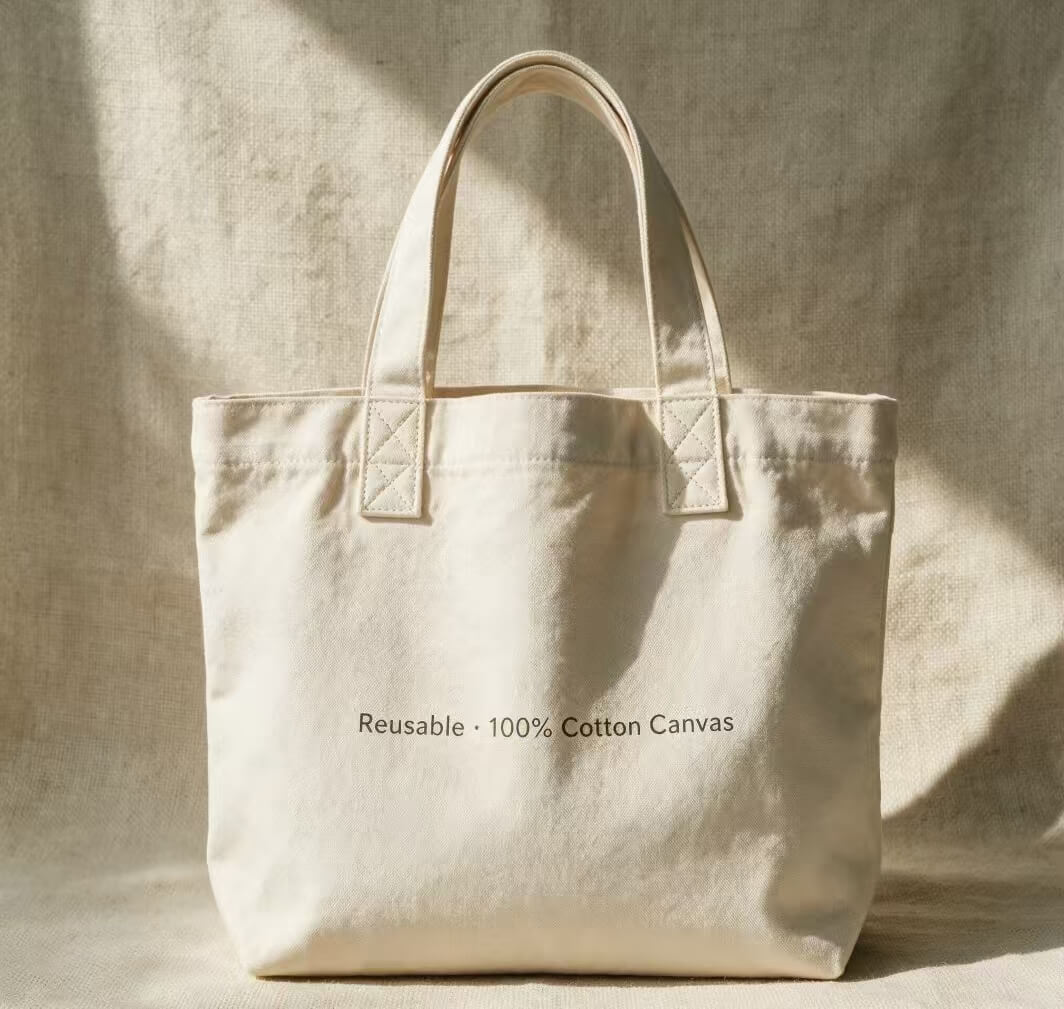
Understanding a quotation is only the first step. The next challenge for most trading companies is deciding how much to order.
Ordering 2,000 pieces at once can tie up a large amount of cash. If the product doesn't sell, you'll be left with expensive inventory.
A smarter approach is to test the market with a smaller order before scaling up.
This is where the 300-piece flexible production model becomes a valuable strategy.
XINHUI Case Study: A Flexible MOQ of 300 Pieces
XINHUI's production model is designed for buyers who want to reduce inventory risk while keeping customization options open.
| Order Type | XINHUI MOQ | Typical Industry MOQ |
|---|---|---|
| Single-color logo basic canvas tote bag | 300 pcs | 500+ pcs |
| Monthly Production Capacity | 30,000 pcs | Varies by factory |
Compared with many suppliers that only accept large production runs, XINHUI allows customers to launch new products with much lower upfront investment.
This flexibility is especially useful for promotional companies, importers, wholesalers, and e-commerce brands testing new designs.
Four Steps to Test a Product with Just 300 Pieces
Step 1: Choose the Right Blank Tote
Start with a versatile blank bag.
Among XINHUI's product line, the XH-AMZ256-G (12 oz cotton canvas tote with an inside zipper pocket) is one of the best-selling models and has a high reorder rate.

For premium collections, consider heavier fabrics such as the 20 oz canvas tote (Model XH-G0012), which features reinforced X-shaped stitching on the handles for added durability.

Selecting the right blank bag gives you a reliable foundation for product testing.
Step 2: Produce a Small Custom Order
Instead of committing to thousands of pieces, begin with 300 units featuring a single-color logo.
XINHUI supports multiple decoration methods, including:
- Silk screen printing
- Heat transfer printing
- Sublimation printing
- Embroidery
The factory also provides complete OEM, ODM, Design, and Buyer Logo customization services, making it easy to create customized natural cotton canvas grocery tote bags that match your customer's branding.
Step 3: Test Multiple Sales Channels
Divide the 300 bags across different customer groups or sales channels.
For example:
- Corporate gift customers
- Retail distributors
- Online marketplaces
- Promotional campaigns
- Brand owners
Track which design receives the highest sales, the best customer feedback, or the strongest reorder demand.
Real market data is much more valuable than assumptions.
Step 4: Scale Up the Best Seller
Once the testing period is complete, reorder only the winning design.
Instead of producing several unproven products, concentrate your budget on the item that has already demonstrated market demand.
With a monthly production capacity of 30,000 bags, XINHUI can quickly handle repeat orders of 2,000–5,000 pieces while maintaining stable production schedules.
This approach minimizes inventory risk and improves purchasing efficiency.
Cost Comparison for basic canvas tote bag Procurement
| Purchasing Method | Estimated Investment | Inventory Risk | Success Rate |
|---|---|---|---|
| Traditional order: 2,000 pcs × RMB 15 | RMB 30,000 | High | Depends on one product |
| 300-piece testing: 3 designs × 300 pcs × RMB 18 + reorder 2,000 pcs × RMB 12 | Around RMB 40,000 | Low | Much higher |
Although the initial testing strategy may require a slightly larger total investment, it dramatically reduces the risk of stocking slow-moving products.
Instead of betting everything on one design, you use real customer feedback to decide which product deserves large-scale production.
For trading companies, this is often the more profitable long-term approach.
Why Flexible Manufacturing Is Becoming the Industry Standard
The promotional bag market changes quickly.
Customers expect shorter lead times, lower MOQs, and more customized options than ever before.
By combining small-batch production with fully integrated in-house manufacturing, XINHUI has reduced the practical MOQ for customized canvas tote bags to 300 pieces.
This flexible production model is becoming one of the biggest trends in canvas bag sourcing and allows buyers to react faster to changing market demand.
For companies sourcing customized natural cotton canvas grocery tote bags, adopting a flexible supply chain is no longer just an advantage—it is becoming a competitive necessity.
Environmental sustainability has become one of the strongest selling points for customized natural cotton canvas grocery tote bags, especially in the European and North American markets.
For many overseas buyers, environmental compliance is no longer optional—it is a purchasing requirement.
Understanding the most common certifications helps trading companies recommend the right products and avoid unnecessary sourcing risks.
Two Essential Certifications You Should Know
GOTS (Global Organic Textile Standard)
GOTS focuses on organic textile production across the entire supply chain.
Requirements include:
- At least 70% certified organic fibers
- Strict environmental standards during production
- Responsible chemical management
- Social responsibility throughout manufacturing
GOTS-certified products are the preferred choice for organic brands and environmentally conscious retailers.
OEKO-TEX® Standard 100
OEKO-TEX® Standard 100 focuses on product safety rather than organic content.
Products are tested for harmful substances such as:
- Azo dyes
- Formaldehyde
- Heavy metals
- Other restricted chemicals
Many mainstream European retailers require this certification before purchasing textile products.
Which Certification Should You Recommend?
Different customers have different priorities.
| Customer Type | Recommended Product |
|---|---|
| Organic brands in Europe | GOTS-certified customized natural cotton canvas grocery tote bags |
| Mainstream EU retailers | OEKO-TEX® Standard 100 certified products |
| Promotional giveaways | Natural cotton canvas bags with SGS testing |
Matching the right certification to the customer's market can improve competitiveness while avoiding unnecessary certification costs.
Natural Cotton Is Not Pure White
This is one of the most common misunderstandings among buyers.
Many customers expect natural cotton to look bright white.
In reality, 100% natural cotton canvas usually has:
- A slightly creamy or yellowish tone
- Small dark cottonseed specks
- Minor natural color variations
These characteristics are completely normal.
They are natural features of unbleached cotton rather than quality defects.
Before production, trading companies should explain this clearly to customers.
A simple explanation can prevent unnecessary complaints after delivery.
For example:
"Natural cotton is not pure white. Slight color variations and visible cottonseed specks are normal characteristics of unbleached cotton fabric."
If customers prefer a cleaner appearance, recommend bleached white canvas or dyed fabric instead.
Buying Tips for basic canvas tote bag
Beyond pricing and certifications, experienced buyers also pay attention to product construction.
These details can make a significant difference in product quality and customer satisfaction.
Reinforced Handles Are Essential
The handle is the area that experiences the greatest stress.
A high-quality tote should include reinforced stitching where the handles connect to the bag body.
For example, XINHUI's 20 oz canvas tote (XH-G0012) uses X-shaped reinforced stitching, providing better durability for repeated daily use.
This is also an easy inspection point during quality control.
Simply turn the bag inside out and check the stitching.
12 oz vs. 20 oz Canvas
Choosing the correct fabric weight depends on the customer's budget and intended use.
12 oz Canvas
- Most popular option
- Strong enough for everyday shopping
- Cost-effective
- Ideal for promotional and retail use
20 oz Canvas
- Much heavier and stronger
- Premium appearance
- Better for luxury brands and high-end retail
- Higher material cost
For most projects, a 12 oz basic canvas tote bag offers the best balance between price and durability.
Popular Market Sizes
Choosing a proven size helps reduce sourcing risk.
Some of XINHUI's most popular dimensions include:
- 14.9" × 15.7" (Model XH-AMZ256-G)
- 34 × 16.7 × 38 cm
These sizes have been widely accepted across multiple international markets.
Fabric Weight Options
One advantage of XINHUI is its wide fabric selection.
Customers can choose cotton canvas ranging from:
- 4 oz
- 6 oz
- 8 oz
- 10 oz
- 12 oz
- 16 oz
- 20 oz
- 24 oz
This range covers everything from lightweight promotional bags to heavy-duty shopping totes.
As your sourcing projects grow, you may also consider different canvas weights to better match customer needs while maintaining consistent quality.
FAQ
Q1: Why did the factory quote RMB 15 per bag, but the final cost became RMB 18 or even RMB 20?
Answer:
This is one of the most common issues in sourcing a tote bag canvas bag.
The initial unit price often covers only the material and manufacturing costs. Additional expenses—such as sample fees, printing plate charges, packaging, freight, taxes, and special processing—may be added later.
In many cases, the final purchase price is 10%–30% higher than the original quotation.
To avoid unexpected costs, always review the seven-point quotation checklist and make sure every charge is clearly stated in the contract before production begins.
Q2: Is the sample fee a wasted expense?
Answer:
Not necessarily.
Many professional manufacturers refund the sample fee once the bulk order reaches a specified quantity or order value.
With over 20 years of manufacturing experience, XINHUI works closely with customers during the sampling stage to confirm:
- Fabric weight (4 oz–24 oz)
- Printing method
- Bag dimensions
- Construction details
- Logo placement
Identifying potential issues before mass production can save far more than the sample fee itself.
When negotiating with any supplier, ask them to include the sample fee refund policy in the purchase agreement.
Q3: My customer says the natural cotton bag looks yellow and has small dark spots. Is it defective?
Answer:
No.
This is a normal characteristic of 100% natural cotton canvas.
Unbleached cotton naturally contains tiny cottonseed specks and usually appears slightly cream or light yellow rather than bright white.
These are natural features—not manufacturing defects.
XINHUI explains these characteristics to customers before production and also offers bleached white or dyed canvas as alternatives for buyers who prefer a cleaner appearance.
Setting the right expectations before production helps prevent unnecessary after-sales disputes.
Q4: After a successful 300-piece test order, how can I ensure the next 2,000-piece order matches the first batch?
Answer:
Consistency starts with choosing the right manufacturing partner.
XINHUI provides complete OEM and ODM services and keeps production records for long-term customers.
To ensure consistent quality, you should request that the factory:
- Keep your production patterns and artwork on file.
- Use the same canvas specification whenever possible.
- Provide physical approval samples before repeat production.
- Define an acceptable color tolerance (for example, ±5%) in the purchase contract.
These steps help create a smooth transition from small-batch testing to large-volume production while maintaining consistent color, construction, and overall quality.
Conclusion
Choosing the right supplier involves much more than comparing prices.
A reliable manufacturer should provide transparent quotations, flexible minimum order quantities, stable quality, and dependable after-sales support.
Whether you are sourcing a tote bag canvas bag, looking for a basic canvas tote bag , or developing customized natural cotton canvas grocery tote bags, following the quotation checklist and using a 300-piece market validation strategy can significantly reduce purchasing risks and improve profitability.
Working with a factory that combines one-stop manufacturing with flexible production allows you to respond to market demand faster, test new products with confidence, and scale successful designs efficiently.
Tie Dyeing Method Solves Bulk Order Headaches Fast
Tote Bag Zip Closure Not Secure? Avoid Costly Mistakes
Related Article


