
Tackle Bag Mistakes That Could Ruin a Great Fishing Trip

Buying a tackle bag online can look simple: pick the biggest capacity, check the materials, and place the order. The problem usually starts after delivery, when the bag turns out to be too heavy, too bulky, or simply unsuitable for the way you normally fish.
Many tackle bag listings highlight high-denier fabric, multiple compartments, and large storage capacity. That can make a bigger fishing bag look like the better choice. But once you carry three or four standard 3600-size tackle trays on a long walk to the bank, the total load can reach 6–10 kg. Shoulder fatigue can become a problem very quickly.
Fly anglers face a different issue. A standard fishing bag may look perfectly practical on the product page, but it may not work well with waders. The straps can catch on the waistband, and the bag may swing around while casting.
Before comparing fabric thickness or waterproof claims, start with four simple questions.
Start With Your Tackle Bag Needs
- How long is a typical trip? Is it a 1–3 hour session or a full day outdoors?
- Where do you normally fish—rocky banks, boat decks, kayaks, or wading environments?
- How much walking or rock scrambling do you need to do before reaching the fishing spot?
- How many 3600- or 3700-size tackle boxes do you usually carry?
These answers will help you narrow down the right bag style before getting distracted by unnecessary features.
Choose a tackle bag for Bank Fishing
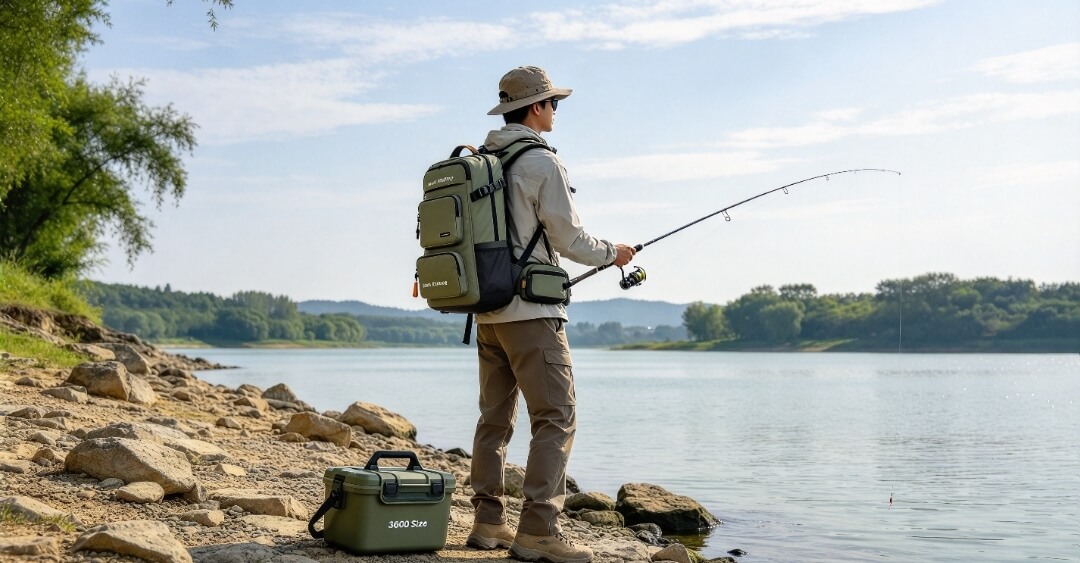
For bank fishing that involves long-distance walking, a backpack-style tackle bag with a proper carrying system is usually the better choice.
Look for well-padded shoulder straps, a chest strap, and a waist belt. Together, these features spread the load across your torso instead of placing most of the weight on your shoulders.
Capacity also matters. A larger storage area is not always an advantage. If you rarely use all the compartments, choosing a smaller size can reduce the overall weight and make the bag much more comfortable to carry.


What to Look for on a Boat
Boat fishing usually involves much less walking, so weight is not as critical. Instead, focus on practical details such as a non-slip bottom, drainage holes, and corrosion-resistant zippers.
A large fishing bag can also become awkward on a crowded boat deck. When working space is limited, a medium-capacity model is often easier to handle and keeps your equipment within reach without taking up too much room.
Brands developing storage gear for offshore fishing often discover that product drawings do not tell the whole story. A sample may look perfect in the factory, yet real saltwater use can reveal problems such as salt buildup around hardware, bottom panels that wear through after repeated friction, or drainage holes placed in the wrong locations.
Many general bag factories focus mainly on producing according to drawings. XINHUI Bag Factory also considers how anglers actually use the product. During sampling, the factory can simulate conditions such as shoreline dragging, seawater spray, and full-load carrying. This helps identify structural problems that may not be visible on a drawing and allows the team to adjust compartment dimensions, carry points, and hardware selection before mass production.
Why fly fishing bags Need a Different Design
Fly fishing bags have different structural requirements from standard lure-storage bags.
Most fly fishing is done while wearing waders, so chest packs and sling-style bags need to be checked for strap interference. The straps should not fight with the wader belt or restrict your casting motion.
The purpose of fly fishing bags is also different. They are usually designed for quick access to fly boxes, leaders, tippet, forceps, and other small tools. They are not normally intended to hold large 3600-size tackle trays. Trying to force a large tray into a compact fly bag can put excessive pressure on the zipper and reduce ease of access.
For fly anglers, freedom of movement and quick access are generally more important than maximum storage capacity.
What About Kayak Fishing?
Kayak fishing has its own storage requirements. Pay close attention to external attachment points and the overall thickness of the bag.
A bag that sticks out too far can interfere with paddle strokes or compete for limited space around the seat. It should also have a practical drainage path so water that splashes inside can escape instead of pooling at the bottom.
Tackle Bag Essentials vs. Marketing Extras
When comparing fishing gear, it helps to separate genuine requirements from features that simply look impressive on a product page.
Must-have features include:
- Compatibility with the tackle box sizes you actually use
- Corrosion-resistant hardware for the fishing environment
- Enough capacity for the length of your typical trips
- A fit that does not interfere with casting or movement
Common marketing extras include:
- Large numbers of unused compartments
- Excessive external webbing
- Overstated “fully waterproof” claims
Some products include more than a dozen storage sections, but during a normal fishing trip, most of them may stay empty.
The goal is not to find the bag with the most features. It is to find the bag that matches the way you actually fish.
Match the Bag to Your Main Fishing Style
Once you complete the self-check, you can eliminate most models that do not fit your needs. Then compare the remaining options based on fabric, base construction, drainage, and water resistance.
There is no single fishing bag that works perfectly for every fishing environment. The best choice is the one that matches your most common fishing style.
For anglers who regularly switch between very different setups, two specialized storage systems may actually be more practical than one oversized bag that tries to do everything.
Use These Standards for Product Development
Fishing brands developing custom storage products can also use this self-check process as a product-development reference.
Many custom tackle bag projects fail because the design team copies the appearance of a popular product without understanding how anglers actually use it. A product can look right and still have the wrong compartment sizes, carrying points, or hardware for its intended environment.
XINHUI Bag Factory goes beyond simple drawing-based reproduction. For bank fishing, boat fishing, and fly fishing applications, the team can suggest practical design changes based on the real use conditions.
The material range includes commonly used fishing-bag fabrics such as nylon and polyester. Development also considers load-bearing points, saltwater resistance of hardware, and the outdoor durability of different logo application methods.
The result is a more complete material and production specification, making it easier for brands to carry out follow-up quality-control checks.
FAQ
Q1: What should left-handed anglers check when choosing a sling-style fishing bag?
A: Check whether the strap direction can be switched. Some sling bags are designed specifically for right-shoulder carry, with the opening and tool attachment points positioned accordingly. When worn on the left shoulder, reaching for pliers or small accessories can become awkward. Product photos can often reveal the direction of the attachment points before you buy.
Q2: How can I make it easier to switch between bank fishing and boat fishing?
A: Use removable inner storage boxes. Keep tackle trays and small accessories inside separate inner cases, then move the entire case to the new fishing spot. This saves you from unpacking and reorganizing every loose item each time.
It can reduce the hassle, but it cannot completely remove the different storage requirements of bank and boat fishing.
Q3: How does MOLLE webbing hold up in saltwater?
A: The webbing itself can generally handle seawater exposure, but the plastic buckles and metal attachment points can collect salt crystals over time.
Rinse the bag after each saltwater trip. Long-term salt buildup can accelerate plastic embrittlement and make buckles and hardware harder to open and close.
Choosing the right bag is ultimately less about maximum capacity and more about matching storage, comfort, durability, and access to the fishing conditions you encounter most often.
How to Choose the best garment bag for travel
Related Article


