
Why Are More People Ditching Big Bags for a phone pouch?
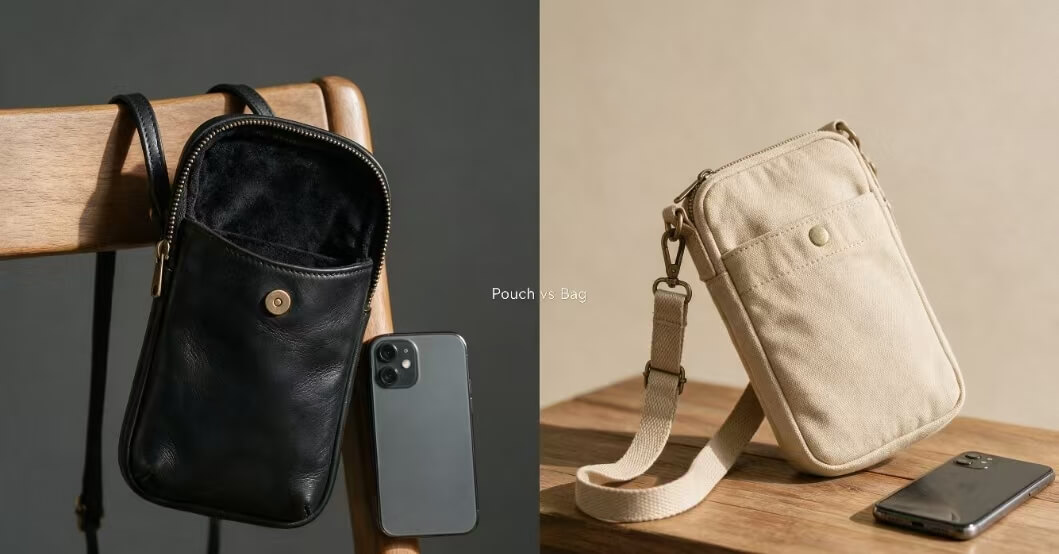
Ninety percent of the space in the large bag you carry every day is probably wasted.
Don’t believe me? Open your bag and take a look. Is it stuffed with charging cables, an umbrella, a makeup bag, a notebook, and a thermos—but the only things you actually use today are your phone, transit card, and keys? Everything else is there “just in case,” while your shoulders carry the weight of all that anxiety.
That’s why the phone pouch has quietly replaced oversized bags for many people over the past two years. So, what is a phone pouch? The answer is simpler than you might think: it’s a small bag designed specifically for your phone and two or three essentials. It’s small enough to force you to pare things down, yet big enough to hold exactly what you need.
A phone bag is essentially the upgraded version. It usually comes with a shoulder strap and a few extra compartments, giving you room for your phone, cards, keys, and a lipstick—nothing more.
Phone Pouch Solves What Big Bags Don’t
Many people overlook one simple problem: a large bag creates an “illusion of storage.” You think everything is organized because it all fits inside, but in reality, you’ve just thrown everything in.
Your phone, cards, and keys—the things you reach for most often—always seem to end up at the bottom.
The logic behind a phone pouch and a phone bag is completely different. Your phone is the star, and everything else is supporting cast.
Most mainstream designs measure around 18–22 cm long by 10–13 cm high. That’s enough to fit an iPhone 15 Pro Max or Huawei Mate 60 series phone, with some extra room for cards, coins, wireless earbuds, and other small essentials.
In other words, it’s not simply a variation of a phone case. It’s a branch of the mini-bag category.
💡 Key takeaway: If you only need to take your “phone + one or two small essentials” with you, carrying a large bag is overkill. A phone pouch is just the right amount of storage.
Phone Pouch vs. Phone Bag
The two terms are often used interchangeably, but there is a clear difference in practice:
| Feature | phone pouch | phone bag |
|---|---|---|
| Capacity | Fits the phone snugly, with room for at most a transit card | Phone + cards + keys + lipstick |
| How you carry it | Around your neck, clipped to a belt, or inside a handbag | Mainly crossbody or over the shoulder, with its own strap |
| Strap | None or very short | Adjustable, usually around 110–130 cm |
| Typical use | Coffee runs, dates, quick QR-code scans | Commuting, travel, full-day trips to places like Disneyland |
| Style | Minimal and close to the body | Mini bag and fashion accessory |
Put simply, a phone pouch is the extra “layer of skin” you carry when you don’t really want a bag. A phone bag is the mini version you choose when you do.
What Is a Phone Pouch Made Of?
The real answer to what is a phone pouch isn’t just about its definition. The material it’s made from matters just as much.
1. Genuine Leather
Pros: Durable, breathable, develops a beautiful patina over time, and works well in formal settings.
Cons: Heavier and more expensive, sensitive to sweat stains, and requires conditioning every 3–6 months.
Best for: Commuters, business settings, and anyone who values long-term quality.
Typical price: Around RMB 300–500 for entry-level luxury styles, with high-end options costing RMB 1,000 or more.
2. Canvas / Cotton-Linen
Pros: Lightweight, casual, affordable, and develops more character with use.
Cons: Gets dirty easily, isn’t naturally waterproof, and is less abrasion-resistant than nylon.
Best for: Students, creatives, weekend markets, exhibitions, and casual outings.
Typical price: Around RMB 100–300.
3. Nylon / Oxford Fabric
Pros: Water-resistant, lightweight, and tear-resistant.
Cons: Has a more sporty look and may feel out of place with a formal suit.
Best for: Outdoor activities, commuting, and rainy urban environments.
Typical price: Around RMB 100–300.
⚠️ One counterintuitive tip: PU leather may be cheap and water-resistant, but its coating can peel over time. In hot and humid environments, low-quality PU can start cracking within just three months. If your budget allows, go for genuine leather or water-resistant nylon instead.
How the phone bag Became a Fashion Statement
Over the past two years, the fashion world has seen an interesting shift: mini bags have gone from novelty items to everyday essentials.
The mybest phone-bag rankings include models from GUCCI, PRADA, BALENCIAGA, and Michael Kors. That’s no coincidence. Once a bag becomes small enough to hold little more than a phone, it stops being merely a “functional container” and becomes a fashion accessory.
The styling formula is simple:
- Genuine leather + metal hardware + chain strap → dates, dinners, exhibitions
- Canvas + vegetable-tanned leather accents → markets, cafés, weekend trips
- Nylon + adjustable webbing → commuting, cycling, travel
- Brocade + hand embroidery → hanfu, qipao, and modern Chinese-style occasions
Strap width is also seriously underrated. A strap narrower than 2.5 cm can start digging into your shoulder after an hour. It’s one of those invisible dividing lines between a phone bag that looks good and one that’s actually comfortable to use.
Why a Phone Pouch Is a Dark-Horse Gift

Most people don’t immediately think of a phone pouch when shopping for gifts. Yet custom canvas phone bags are widely used as promotional giveaways, while cultural and creative brands often turn them into customized merchandise.
Why does a phone pouch make such a good gift?
- Used constantly: Everyone carries a phone, so the gift gets used and seen every day.
- Budget-friendly: There are plenty of options in the RMB 100–500 range without making the recipient feel pressured.
- Highly customizable: You can choose the color, material, embroidery, artwork, and even traditional brocade techniques.
- Works for many recipients: Choose practical dark colors for parents, pink or embroidered designs for close friends, or Chinese-inspired designs for international friends.
📌 If you want to customize a batch of phone pouches for your brand or event, the key is finding a supplier that can respond quickly. A factory like XINHUI, with 20 years of experience, can produce customer-designed samples in just 3–5 working days, with the first batch delivered in as little as 30 days.
You only need to provide the design and logo. They handle everything else, from fabric sourcing and sewing to screen printing, embossing, foil stamping, digital printing, and embroidery. You can also receive a quotation and digital mockup within 24 hours, saving you the time and effort of coordinating with multiple factories.
5 phone pouch Details to Check Before Buying
1. Choose a Size Only Slightly Larger Than Your Phone
If the bag is much larger than your phone, the phone will move around inside and the camera lenses can easily get scratched by your keys.
For an iPhone 14 Pro Max-sized phone, an internal length of at least 17 cm and width of at least 8 cm is a good safety baseline.
2. Zippers > Magnetic Snaps
Magnetic closures are convenient, but they can open accidentally. In a crowded subway, a zippered design offers better security.
3. Look for a Soft Fabric Lining
A fleece or soft-fabric lining helps protect your phone and camera lenses from scratches. This is especially important if you care about photography.
4. Choose a Strap at Least 2.5 cm Wide
A narrow, stiff strap can turn into a “fashion torture device.” Look for a wider strap with extra padding if you plan to wear it for long periods.
5. At Least Two Compartments
Ideally, one compartment should hold your phone while another holds cards or cash. This keeps your essentials separated and reduces unnecessary rubbing and scratches.
💡 These details matter even more when purchasing in bulk. XINHUI has multiple certifications, including CE, ISO, and BSCI, and accepts both factory inspections and customer production inspections.
Its quality-control process covers five stages: checking raw materials and specifications before production, monitoring the manufacturing process, sampling finished products according to AQL standards in cooperation with third-party organizations, inspecting packaging and labels, and supervising shipment.
That means the quality of every batch you receive can be monitored and controlled.
How to Make Your phone pouch Last 3+ Years
Different materials require different care:
- Genuine leather: Wipe away dust with a slightly damp soft cloth every 1–2 months. Apply leather conditioner every 3–6 months. Keep it away from alcohol, perfume, and sunscreen sprays.
- Canvas: For localized stains, gently brush the area with a soft brush and diluted laundry detergent. Pure cotton canvas absorbs water and can take a long time to dry, so water-resistant canvas is preferable.
- Nylon: Simply wipe it with a damp cloth. It’s the easiest material to maintain and the most hard-wearing.
FAQ
Q1: Is a Phone Pouch the Same as a Phone Wallet?
No. The core purpose of a phone pouch is to carry your phone, with room for perhaps one card.
A phone wallet combines a phone case with a wallet. It usually has dedicated card slots, a cash compartment, and sometimes RFID protection. It offers more storage—essentially combining a slim wallet and a phone holder into one.
If you don’t even want to carry a separate card holder, choose a phone wallet. If your main goal is simply to keep your phone secure and easy to access, choose a phone pouch.
Q2: Will a Phone Bag Look Too Feminine on a Man?
Not at all. The key is choosing the right style.
Avoid chains, bright pinks, and cartoon embroidery. Instead, go for black, dark brown, or military green in leather or nylon. Choose a strap at least 2.5 cm wide, and pair it with cargo pants or a casual suit for a clean, streamlined look.
Many men use a phone bag instead of a traditional belt bag or briefcase. The result can actually look cleaner and more polished.
The key is simple: skip the glitter and lace.
mesh tote bags for Every Trip: 3 Styles Worth Knowing
Do Tote Bags Shrink After Washing?
Related Article


