
How Can Jute Canvas Bags Work Beyond the Beach?
You’ve searched through your shopping basket, added a third jute bag, and then realised you can’t remember where the last one ended up.
There’s nothing wrong with the bag. The problem is that, beyond the beach and the weekly shop, you’re not quite sure what to wear it with.
That’s the biggest styling challenge with jute canvas bags: the natural texture is effortlessly appealing, but they can easily become an occasional accessory rather than an everyday favourite.
And that’s a shame.
Jute is a practical, naturally textured fibre with a strong connection to more conscious consumption. It comes from plants in the Corchorus genus, has a relatively short growing cycle of around four to six months, requires comparatively little water, and does not rely on pesticides or chemical fertilisers in the way many conventional crops do. The Food and Agriculture Organization of the United Nations has identified jute as one of the fibres with potential for the future. Natural jute fibre is also biodegradable.
The material, in other words, isn’t the problem.
The real issue is design.
Many jute bags are soft, unstructured and decorated with generic graphics. They work beautifully with jeans and a white T-shirt, but become much harder to style once you want something smarter. Eventually, the bag gets pushed to the back of the wardrobe and becomes another well-intentioned purchase that rarely gets used.
There is an important lesson here when it comes to sustainable fashion: the environmental value of a reusable bag depends largely on how often it is actually reused.
The UK Environment Agency’s 2011 life-cycle assessment of supermarket carrier bags is often simplified online. One of its findings was that a cotton bag needed to be reused 131 times to have a lower climate-change impact than a conventional HDPE plastic bag used once. If the plastic bag was reused as a bin liner, the cotton bag needed to be used 173 times.
The point isn't that plastic bags are ‘better’. It is that a reusable bag only delivers its environmental benefits when you actually keep using it.
A pair of personalised jute bags that comes out of your wardrobe 200 times is ultimately far more useful than an ‘eco bag’ that sits untouched for years.
So, rather than treating your jute tote as a beach-only accessory, let’s make it work harder.
The goal is simple: one well-designed customised bag that can take you from Monday morning to weekend dinner.
Choose the right jute canvas bags shape
Before thinking about outfits, think about the bag itself.
The shape of a tote determines where it feels appropriate. A floppy shopper has a relaxed, practical character. A structured square tote can look perfectly at home in an office. A smaller, carefully finished style can even work for dinner.
This is where jute canvas bags have an advantage over traditional all-jute designs.
A common construction combines jute side panels and a jute base with canvas front and back panels. The canvas gives the bag a cleaner surface and helps it retain its shape, while the jute provides the natural texture that makes the style distinctive.
A bag that can stand upright rather than collapsing on the floor immediately feels more considered.
Make it personal
Personalised jute bags are particularly useful when you want to move away from the traditional ‘market tote’ aesthetic.
Depending on the design, you can add screen printing, heat-transfer artwork, embroidery or a contrasting fabric patch. Even a small monogram or woven label can make the bag feel more like a personal accessory than a promotional giveaway.
The key is restraint.
A thoughtful detail can elevate a simple natural-fibre tote. Too many competing graphics can make it much harder to wear.
Think beyond the ready-made tote
Customized jute tote bags give you greater control over the details that actually matter in everyday life.
You can adjust the dimensions, choose the colour, change the handle material, add an inner lining or modify the pocket arrangement.
Instead of asking, ‘Which ready-made bag do I like?’, ask:
‘What do I need this bag to do every day?’
That shift in thinking makes customisation much more useful.
The first rule of styling: choose a bag that fits your lifestyle before choosing the outfit that fits the bag.
Office dressing: structure matters
Taking customized jute tote bags into the office is less about making your outfit formal and more about making sure the bag has enough structure.
A well-shaped tote can work surprisingly well with tailored clothing, particularly when its natural texture provides contrast against sharper fabrics.
Try:
- A structured square tote with a reinforced base.
- A tailored blazer with straight-leg trousers.
- A crisp cotton shirt or fine knit.
- Neutral tones such as beige, cream, navy, black and camel.
- Minimal jewellery and a simple watch.
The styling principle is contrast.
The texture of jute adds warmth and softness, while tailored clothing provides clean lines. Together, they create an outfit that feels polished without becoming overly corporate.
If your clothes are already loose, soft and oversized, choose a firmer bag to provide some definition.
A structured camel-coloured style such as XH-CS184-G works particularly well with dark tailoring. It adds warmth without competing with the outfit.

From café to creative studio
This is arguably the natural territory of jute canvas bags.
Think smart-casual rather than strictly casual.
A fitted knit with tailored trousers works beautifully with a jute tote because the texture of the bag softens the sharper lines of the trousers.
For a more relaxed look, pair an oversized shirt with straight-leg trousers and let the texture of the bag provide another layer of interest.
The colour strategy is straightforward:
- Neutral bag: you can introduce colour through your clothing, but keep one shade as the main accent.
- Statement bag: keep the rest of the outfit neutral and let the bag take centre stage.
This is one of the biggest advantages of ordering a custom bag: you can decide its role in your wardrobe before deciding what goes on it.
Many people do this the other way round. They create an elaborate bag first and only afterwards discover that nothing in their wardrobe works with it.
The result is predictable: another tote that spends more time in the wardrobe than on your shoulder.
Weekend markets and everyday errands
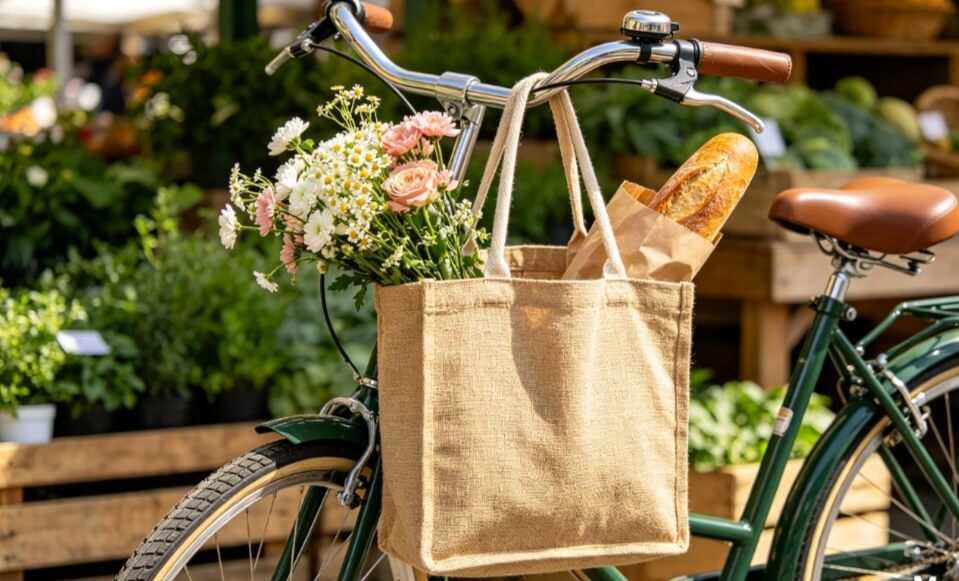
For farmers’ markets, flower shops, school runs and weekend errands, jute canvas bags require very little styling effort.
Jeans and a plain T-shirt are enough.
The natural texture of jute prevents a simple outfit from looking too flat, particularly when everything else is made from smooth cotton or denim.
If you prefer loose-fitting dresses, however, choose a tote with a little more structure. A relaxed dress paired with an equally floppy bag can make the entire silhouette look shapeless.
Functionality matters here too.
A style such as XH-G054, with a waterproof lining, is useful for trips to the flower shop or market when you might be carrying damp produce, flowers or other items that could release moisture.
Jute also has a naturally textured surface that makes it practical for beach use. After a sandy day out, a good shake can remove much of the loose sand from the exterior.

Beach days: choose function first
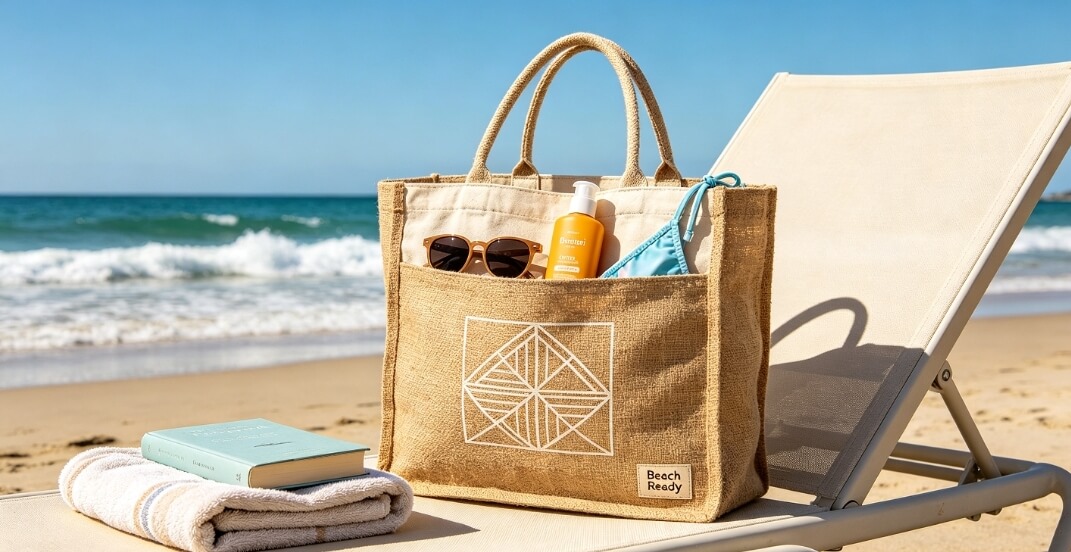
The beach may be the traditional home of the jute tote, but not every jute bag is equally suited to it.
The details that matter most are the lining, pockets and closure.
An unlined jute bag can allow moisture from wet swimwear to pass through, while sand may escape through the weave. That is where a more functional design becomes worthwhile.
For example, XH-G054 combines a waterproof lining with a canvas zipped pocket, giving wet swimwear, your phone and your wallet their own spaces.
Pair it with swimwear, a linen shirt or a lightweight cover-up and the look feels completely natural.
The important thing is that the bag shouldn't just look like a beach accessory. It should actually perform like one.
Dinner and date nights
Can personalised jute bags really work after dark?
Yes — with a few changes.
The trick is to make the bag smaller, more structured and less heavily customised.
Choose a compact square shape with a subtle embroidered monogram, minimalist screen print or small woven label. Pair it with a little black dress, a silk blouse or tailored evening separates.
If possible, swap a long canvas handle for a shorter leather or PU handle.
The result creates an intentional contrast: the clothes feel distinctly evening-ready, while the natural jute keeps the accessory relaxed.
That slight tension is what makes the look interesting.
It says, ‘I didn't need to change everything just because the sun went down.’
There is one important rule here: keep evening-friendly personalised jute bags small, structured and understated.
A large, floppy shopping tote may be perfectly practical, but at a smart restaurant it can look as though you've arrived straight from the supermarket.
Camel and natural jute shades also work particularly well under warm restaurant lighting, where they feel softer and less visually heavy than black or very dark brown.
One bag, 16 hours
The real test of a good customised tote is versatility.
Imagine the same bag moving through your day:
7:30 a.m. — School run
Jeans, a simple knit and your customised tote.
10:00 a.m. — Office
Add a tailored blazer. The bag stays exactly the same.
12:30 p.m. — Client lunch
Change into pointed flats. Keep the tote.
7:00 p.m. — Dinner
Add a red lip and a little black dress. The bag stays with you.
That level of versatility is possible when your customized jute tote bags meet three simple criteria:
- Medium size — large enough for everyday essentials, but not so large that it looks like a shopping bag.
- Neutral colour — easy to combine with different outfits.
- Restrained customisation — a small embroidered detail or woven label rather than a full-surface print.
This is why first-time customisation is usually better kept simple.
The more visual space you leave open, the more outfits your bag can work with.
Customisation details that matter
When designing personalised jute bags, the smallest technical decisions can have the biggest effect on how often you actually use them.
Material
A combination of jute side panels and canvas front and back panels offers a useful balance between texture and practicality.
The jute gives the bag its distinctive character, while the smoother canvas creates a better surface for printing.
Size
For everyday commuting, a medium tote around 35–42 cm high is a practical starting point.
If you regularly carry a laptop or larger work essentials, consider a larger design of 45 cm or more.
Handles
Different handle materials create noticeably different impressions:
- Canvas webbing: relaxed and casual.
- PU leather: cleaner and more office-friendly.
- Cotton rope: ideal for holiday and resort styling.
Base construction
A gusseted side and base can increase capacity and help the tote stand upright.
That small structural detail can make a surprisingly big difference when you're carrying a laptop, notebook, water bottle and everyday essentials.
Printing
Jute has a naturally coarse surface, so bold logos, simple illustrations and strong lines tend to work best with screen printing.
For detailed artwork, fine lines or gradients, the smoother canvas panel is generally a better choice. Heat transfer and digital printing can produce cleaner results there.
Lining
If you regularly visit the beach or carry damp items, a waterproof lining is worth considering.
For ordinary commuting and everyday errands, a lining is more about preference than necessity.
Build quality matters more than the fibre alone
Jute itself is a strong, breathable natural fibre, but the lifespan of a tote depends heavily on how the bag is constructed.
Look for:
- Reinforced stitching at stress points.
- Metal rivets where the handles carry weight.
- Reinforced canvas around the opening.
- A strengthened base.
- Securely attached handles.
These details determine whether a tote becomes a short-term accessory or something you genuinely use for years.
A sustainable bag isn't simply one made from a natural material.
It is a bag you actually want to keep using.
FAQ
Can customized jute tote bags work with different clothing styles?
Yes, provided you customise them with versatility in mind.
A neutral colour combined with restrained detailing can move easily between casual, smart-casual and workwear outfits.
A bright all-over print or highly specific theme is more difficult to style because it ties the bag to a particular aesthetic.
If this is your first custom tote, understated design will usually give you more options in the long run.
What happens when jute canvas bags get wet?
Jute is hygroscopic, which means it naturally absorbs moisture.
After getting caught in the rain, the bag may become heavier or change colour temporarily. If it remains damp for too long, it can also lose its shape or develop an unpleasant smell.
If your jute canvas bags get wet:
- Gently blot away excess moisture with a dry cloth.
- Stuff the bag with newspaper or clean paper to help it retain its shape.
- Leave it to dry naturally in a cool, well-ventilated area.
- Avoid direct sunlight and tumble drying.
If you regularly use your tote in wet weather, consider adding a waterproof lining during the customisation process.
Will designs on personalised jute bags fade or wear away?
That depends largely on the decoration method.
Screen printing generally performs well on the textured jute surface. Heat-transfer printing tends to be more stable on canvas, while embroidery and woven labels are physically attached to the fabric rather than printed onto it.
For cleaning, use water at around 30–40°C with a mild detergent.
Avoid soaking, machine washing and bleach.
With the right printing method and proper care, a well-made custom design can remain clear and attractive for years.
The takeaway: make your jute tote earn its place
The best personalised jute bags aren't the ones with the most elaborate designs.
They're the ones you reach for without thinking.
A structured shape, versatile colour, practical lining and restrained customisation can take a jute tote from the school run to the office, from a Saturday market to the beach, and even from daytime errands to dinner.
That is the real potential of jute canvas bags and customized jute tote bags: not simply replacing another shopping bag, but becoming a genuinely useful part of your everyday wardrobe.
Choose the right shape. Keep the design versatile. Add the features you will actually use.
Then let the bag do the rest.
Why custom bags fail before they reach your warehouse
Is a Tote Shopper Bag Really Better When It Is Thicker?
Related Article


