
Why bicycle bags Need More Than a Visual Inspection
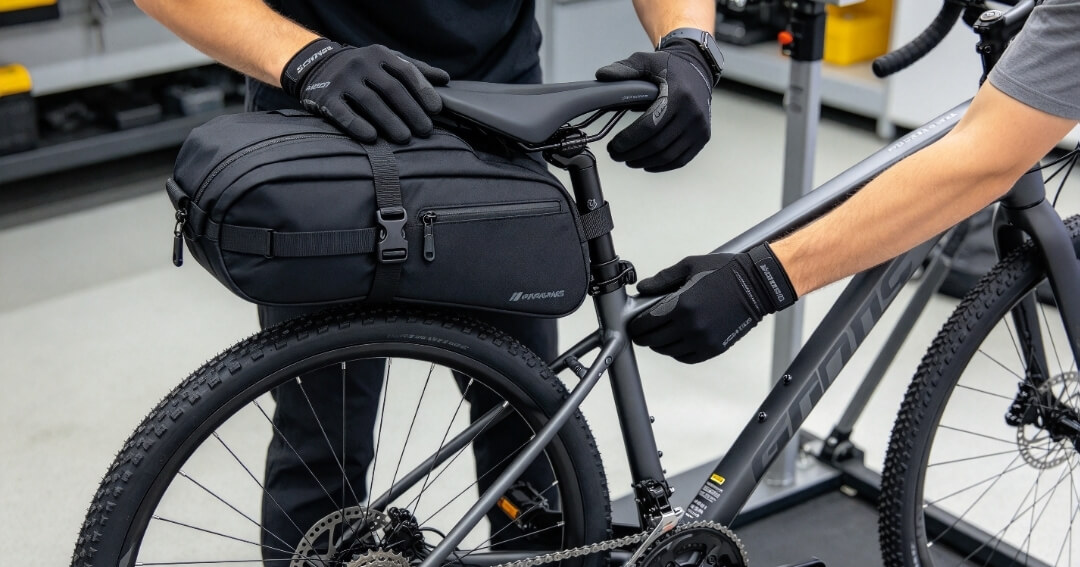
You’ve just received a message from the warehouse: the container carrying your bicycle bags has been unloaded.
You open a few cartons and give the products a quick look. The appearance, stitching, and color scheme all match the approved sample.
But once you fit the cycling bags onto a bike and take them out for a test ride, problems start to show up.
Why Visual Checks Aren’t Enough for Bicycle Bags
Many buyers rely too heavily on visual inspections during quality checks. A factory may test samples thoroughly but simplify certain steps during mass production. A bike saddle bag that looks perfect at first glance may loosen at its strap attachment points after repeated bumps on the road. The bag may also swing around and make unwanted noise while riding.
Bicycle bags are not ordinary storage pouches. You cannot judge the quality of a finished product simply by placing it on a table and looking it over.
Three-Stage QC for Cycling Bags
Quality inspections for cycling bags should cover three stages: incoming material inspection, in-process inspection of semi-finished products, and functional testing of finished products.
During incoming inspection, check the fabric weight, webbing width, and buckle and hardware materials against the approved sample. Every specification should match.
For each bike saddle bag, pay particular attention to reinforced strap attachment points. Areas that bear tension must have bar-tack stitching for added strength. Surface stitching alone may look fine even when the underlying seams are weak.
Waterproof Testing and Compliance for Bicycle Bags
For waterproof cycling bags, a fabric hydrostatic pressure test report is not enough. Finished products should also undergo spray testing, with particular attention to the edges and corners of the taped seams. A passing fabric test does not guarantee that the finished product’s seams will keep water out.
For export orders, verify all label information, including material composition, country of origin, and warning statements. Products destined for the EU must meet applicable REACH substance restrictions, while those sold in California must comply with Proposition 65 (CA65) labeling requirements.
Test reports issued by third-party laboratories such as SGS and BV must correspond to the actual mass-production batch. Reports from previous samples should not be reused as evidence of compliance for a new production run.
Defect Classification for Cycling Bags
Once inspection is complete, record the findings and classify defects by severity.
Buckle breakage and strap detachment should be treated as critical defects. Noticeable movement during riding and water leakage through taped seams are major defects. Loose threads and minor color variations fall under minor defects.
Create a separate inspection checklist for each type of cycling bags. A bike saddle bag also needs an additional fit and clearance check after installation to confirm that it will not rub against the tire or spokes while riding. For frame-mounted bags, pay particular attention to whether any edges could scratch the bike’s paintwork.
Final Release Checks for Bike Saddle Bag
Only release the shipment after the full inspection process has been completed and the results reviewed.
This process cannot eliminate every after-sales complaint, but it can catch most usage-related defects in a mass-production order before the products leave the factory. Buyers can also adjust the AQL acceptance limits according to their sales channels, target pricing, and quality requirements to establish an inspection standard that suits their orders.
How XINHUI Maintains Quality in Bicycle Bags
For buyers, managing design, sampling, production, and the entire QC process at the same time can be difficult.
XINHUI is a bag manufacturer specializing in bulk OEM production of bicycle bags and a wide range of other cycling bags. The factory has a dedicated QC team that implements the three-stage inspection process throughout production. A sealed reference sample from the same production batch is retained for every order, and records are maintained from fabric receiving and warehousing through finished-product packing.
XINHUI also supports on-site inspections by third-party agencies such as SGS and BV and can prepare testing documentation to meet the requirements of target markets, including EU REACH and California CA65.
The factory is familiar with real-world fitting and riding tests for cycling bags. During mass production, samples of each bike saddle bag are selected for on-bike vibration and bump testing to identify issues such as excessive movement and rubbing that are difficult to detect through visual inspection alone.
If you are developing a new style or need a more reliable supply chain for an existing order, you can request the relevant inspection samples and QC process records to assess whether the factory meets your requirements. Final product acceptance should always be based on the inspection standards agreed upon by both parties in advance.


FAQ
Q1: Do defect acceptance standards need to be adjusted for bicycle bags sold in different countries?
A: Yes. European and North American markets often have stricter safety and environmental labeling requirements, and the likelihood of customer complaints over the same cosmetic defect can vary by market. Before placing an order, include the target market’s compliance requirements in the inspection criteria and share them with both the factory and the inspector.
Q2: If a few major defects are found during sampling inspection and the factory reworks the products, does the entire batch need to be reinspected?
A: Not necessarily. Inspect the reworked products and add a small number of random checks from the batch to confirm that the rework has not introduced any new quality issues.
Q3: Beyond checking logo placement, what QC issues are often overlooked with custom-logo cycling bags?
A: In addition to checking alignment, test the print’s abrasion resistance. The design should not fade significantly after repeated rubbing. The ink should not have a strong, unpleasant odor, and export orders should be checked to ensure that the ink complies with the relevant restrictions on hazardous substances in the destination market.
How to pack a bike bag for better stability
Related Article


