
How to Choose the best garment bag for travel
After clearing security, you walk toward the cabin carrying your new garment bag. Its empty dimensions appear to meet the airline’s carry-on requirements. You pack a wool suit inside, close the foldable garment bag, and notice the sides bulging outward.
A ground crew member immediately points out that the bag exceeds the permitted thickness. At airports in Europe and the U.S., one option is usually a gate-check, where the bag is handed over at the gate and transported in the aircraft’s cargo hold. If you have already used your full carry-on allowance, you may need to remove or rearrange some items. Your original plan of taking the garment bag onto the plane and heading straight to a meeting after landing is suddenly disrupted.
Many travelers choose a suit bag foldable model and focus mainly on the folded length shown on the product page, while overlooking the actual thickness after packing. Some products marketed as the best garment bag for travel display dimensions only when the bag is empty and do not indicate how much the bag expands after formalwear is packed inside.
Many brands only measure the static dimensions of an empty bag and do not conduct simulated travel tests under full load. The problems often become obvious only when customers actually use the product.
XINHUI, a bag factory specializing in the development of folding garment storage products, performs full-load packing simulations and short-distance movement and vibration tests during the sample stage. Expansion after packing and deformation caused by pressure on the hinges are included in the prototype verification process. This helps avoid the usage problems that can result from relying only on empty-bag specifications. This type of real-world testing is also a basic quality-control step for many foldable garment bag products made for export.
Three-Fold garment bag Design
The space-saving advantage of a three-fold garment bag comes from its two-stage folding structure. Once closed, the bag is relatively short and fits the overhead bins of many full-service airlines in Europe and the U.S.
However, this advantage depends on avoiding overpacking. When outer pockets are filled with shoes or bulky accessories, the folding sections can be forced open. This puts additional pressure on the folding hinges and can create unwanted creases across the chest and shoulder areas of a suit.
These creases are not part of the intended fold lines. Repeated bending can also cause fatigue in the fabric and stitching around the hinges, making this one of the more common complaint areas with three-fold designs.
For this reason, XINHUI reinforces these areas with double-layer fabric and adds cushioning to the folding rods. These changes reduce wear caused by repeated bending. They may not appear in a product specification sheet, but they can directly affect the long-term service life of a foldable garment bag.
Choosing a garment bag for Formalwear
A two-fold design has only one folding point, so it compresses clothing less. This makes it more suitable for long dresses and carrying multiple formal outfits.
Its weakness also becomes more noticeable after packing. Once several formal outfits or evening dresses are packed, the overall thickness increases. Even when the unfolded length is suitable, the actual folded volume may exceed the airline’s carry-on allowance.
When choosing a suit bag foldable model for formalwear, do not rely only on the static measurements shown on the product page. Once you receive the physical product, perform a simple packing test.
Place the suit and accessories you plan to carry inside the bag. Fully close it, then measure the length, width, and thickness in inches. Compare those measurements with the carry-on specifications published on the airline’s official website.
Many full-service airlines in Europe and the U.S. allow a foldable garment bag to be carried as one piece of cabin baggage. However, low-cost airlines such as Ryanair and Spirit do not offer a special garment-bag exemption, so their size and weight limits can be stricter. Their rules should not simply be replaced with the standards used by full-service airlines.
Whether you are purchasing finished products or working with a factory on OEM customization, the packed dimensions under full load should be used as the verification standard. When providing technical information to brands, XINHUI supplies two sets of measured dimensions in inches: one for the empty bag and one for the fully loaded bag. This gives buyers and brand owners a more complete reference when evaluating a suit bag foldable product.


Using a garment bag Correctly
Most buyers never use the internal securing straps that come with a garment bag. These straps are not designed to squeeze clothing tightly. Their purpose is to prevent garments from sliding up and down inside the bag.
While traveling, walking with luggage and handling bags can cause clothing to shift. When garments move away from the intended fold lines, creases may appear on the suit lapels and shoulders, which are among the areas that need the most protection.
The straps only need to be tight enough to keep the clothes from moving around. Tightening them too much can also leave pressure marks on the fabric.
During the sample development stage, the strap position and webbing width need to be adjusted through repeated testing. Even a positioning error of a few centimeters can increase the risk of unwanted wrinkles. For a foldable garment bag, this small structural detail can make a noticeable difference in the final user experience.
Garment bag Storage Tips
For everyday storage, it is not recommended to keep a garment bag folded for long periods.
A three-fold structure has two sets of folding hinges. Prolonged bending can cause fatigue in the fabric and stitching, while repeated folding can create permanent creases in the bag itself. During later use, those creases can transfer directly to the garments inside.
When the bag is not being used, keep it spread out and store it hanging whenever possible. This helps reduce long-term stress on the folding areas and preserves the original shape of the bag.
Garment bag Hooks and Handling
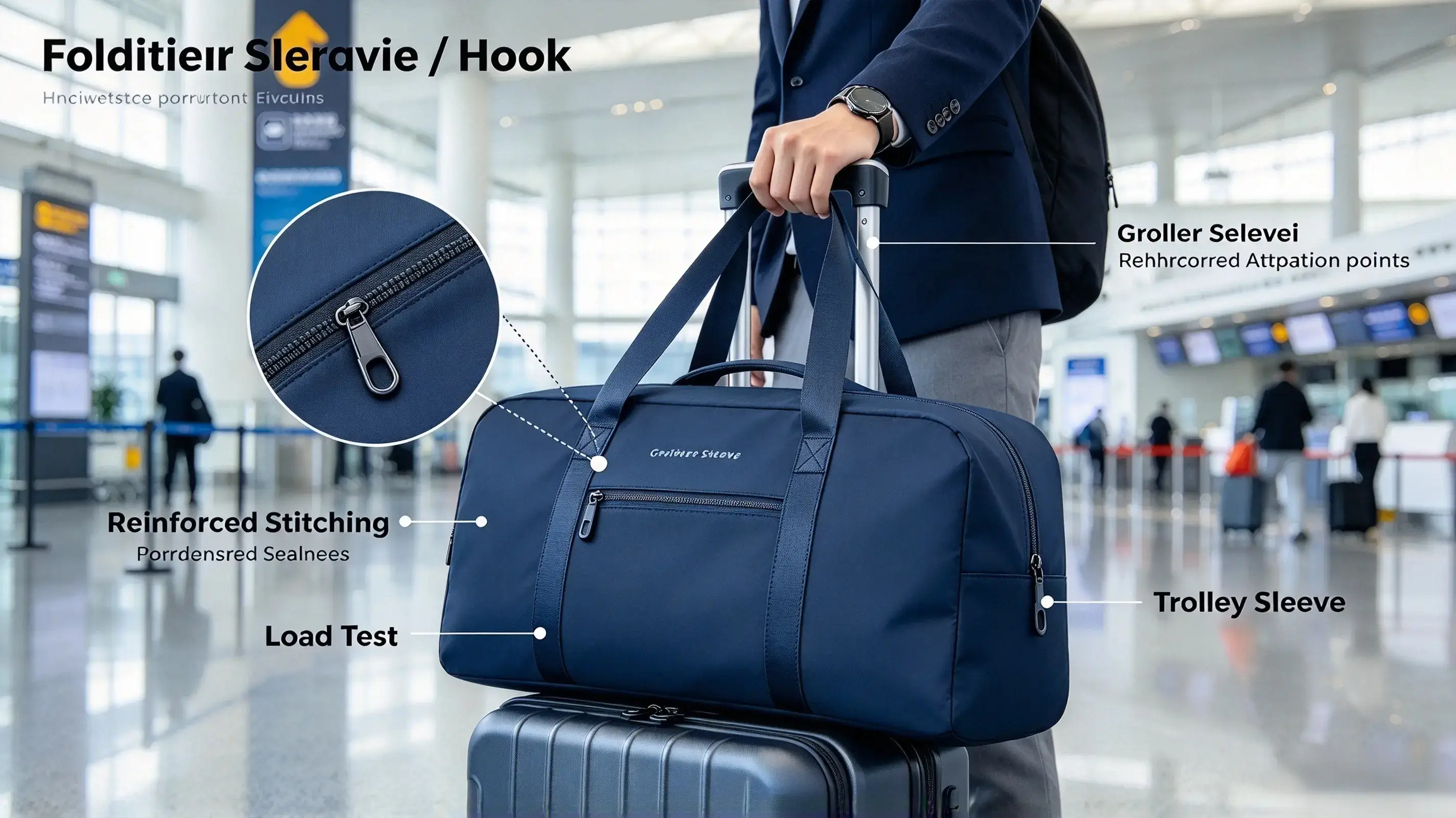
Many foldable formalwear bags are designed with a hook or sleeve that can attach to a suitcase handle. This feature is useful for short-distance movement through an airport, but it is not intended for dragging the bag throughout an entire journey.
Continuous bumps and twisting while pulling the bag can put stress on the hook attachment points and accelerate wear around the folding hinges.
The hook stitching is a key load-bearing area. XINHUI uses double-row reinforced stitching at this point and conducts load-bearing shake tests to reduce the risk of tearing during everyday use. The testing process follows commonly used quality-control practices in the luggage industry.
When evaluating the best garment bag for travel, features such as reinforced hook stitching may seem minor, but they can have a significant effect on durability.
Finding the best garment bag for travel
After looking at these details, you can select a foldable storage bag that matches your travel frequency and the types of clothing you normally carry.
The same garment bag can perform very differently depending on how it is packed and used. There is no single design that works perfectly for every travel situation.
Even a product that has gone through complete prototype testing can still develop creases or exceed the airline’s size limits if the user overpacks it.
For buyers searching for the best garment bag for travel, actual packed dimensions, clothing type, packing habits, and airline requirements all need to be considered together. Empty-bag specifications alone do not tell the whole story.
If you need to place a bulk order for foldable garment storage bags, please contact our team.
FAQ
Q1: Can a suit bag foldable design hold a wool suit directly, or should I use a garment cover?
A: We do not recommend letting wool formalwear come into direct contact with the inner lining of the bag. Friction and movement during travel can cause the fabric to develop fuzz or pilling. Loose fibers can then collect on the lining and transfer to the next garment you pack.
Placing the suit in a thin dry-cleaning garment cover before putting it into the bag can reduce friction without noticeably increasing the overall thickness.
Q2: In a three-fold foldable garment bag, how do different types of hangers affect suit creasing?
A: Thin metal hangers from dry cleaners can press against the shoulders when folded inside a three-fold bag, and their narrow edges may leave pressure marks. Wide-shoulder plastic hangers with rounded edges are a better choice.
Wooden hangers are relatively heavy and can increase downward pulling inside the bag, so they are better suited to two-fold designs.
Q3: What can go in the outer pockets, and what should be kept out?
A: Lightweight small items such as boarding passes, note cards, ties, and cufflinks are suitable for the outer pockets.
Bulky shoes and hard-sided toiletry or cosmetics cases should stay out of the outer pockets. They can create local bulges, change the bag’s intended flat folding shape, and put extra pressure on the clothes, causing unwanted creases.
For anyone researching the best garment bag for travel, the key is to judge the bag after it has been packed, not just when it is empty.
Why Can a saggy bag Look Fine Until It Is Half Empty?
Related Article


