
Are Corduroy Bags Really Better With Zippers?

Crowded buses during rush hour can make it easy for keys, earphones, and other small items to slip out of a bag. That’s why many people choose corduroy bags for added security, specifically looking for a corduroy tote bag with zip. But once the bag arrives, some of the problems that show up in everyday use are things that promotional pages rarely mention.
Corduroy Tote and Everyday Use
A corduroy tote has a retro look and enough room for a 13-inch laptop and a few folders. Many people assume that choosing a zippered design will completely prevent their belongings from slipping out. In reality, other wear-related issues can appear.
With a corduroy tote bag with zip, the weak points are often not the corduroy fabric itself, but the interaction between the zipper hardware and the raised surface of the fabric. Some users find that after repeated opening and closing, the zipper teeth can catch on the corduroy ribs and pull out tiny fibers. If the bag is regularly overloaded with heavy items, the stitching along both sides of the zipper is put under greater tension, which can eventually cause localized loose threads or seam damage.
Cotton vs. Blended Fabric
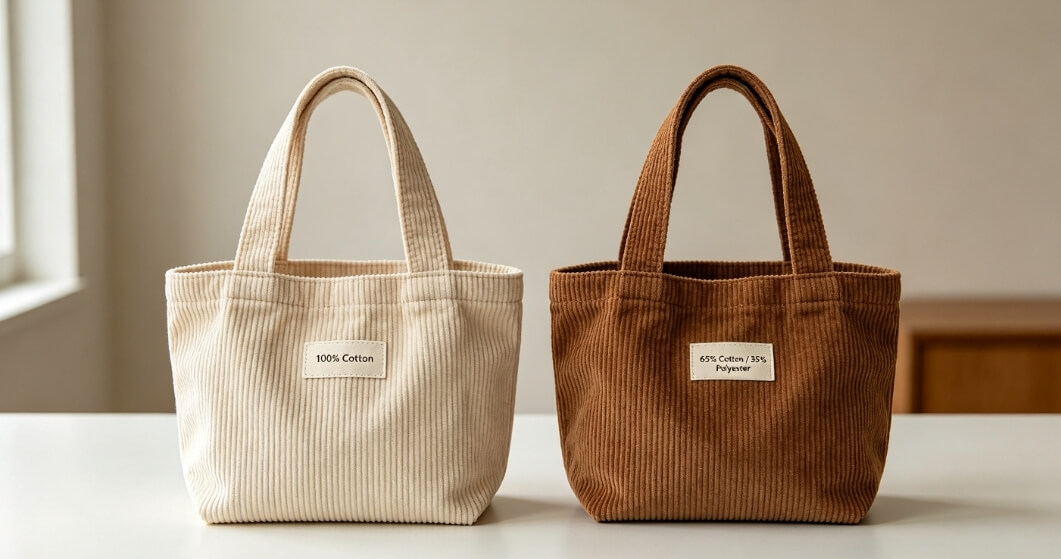
Corduroy bags generally come in two common fabric types: 100% cotton and cotton-polyester blends. The fabric label will show the fiber composition, and publicly available textile information indicates that the two materials can perform differently when used for bags.
100% cotton corduroy has fuller, softer ribs, but a new bag may shed loose fibers more easily. Over time, a heavily loaded cotton corduroy tote is also more likely to lose its shape and become soft or saggy.
A commonly used blend is 65% cotton and 35% polyester. This material tends to shed less and offers better resistance to deformation, although it can feel slightly firmer. Neither option is universally better. The right choice depends largely on how much weight you normally carry.
Using a Corduroy Tote Bag With Zip Properly
If you use a corduroy tote bag with zip, avoid keeping it loaded with excessively heavy items for long periods. Constant overloading puts extra strain on the zipper track, which can make the zipper harder to operate and accelerate wear along the side seams.
If you regularly carry heavy books, tools, or similar items, don’t rely on the bag’s capacity alone. Consider whether the fabric, stitching, and zipper hardware are actually designed to handle that amount of weight.
When the zipper starts sticking, don’t force it. A small amount of colorless solid paraffin wax can be applied to the zipper teeth as a lubricant. Avoid colored candles, as their pigments may stain the corduroy surface.
Spray lubricants should not be applied directly to the corduroy ribs. Oil can seep into the gaps between the ribs and leave marks that are difficult to remove.
When storing a corduroy tote, you don’t need to keep the zipper fully closed all the time. Keeping it tightly closed for long periods can put continuous stress on the fabric seams and accelerate localized deformation. Store the bag in a cool, dry place and loosely fill the inside with waste paper to help it maintain its shape.
How to Choose Better Corduroy Bags
Most shopping guides focus on color, styling, and basic cleaning instructions. Far fewer explain how to assess zipper hardware and construction.
When choosing corduroy bags, you can check two simple details.
First, the zipper tape should be securely stitched to the body of the bag, with neat and evenly spaced stitches. Second, the zipper stops at both ends should be properly finished, without sharp burrs or protruding edges. These rough spots can repeatedly rub against the corduroy surface and damage the raised ribs.
Understanding the differences between fabrics and knowing the practical limits of your bag can prevent most avoidable damage. However, corduroy is still a fabric with inherent limitations. Areas exposed to frequent friction will gradually show signs of wear. This is normal material wear and cannot be eliminated completely.
FAQ

Can Dye Transfer Damage a Light-Colored Corduroy Tote Bag With Zip?
Q: What should I do if dye from my jeans rubs onto a light-colored zippered corduroy bag?
A: If dye transfer occurs, avoid soaking the entire bag. Mix a mild detergent with cold water, then use a clean cotton cloth to gently dab the stained area. Move to a clean section of the cloth as it absorbs the transferred dye, rather than rubbing the corduroy back and forth. After treatment, let the bag air-dry in a well-ventilated place. For stubborn stains, professional textile cleaning is recommended.
Can a Liner Be Used Inside a Corduroy Tote?
Q: Can I use an organizer or liner inside a corduroy tote without damaging the fabric?
A: Yes. A soft fabric liner is generally suitable. Avoid rigid plastic organizers or liners with rough edges, as hard corners can move around inside the bag and repeatedly rub against the corduroy ribs, eventually flattening them. The liner should also not be oversized, since forcing an overly large insert into the bag can keep the body stretched and cause it to lose its shape.
How Should Corduroy Bags Be Stored in Summer?
Q: What should I keep in mind when storing corduroy bags in a hot environment during summer?
A: Avoid keeping the bag sealed inside a hot, poorly ventilated cabinet for long periods. In hot and humid conditions, residual body oils and dust can encourage mold growth. Before storage, brush away surface dust and make sure the bag is completely dry. Avoid sealing it in a plastic bag for extended periods; allow sufficient airflow instead.
Why Does Your pvc bag Age So Fast? Avoid These Mistakes
How Can a Velvet Bag Stay Soft and Spotless?
Related Article


