
Why Can coated canvas Resist Splashes but Still Be Kept Out of the Rain?
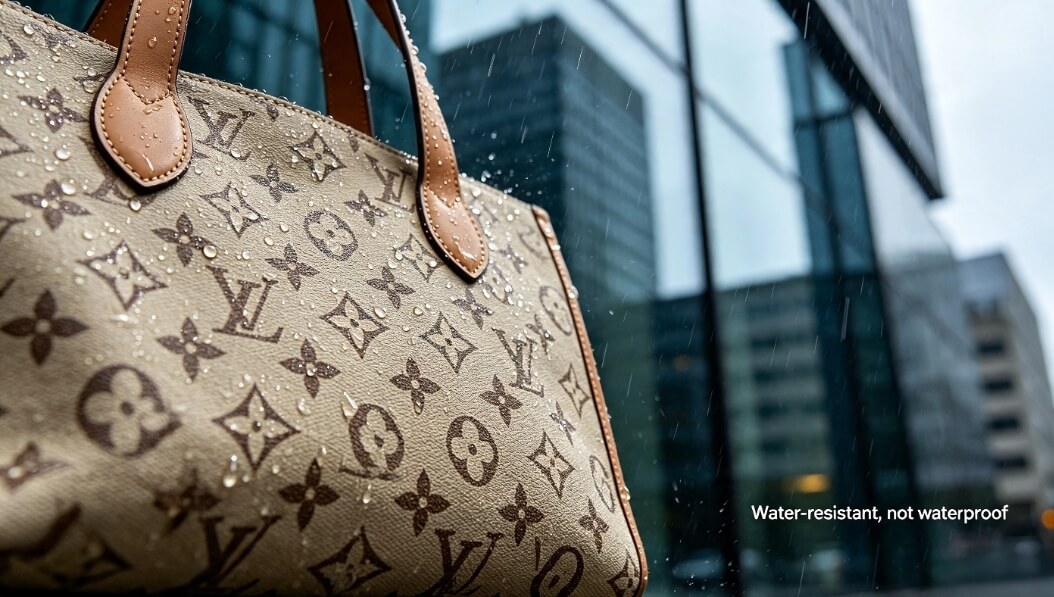
Many people searching for what is coated canvas are really asking a practical question: What should I do if I’m carrying a bag made from this material and it starts raining?
The answer is quite different from what many people assume. On the Australian website of Louis Vuitton, the product pages for the Neverfull MM Monogram and Noé bucket bag give clear care instructions for Monogram coated canvas : keep the product away from moisture, avoid direct sunlight, and keep it away from heat sources. The official wording is simple: ‘Keep your product away from water.’
If the bag accidentally gets wet or dirty, the recommended approach is to gently blot it dry with a light-colored, lint-free absorbent cotton cloth. Soap and all types of solvents should not be used.
In other words, the A$3,400 Noé bucket bag is made with a Monogram coated canvas body, natural cowhide leather trim, a textile lining, and four metal bottom studs. The coated canvas can handle brief splashes, but the brand still explicitly advises against exposing the bag to rain.
That is the key distinction with coated canvas: splash-resistant does not mean waterproof.
What Is Coated Canvas?
At its core, what is coated canvas comes down to a three-layer composite material rather than genuine leather.
1. Base fabric
The base is usually cotton canvas or polyester canvas. It provides tear resistance and gives the bag its structure and stiffness.
2. Coating layer
The coating is typically PVC or PU resin. It provides basic splash and stain resistance while also serving as the surface that carries printed patterns.
3. Leather or synthetic trim
Most luxury handbags use natural cowhide leather for handles, piping, and other structural details.
Strictly speaking, a coated canvas bag body is not leather. However, its handles and trim are often made from genuine leather.
This also explains a familiar phenomenon with Louis Vuitton bags: the Monogram canvas body can remain usable for decades, while the leather handles and trim often darken and develop a patina much earlier. They are two completely different materials, so they age in very different ways.
PVC vs. PU Coating

| Factor | PVC coating | PU coating |
|---|---|---|
| Feel | Relatively firm, with a noticeable plastic feel | Softer and closer to the feel of leather |
| Splash resistance | Excellent | Moderate; high-density modified PU can provide better water resistance |
| Weight | Around 30%–50% lighter than an equivalent all-leather construction | Even lighter |
| Environmental profile | Difficult to degrade and associated with greater environmental concerns | Lower environmental burden, but still a synthetic polymer |
| Typical applications | LV Monogram, Damier and other luxury coated fabrics | Mid- to high-end contemporary handbags and commuter bags |
Three Weak Points of Coated Canvas
1. Extreme cold can cause PVC cracking
PVC relies on plasticizers to stay flexible at normal temperatures. When temperatures drop sharply, plasticizer activity decreases and migration or crystallization can occur, making the coating more brittle.
At the same time, the coating and canvas substrate expand and contract at different rates. Repeated exposure to large temperature swings can build up internal stress and eventually create fine surface cracks.
Cases seen in the luggage-repair industry suggest that conventional PVC-coated canvas is not ideal for long-term use in sub-zero conditions.
Practical tip: If you live in a cold region, avoid taking a bag directly from a warm indoor environment into extreme cold. Repeated temperature swings of more than 40°C can gradually shorten the service life of the PVC coating.
2. PFAS regulations are reshaping the supply chain
This is a policy change that exporters need to pay close attention to in 2026.
California’s AB 1817 took effect in January 2025 and restricts the sale of textile products containing regulated PFAS, with an initial threshold of 100 ppm and a stricter 50 ppm threshold scheduled for January 2027. New York, Maine, Vermont, Washington and other states have introduced similar restrictions.
The important distinction is that these regulations target PFAS used in water- and oil-repellent textile finishes, not PVC or PU coating materials themselves.
That creates two practical consequences:
- coated canvas bags sold in the U.S. that use PFAS-based water- and oil-repellent treatments may face future compliance and customs risks.
- Buyers can ask suppliers whether the fabric uses a PFAS-free, fluorine-free treatment. Major brands are already updating their formulations and supply chains.
The broader industry direction is clear: fluorine-free C0 water-repellent finishes are increasingly becoming the preferred alternative to traditional PFAS-based treatments.
3. The weakest point is often the construction, not the coating
For many coated canvas bags, the fabric itself is surprisingly durable. Some vintage Louis Vuitton Speedy bags from the 1990s are still in regular use.
The components that tend to show wear first are usually:
- Natural cowhide leather trim: Sensitive to oils, cosmetics and sunlight, and highly prone to absorbing color.
- Edge paint: The resin-based finish can become sticky, crack or peel as it ages.
- The coating itself: Cracking is more likely after prolonged exposure to moisture or extreme cold.
The real service-life equation for a coated canvas bag is therefore less about the canvas itself and more about how well the leather trim is maintained.
With proper care, a coated canvas bag can remain in good condition for 20 years or more. But once the leather trim becomes badly worn or damaged, the overall appearance can deteriorate dramatically even when the fabric remains intact.
Three Questions Before Buying a Coated Canvas Bag
1. What is the climate like where you live?
Do you deal with high humidity or large temperature swings?
During long, humid rainy seasons, use desiccants and store the bag in a dry environment. In winter, avoid sudden transitions between warm indoor air and freezing outdoor temperatures.
2. Can you follow the care instructions?
If the bag gets caught in the rain, blot it dry immediately rather than rubbing it aggressively.
Louis Vuitton specifically advises against soap and solvents. Baby wipes, alcohol wipes and melamine ‘magic erasers’ can also damage the coating.
3. Are you comfortable with natural leather changing color?
Natural cowhide gradually changes from pale beige to a deeper caramel tone. This patina is a normal aging process, not damage.
If you strongly prefer trim that stays consistent in color, a PU-coated bag with synthetic leather trim may be a better fit.
XH-D101 Tote: A Different Approach to Coated Canvas

The issues above are common across the coated canvas category. The XINHUI XH-D101 tote offers a different approach to addressing some of them.
Its body uses a durable printed coated fabric. The basic concept is similar to traditional coated canvas : the base fabric provides strength, while the coating carries the print and provides basic protection.
The design makes several deliberate trade-offs:
- Synthetic leather handles: They avoid the oil sensitivity, color transfer and maintenance demands of natural cowhide. They are less prone to discoloration and are easy to maintain, while remaining soft and flexible when carrying heavier items.
- Rust-resistant hardware: The zipper is designed for smooth operation in humid conditions, helping address common rust and sticking issues in rainy climates.
- 46 × 13 × 28 cm capacity: The interior can accommodate a 13–15-inch laptop and A4 documents. A full-length top zipper provides additional security for personal belongings.
- Full customization: Patterns, logos, colors, dimensions and interior compartments can all be customized, making the bag suitable for corporate gifts, promotional merchandise and branded business use.
The XH-D101 does not attempt to replicate the classic Louis Vuitton Monogram aesthetic. Instead, it takes a different route, combining low-maintenance synthetic leather components, a zip-top tote structure with better privacy, and flexible customization.
It is designed for business commuting and corporate gifting rather than as a replacement for a classic luxury handbag. For buyers looking for durability, easy maintenance and custom branding, it offers a different value proposition.
The Future of Coated Canvas: PFAS-Free Is Becoming the Baseline
Environmental regulations around the world are becoming stricter, and simply applying a PVC coating is no longer enough to define a competitive material solution.
The long-term direction for coated canvas is increasingly clear:
- Gradually replace solvent-based, high-VOC PU coatings with water-based PU.
- Replace traditional PFAS-based water- and oil-repellent finishes with C0 fluorine-free alternatives.
- Provide complete compliance documentation, including PFAS-free declarations and testing certificates such as OEKO-TEX.
Ultimately, what is coated canvas is more than a question about whether a fabric can handle a splash of water. It is a composite material with its own strengths, limitations, care requirements and evolving regulatory landscape.
The most important takeaway is simple: coated canvas can resist brief splashes, but that does not make a coated canvas bag suitable for prolonged exposure to rain.
Valentines Gift Bag Bigger Isn’t Always Better
mesh tote bags for Every Trip: 3 Styles Worth Knowing
Related Article


