Why Do bulk orders Pass Samples but Fail Inspection?
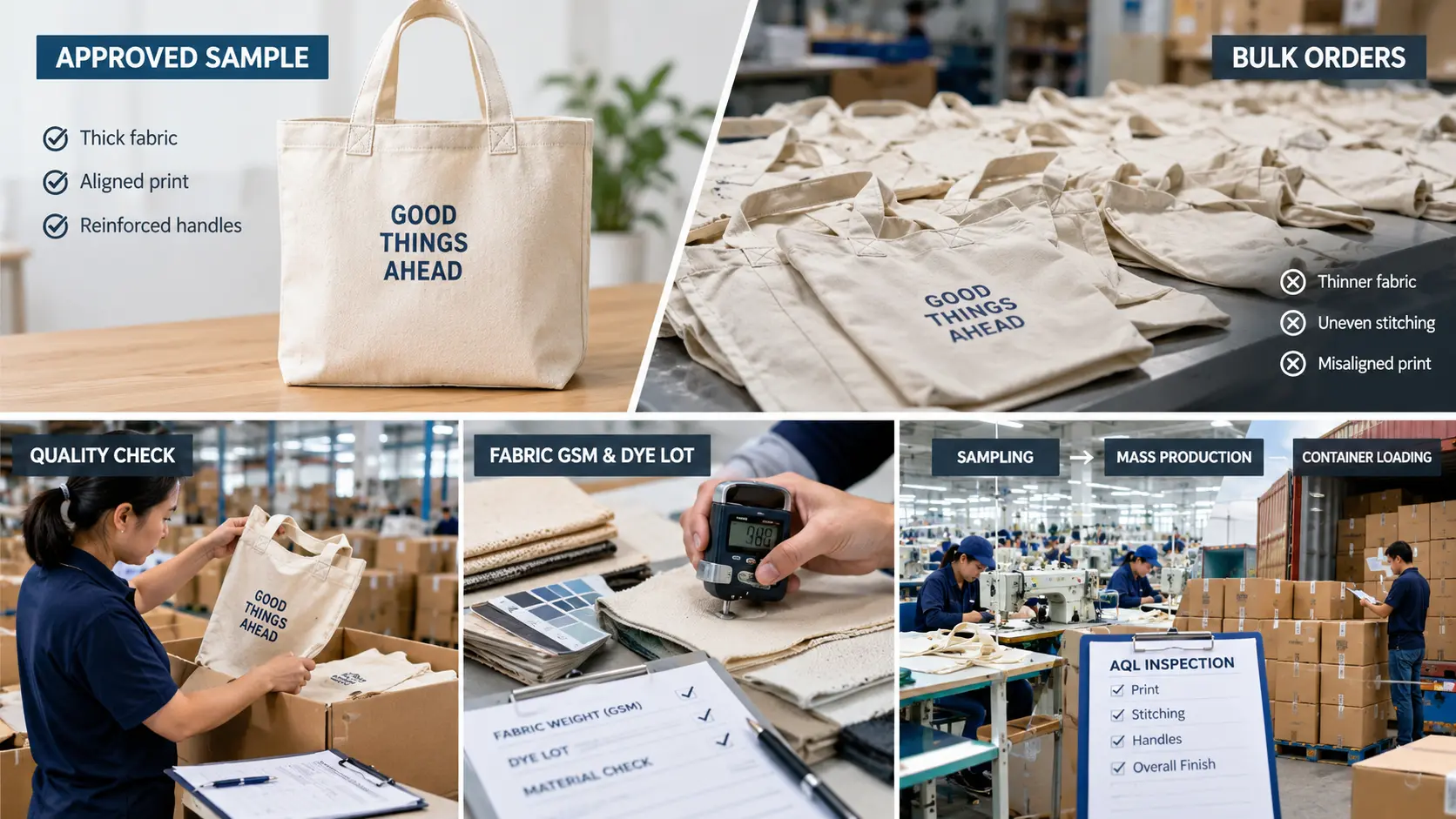
When the warehouse team opened the container, the canvas bag samples felt thick and sturdy, the prints were properly aligned, and the handles were reinforced as expected. But once the same batch of bulk orders was unpacked and laid out, some bags had noticeably thinner fabric, while the handle stitching varied in density from one bag to another. The goods could not be put on retail shelves as planned.
Many cross-border buyers and promotional-product purchasers have run into this kind of problem. A signed-off sample may look perfect, yet it does not always provide enough control over the quality of the final shipment.
Why bulk orders Can Differ From Approved Samples
Many buyers assume that once wholesale suppliers deliver an approved sample, the entire production run will follow exactly the same standard.
In practice, when working with canvas bag manufacturers, sampling and mass production often operate as two separate systems. A difference between the sample and the finished goods does not necessarily mean the manufacturer intentionally switched to cheaper materials.
Some canvas bag factories have a dedicated sample room. Samples are made by experienced sample technicians using small quantities of higher-grade fabric and complete sets of trims and accessories. They may spend as much time as necessary refining a single piece.
Mass production, on the other hand, is usually handled by regular production teams. After receiving bulk orders, some suppliers may also outsource part of the sewing work. The full standards used in the sample room may not be passed on properly to external production teams.
In some cases, the approved sample and paper specification sheet remain with the sampling department, while outside sewing workers rely only on verbal instructions. This situation is more common when working with wholesale suppliers on small orders of only a few hundred pieces.
What to Check With canvas bag manufacturers
When working with canvas bag manufacturers, do not rely only on the physical samples they send you. Several verification steps can be carried out during the communication and production process.
Check Whether Production Is Actually In-House
First, ask whether every sewing process is completed inside the manufacturer's own factory.
If any work is outsourced, ask the supplier to provide the name of the subcontracting unit in writing and explain exactly how production standards are communicated to that outside team. Do not rely on verbal assurances alone.
Control Fabric Before Production Starts
Second, do not leave all quality control to the final finished-product inspection.
At the fabric receiving stage, verify fabric weight, lot or dye-batch records, and other incoming-material details. Within the same bulk orders, canvas from different dye lots should not be mixed and cut without approval.
When fabrics from different dye lots are mixed, color variation can appear even within the same carton. A single fabric roll may match the approved sample perfectly, while the finished shipment still shows noticeable shade differences across the full production batch.
XINHUI's internal quality-control process covers the entire chain, from incoming fabric inspection and in-line production checks to AQL-based finished-product sampling and packaging inspection. Container-loading supervision can also be arranged when required, helping identify problems before shipment.
Set Realistic Expectations for Small-Batch Orders
Third, buyers placing small bulk orders need to adjust their expectations accordingly.
Many wholesale suppliers cannot reserve a complete stock of fabric from the same dye lot exclusively for an order of only a few hundred pieces. Instead, they may need to use assorted fabric rolls and small quantities of hardware from warehouse stock.
Production lines also have to switch styles more frequently, and changing machine settings takes time. As a result, variation between individual pieces within the same batch can become more noticeable.
A custom bag manufacturer with a well-established supply chain can handle smaller production runs more systematically. XINHUI offers small-batch customization, with sample development typically completed within 3–5 working days and quotations and artwork provided within 24 hours. Lead times can be kept under control, with large orders completed in as little as 30 days. Available finishing options include screen printing, embroidery, embossing, and other surface treatments.
How bulk orders Avoid Material Mix-Ups
Some quality issues are not caused during cutting or sewing.
A canvas bag may pass all sewing and printing inspections, yet still develop heavy creases or become stiff after being tightly packed inside cartons and exposed to changing humidity during ocean transportation.
Once the goods arrive, buyers may assume the problem happened during manufacturing.
Before shipment, ask the supplier to provide photos of the actual packed cartons. Confirm the folding method and the number of bags loaded into each carton. This can help reduce appearance-related damage caused by packing, handling, and transportation.
How bulk orders Avoid Shipping Damage
Purchase orders should include clear clauses covering material substitutions, mandatory disclosure of outsourced production, and acceptable inspection tolerances.
Sample requirements agreed verbally provide little protection when a dispute arises. The signed and approved physical sample should therefore be archived as an attachment to the purchase order and treated as part of the agreed specification.
Completing all of these checks can significantly reduce the gap between approved samples and delivered goods.
That said, fabric products cannot realistically be made to look and feel completely identical piece by piece. Some variation is inherent in cotton yarn, dyeing processes, and other raw-material conditions. Even thorough checks before production cannot eliminate every possible risk.
FAQ
Q1: If I already have a third-party factory inspection report, do I still need to check dye lots and packing records myself?
Yes.
Third-party inspection reports are generally based on selected samples. A passing report does not automatically mean that every fabric dye lot and every packing method meets the agreed requirements.
Issues in uninspected batches or risks introduced during storage and transportation may not appear in the inspection results. Dye-lot records and packing details still need to be verified separately.
Q2: If a wholesale suppliers says, “We will use exactly the same materials as the last order,” can I skip the pre-production sample for a repeat order?
No.
When a repeat order is placed after a period of time, the original yarn and hardware inventories may already have been used up. Even when the design remains unchanged, the material batches may be different.
A repeat order should still be based on a newly confirmed pre-production sample rather than relying entirely on the standards from the previous batch.
Q3: How can I quickly tell whether a slight difference in canvas feel is normal fabric variation or a reduction in material specifications?
Check the fabric-weight test records for the entire production batch and compare them with the GSM requirement stated in the order.
If the fabric weight remains within the agreed tolerance range and only a slight difference in hand feel is noticeable, that would generally fall within normal textile variation.
If the fabric weight consistently falls below the agreed lower limit, the material specification has deviated from the order and should not be treated as a normal process variation.
Working with experienced canvas bag manufacturers and reliable wholesale suppliers can reduce these risks, but clear specifications, written requirements, production-stage checks, and shipment controls remain essential for protecting bulk orders.
Why Is the Quality of Custom Bags So Poor?
Related Article