
Can bag embroidery Go Wrong Even on Good Canvas?
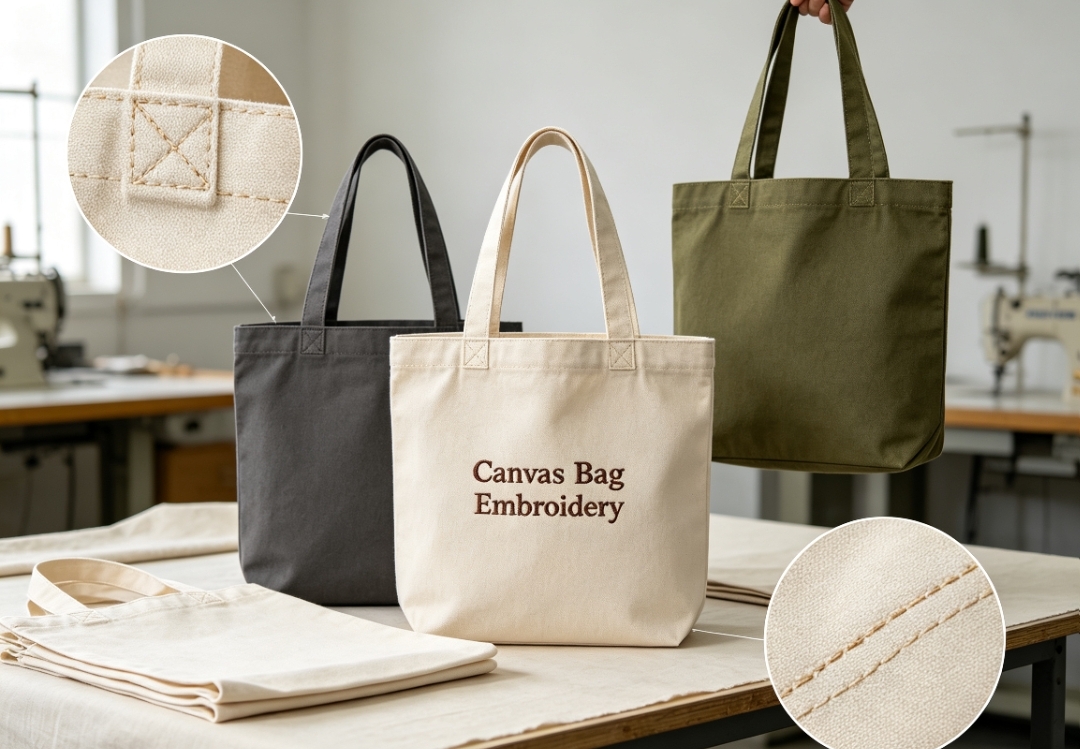
When a batch of canvas tote bags arrives for processing, many people simply choose a good-looking fabric, place the design right in the center of the bag, and start production. By the time the bag embroidery is finished, the fabric has already pulled and wrinkled. After just a few uses, the stitches start coming loose.
The problem usually isn't the complexity of the design. It's choosing the wrong base fabric and embroidery placement.
When selecting a canvas bag with embroidery, don't judge it by appearance and hand feel alone.
Cotton, poly-cotton, and rPET recycled canvas can perform very differently after embroidery.
10 oz canvas has a relatively loose weave and is best suited to small logo embroidery. Large embroidery designs can easily distort the fabric. 12 oz canvas is a versatile choice for small embroidered logos because it offers more stable fabric tension. 14–16 oz canvas has a denser weave and is better suited to heavy, full-coverage embroidery, with less risk of the fabric twisting or warping.
Choosing the Right Fabric for bag embroidery
Cotton canvas has a soft hand feel and moderate recovery after embroidery. Its typical shrinkage after washing is around 3%–5%. For better material safety, batches with OEKO-TEX Standard 100 certification are preferable.
Poly-cotton canvas has lower shrinkage and better wash durability, making it suitable for embroideried purses and bags designed for long-term, repeated use. The trade-off is that heavily embroidered areas can feel somewhat stiff because of the fabric's density.
rPET recycled canvas should be tested with an embroidery sample before bulk production. Evenly spun rPET can work well for bag embroidery, but if the fabric has inconsistent tension across the weave, skipped stitches can occur. In that case, a cut-away stabilizer should be used to reinforce the fabric. Recycled material batches with GRS certification generally offer better consistency.
Best Placement for bag embroidery
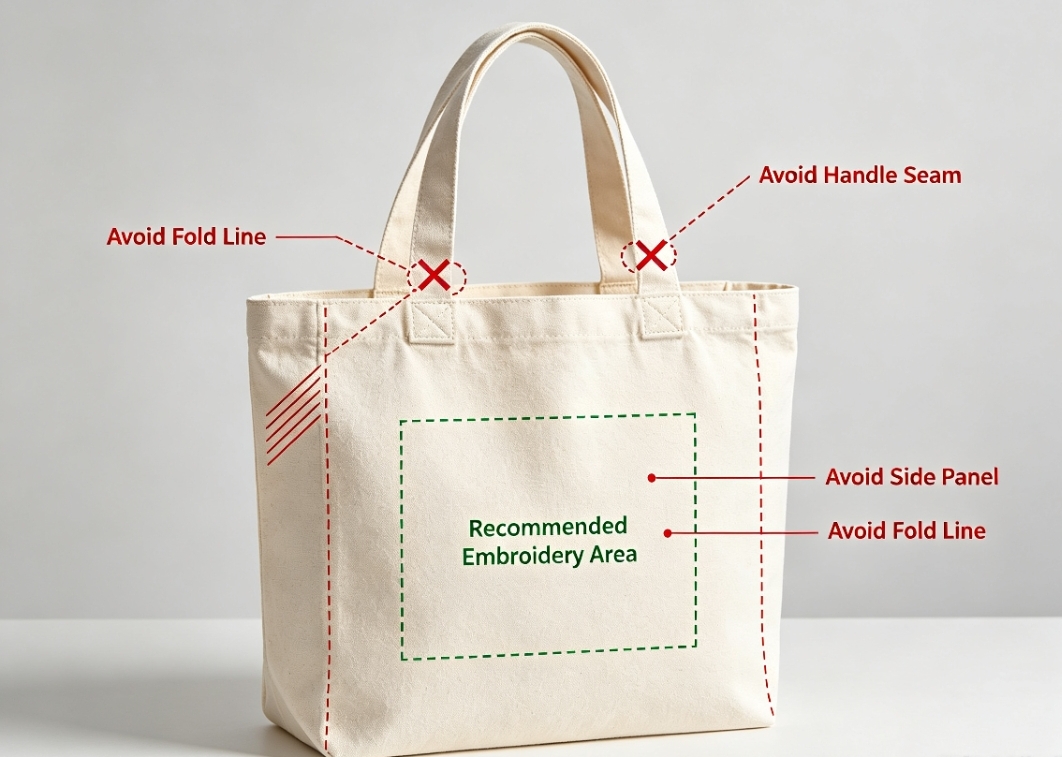
The center of the bag isn't automatically the best embroidery location.
The fold line on the front panel and the area where the handles are sewn to the bag are both areas to avoid. These sections are repeatedly bent and put under stress, which can gradually pull on the stitches and eventually cause them to break.
A better position is the lower section of the front panel, away from the top fold and opening. This area experiences less stress, requires less embroidery reinforcement, and generally produces a more durable finished product.
Large embroidery designs are not recommended on the side panels. These areas experience greater stretching and pulling during use, which increases the risk of distortion and thread breakage.
Common bag embroidery Problems
Most bag embroidery problems can be traced back to the sampling stage.
Wrinkled fabric: The root cause is often insufficient stabilizer support rather than poor thread quality.
Broken stitches: Thread quality matters, but fabric weight must also be checked. Forcing a high stitch count onto lightweight canvas is very likely to cause this problem.
Misaligned designs: This often happens when embroidery is done after the bag has already been sewn. The weight and structure of the finished bag can pull on the fabric while it is being embroidered.
The better approach is to complete the embroidery while the fabric is still in cut-panel form, then sew the panels into the finished bag. Lightweight fabrics should be paired with an appropriate stabilizer, and embroidery density should be kept within a reasonable range.
FAQ
Does rPET canvas need both GRS and OEKO-TEX certification?
Not necessarily. GRS certifies the use and content of recycled materials, while OEKO-TEX Standard 100 focuses on testing for harmful substances.
If the customer only requires proof of recycled or environmental attributes, GRS may be sufficient. For basic textile safety requirements, especially for export products, OEKO-TEX Standard 100 is often requested. Some international orders require both certifications.
Does embroidering cut panels first increase production time?
Cut-panel embroidery doesn't require the finished bag to be supported on the machine, so the embroidery itself is usually faster.
However, it adds an extra step for sorting and managing the cut panels. As a result, total production time may increase slightly. This impact is more noticeable on smaller orders.
Should canvas embroideried purses and bags use tear-away or cut-away stabilizer?
For small logo embroidery, tear-away stabilizer is usually a good choice. Once embroidery is complete, the excess stabilizer can be removed, leaving the inside of the bag lighter and softer.
For large, heavy embroidery designs, a cut-away stabilizer is the better option. It continues to support the fabric after embroidery and helps reduce the risk of puckering.
Choosing the right fabric, stabilizer, and embroidery placement before production is the key to making durable embroideried purses and bags without unnecessary rework.
How to Choose the Right Bag for Everyday Campus Life
Can a custom eva bag Really Handle a Beach Day?
Related Article


