
Backpack Mold: When a Moldy Backpack Is Beyond Saving

Backpack Mold Can Happen Fast
Backpack mold is surprisingly easy to end up with. After a long weekend hike, you’re too tired to unpack. During weeks of rainy commutes, the bag gets shoved into the back of the closet and forgotten. The next time you unzip it, a damp, sweet-sour smell hits instantly. Suddenly, a moldy backpack is no longer somebody else’s bad luck online—it’s the old sticker-covered bag sitting in your hands.
Search for answers online and you’ll usually see two extremes. One side says to throw it away immediately and stop risking your health. The other casually suggests wiping it with vinegar and carrying on like nothing happened. One reaction is overly dramatic; the other is irresponsibly simplistic.
Seeing white mold on backpack fabric is enough to make most people nervous. That white fuzzy or powdery layer immediately looks suspicious, and people often assume it’s some kind of toxic black mold. In reality, though, that white residue often isn’t mold at all.
This isn’t another fake “three-step mold removal hack.” The point is to help you judge the situation realistically. Everything comes down to two questions: Should I throw away a moldy backpack? And how do you get mold out of backpack materials properly—assuming the bag is still structurally salvageable and not already suffering irreversible chemical breakdown?
Backpack Mold Inspection Comes First
Before cleaning anything, spend a few minutes inspecting the backpack carefully. The biggest problem with most mold-cleaning guides online is that they immediately jump into scrubbing without explaining when it’s already time to cut your losses.
Start by checking where the mold is growing. If it’s only a small gray-green patch on the outer base or front pocket, the backpack mold is probably manageable. But if the mold has spread along stitching lines, inside seams, or around zipper edges, cleaning becomes much more complicated.
The most serious warning sign is the Foam Back Panel. Press on it. If a sour, musty smell pushes out from inside the foam, or if you can visibly see mold spreading into the pores, stop wasting your time cleaning. At that point, you should skip ahead and seriously consider the question: Should I throw away a moldy backpack?
Next, inspect the lining. Run your fingers along the semi-transparent waterproof PU coating inside the bag. If it feels sticky or leaves behind white flaky dust known as Chalking, then the problem is bigger than mold. That’s PU Hydrolysis.
In plain English, the material itself is chemically breaking down. Moisture has started destroying the polyurethane chains, releasing acidic compounds that feed fungal growth. Even if you wipe away the visible mold, the “food source” is still there. That means the moldy backpack smell will keep returning.
Don’t forget the Zipper Tape either. Open every zipper and inspect the dark woven fabric around the teeth. Mold loves hiding there. If you notice faint black-gray streaks inside the tape, the spores have already penetrated deep into the woven core. Surface cleaning alone won’t fix it.
White Mold on Backpack or Something Else?
When people notice white buildup on a bag, panic usually starts immediately. But before assuming it’s dangerous white mold on backpack fabric, you need to identify what you’re actually looking at.
Most of the time, it falls into one of three categories.
True Mold
Real mold has depth and texture. It looks fuzzy, soft, and slightly damp, with blurry edges spreading outward. It smells unmistakably musty. This is genuine white mold on backpack fabric.
Salt Residue
Sweat salt buildup looks completely different. It resembles powdered sugar or frost, feels gritty, dissolves in water quickly, and smells more sour-salty than moldy.
PU Chalking
This one gets misidentified constantly. Aging PU coatings can degrade into chalky white residue. It feels like chalk dust, doesn’t dissolve in water, and leaves the surface underneath rough and sticky. Sometimes it even smells slightly like spoiled yogurt.
The easiest test is using a damp paper towel.
- If it dissolves, it’s salt residue.
- If it smears but stays sticky, the coating is degrading.
- Only the fuzzy cotton-like growth with blurred edges is actual white mold on backpack material.
Getting this right matters. Otherwise, you’ll spend hours treating the wrong problem.
Backpack Mold Cleaning That Actually Works
If the backpack passed inspection—meaning the mold is limited to surface fabric or seams, the foam padding is still clean, and the PU coating isn’t sticky—then the bag is probably worth saving.
The key to how to get mold out of backpack materials isn’t finding some miracle cleaning spray. The real issue is understanding that a backpack has multiple layers, and each layer traps contamination differently.
Preparation
Never clean mold indoors. Take the backpack outside so spores don’t spread around your home.
Wear:
- An N95 mask
- Rubber gloves
You’ll need:
- An old toothbrush for zipper tape
- A soft brass brush for nylon surfaces
- Two microfiber cloths
Step 1: Dry Brushing
Don’t start with vinegar.
First, dry-brush away as much visible mold as possible. Open every zipper and hidden compartment. Think of it like sweeping before mopping.
Adding liquid too early can force spores deeper into the fibers.
Step 2: Vinegar Treatment
For home cleaning, diluted white vinegar is the safest option. Mix one part vinegar with two parts water.
It helps suppress fungal growth and neutralize odors without destroying waterproof coatings the way bleach often does.
Dampen a cloth with the solution, but wring it out completely so it doesn’t drip. Press it against moldy areas for about twenty seconds to let the solution penetrate.
Pay extra attention to the zipper tape. Open the zipper fully and gently scrub along the fabric tape using the vinegar-dampened toothbrush.
This is one of the safest ways to get mold out of backpack seams and nylon fabric without damaging the bag itself.
Step 3: Remove All Residue
This is the step people usually rush through.
If vinegar residue and dead mold particles remain inside the fibers, they can become nutrients for future growth once the bag gets damp again.
Use a clean damp cloth and wipe repeatedly until no yellowish residue transfers onto the cloth anymore.
One important warning: if the PU coating feels sticky but hasn’t started heavily flaking, never soak the backpack in water. Excess moisture accelerates hydrolysis and makes the material degrade faster.
Step 4: Dry the Moldy Backpack Fully
This is the real secret.
Mold can tolerate vinegar surprisingly well, but it struggles to survive complete dehydration.
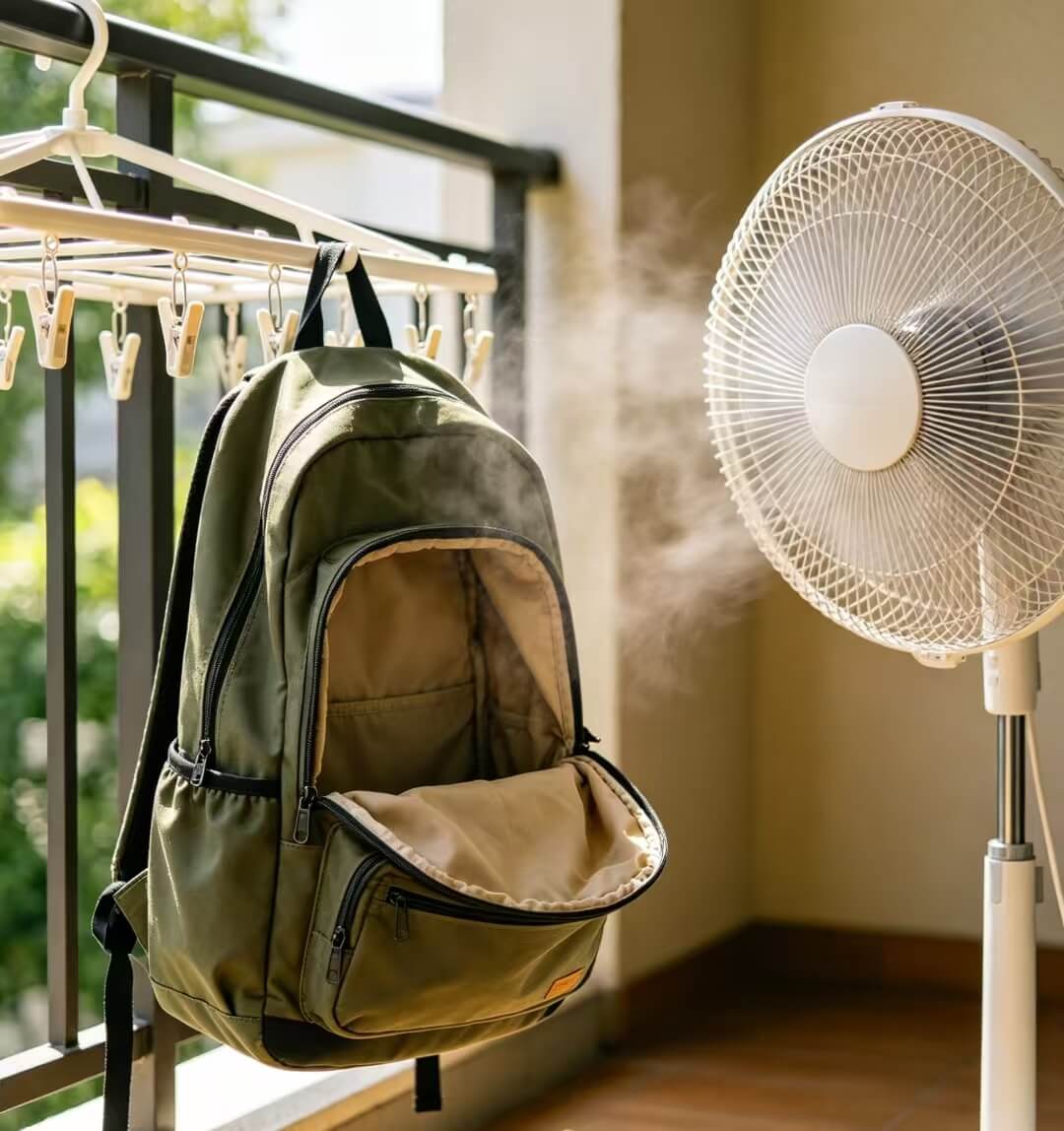
Open every zipper and pull out every hidden pocket. Leave the backpack drying in a cool, ventilated space.
Avoid direct sunlight. UV exposure can weaken nylon fibers and trap internal moisture beneath the coating layers.
A fan works much better. Place dry towels into folded corners to improve airflow inside tight spaces.
How do you know it’s truly dry? Press the thickest part of the back panel. If it still feels cool, moisture is still trapped inside.
Why a Moldy Backpack Smells Again
Sometimes people follow every cleaning step perfectly, but the moldy backpack smell returns a couple of weeks later.
That usually means one of three hidden problems still remains.
Foam Padding Contamination
EVA foam has a porous structure. Once fungal roots penetrate inside, surface cleaning becomes almost useless. This is the same reason mold-contaminated carpet padding is often considered unsalvageable.
Zipper Tape Core Contamination
The outside may look clean, but dormant spores can remain hidden deep inside the woven zipper tape, waiting for moisture to reactivate them.
Plastic Bag Smell Test
After the backpack is completely dry, seal it inside a large trash bag for twenty-four hours.
Open the bag and smell it carefully.
If that stale sweet odor is still there, stop convincing yourself otherwise. The backpack probably isn’t suitable for close daily contact anymore.
Should I Throw Away a Moldy Backpack?
This decision should come down to realistic material condition and health risks—not fearmongering online.
You should seriously consider throwing the backpack away if:
- The Foam Back Panel is contaminated
- The PU lining is sticky, flaking, and chemically degrading
- The bag still smells sour after cleaning
- Someone in your household has asthma or severe allergies
In situations like these, the answer to Should I throw away a moldy backpack? is usually yes.
However, if the mold was only limited to small outer areas and the structure still feels solid, you don’t necessarily need to throw it away immediately.
Just downgrade its purpose.
Don’t keep using it as your everyday commuting bag or let kids carry it. Instead, repurpose it for:
- Garage storage
- Camping laundry
- Dirty gear
- Pet supplies
That way, the bag still has some practical use without staying in close contact with your body.
Backpack Mold Prevention Matters More
The best solution for backpack mold is preventing it in the first place.
Two simple habits make a huge difference:
- After rain or heavy sweating, fully unzip the backpack and let it air out for at least half a day before storing it.
- For long-term storage, place silica gel packs inside and store the bag in a breathable cotton sack instead of a sealed plastic bag.
Plastic traps moisture, and trapped moisture is exactly how backpack mold begins.
At the end of the day, backpack mold isn’t really anyone’s fault. It’s simply what happens when humidity, time, and synthetic materials combine. Whether you keep the bag or throw it away depends entirely on understanding what’s actually happening inside it.
Ignore the internet panic. Trust your eyes and your nose instead.
gaveposer Guide to the Perfect tote bag for gifts
You Probably Don’t Need an Eighth Tote Bag: An Imperfect Confession About zero waste lifestyle
Related Article


