
Why Your Print Color Goes Wrong ?
Choose Fabric Weight for Your cotton bag logo
The weight of a cotton bag, measured in ounces (oz), affects how long it lasts and how good the print looks.
- 4–5 oz lightweight cotton: Best for one-time event giveaways and light grocery shopping. It’s inexpensive, but the bag can start looking worn after 20–30 machine washes.
- 6–8 oz midweight cotton: The standard choice for everyday use. It can carry 15–20 lb without losing its shape, while maintaining consistent print clarity.
- 10–12 oz heavyweight canvas: Built for long-term use and capable of handling hundreds of washes. Ideal for corporate gifts, retail merchandise, and other higher-value applications.
💡 The same cotton bag logo can look and feel completely different on a 6 oz bag versus a 12 oz bag. You can tell the difference immediately when you hold the samples. That’s why experienced bag manufacturers treat ‘sample first, bulk production second’ as a hard rule.
For example, XINHUI generally controls the turnaround from inquiry to sample delivery within 3–5 business days. Its factory is located in Chang’an, Dongguan, with a complete raw-material supply chain within a 5 km radius, allowing it to significantly reduce the time needed to source fabric and accessories.
Fabric Color × Logo Color
Many buyers choose logo color cotton tote bags without considering one important fact: cotton fibers absorb color.
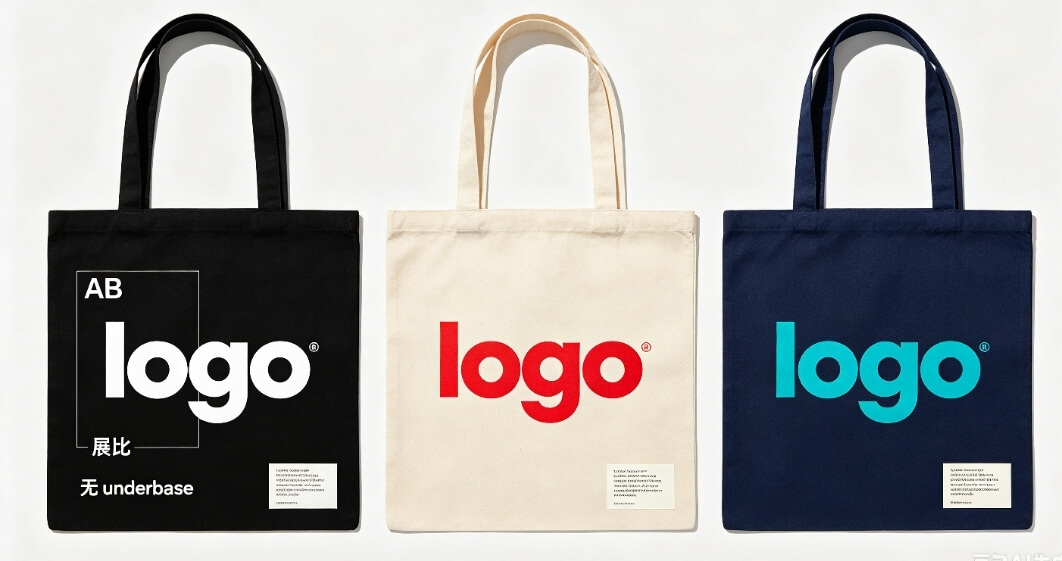
Natural cotton bags (warm cream to beige tones): There is no white underbase, so white ink is absorbed into the fabric rather than sitting cleanly on top. Printed colors will also appear slightly darker than they look on screen. Cyan and magenta may lose some of their vibrancy.
Black or dark-colored bags: A white underbase must be printed first, followed by the brand color. Without this underbase, light-colored logos can be ‘swallowed’ by the dark fabric and appear gray or dull.
Dyed colored bags (black, navy, forest green, burgundy, etc.): Reactive dyes penetrate the fibers and are designed to resist fading during washing. However, custom Pantone colors typically require a minimum order of 500 pieces.
Practical Color-Matching Tips
- Dark logo → Choose a natural or white bag for high contrast.
- Light or white logo → Choose black, navy, or another dark bag, and make sure an underbase is included.
- Brand colors that rely heavily on cyan or magenta → Always request a sample before moving into bulk production.
⚠️ Here’s a detail that factories don’t always mention upfront: the white underbase on dark cotton is essentially an ‘invisible’ extra production step. It adds another printing process, along with additional screen-making and registration costs.
So when you request a quote using your cotton bag logo artwork, make sure the supplier confirms in writing whether the quoted price already includes the underbase. Otherwise, you may end up choosing between a color mismatch and an unexpected surcharge during bulk production.
Minimum Order Quantities and Printing Methods
This is one of the easiest areas to misunderstand when sourcing custom printed cotton tote bags. The traditional assumption is that screen printing requires a minimum order of 50–100 pieces, but today’s manufacturing options are much more flexible.
| Printing Method | MOQ | Best For | Typical Cost Structure |
|---|---|---|---|
| Screen printing | 50–100 pcs | Bold 1–4 color logos and larger orders | Unit cost drops sharply after 50+ pieces; screen setup is typically $30–80 per color |
| Heat transfer (including DTF) | No minimum; 1 pc possible | Full-color designs, gradients, small batches | Higher unit cost, but no screen setup fee |
| Direct-to-garment (DTG) | No minimum | Detailed, multicolor designs; best on light-colored bags | Slightly lower wash durability than screen printing |
| Embroidery | 12 pcs | Premium logos and small icons | Typically +$3–6 per piece |
For 1,000+ piece orders with a single-color design, screen printing is still the most cost-effective option. For full-color gradients under 500 pieces, DTF or heat transfer is generally more practical.
Standard bulk production lead times in the industry are around 30–45 days, but factories with integrated supply chains can move faster. XINHUI can complete bulk orders in as little as 30 days and provides a quotation and digital mockup within 24 hours of an inquiry. That means customers can see how their logo will look on the actual bag before waiting 3–5 days for a physical sample.
💡 If you’re producing logo-printed cotton bags for a product launch, trade show, or event, this ‘24-hour digital mockup’ capability is more valuable than it may seem. It allows you to send the mockup to your marketing team, brand director, or end customer for approval before placing the order, eliminating much of the risk of discovering a color problem after payment.
The 90% of Buyers Miss
Whether a factory can reproduce your cotton bag logo accurately depends heavily on the artwork you provide.
- Screen printing: Provide vector artwork in AI, EPS, or PDF format, with colors specified using Pantone (PMS) codes. Do not rely on CMYK or RGB approximations.
- Digital printing / DTG / DTF: Provide vector artwork or a high-resolution bitmap at 300 DPI.
- Fonts: Always convert fonts to outlines. Otherwise, the factory may automatically substitute fonts that are not installed on its system.
- Pantone matching: Give the supplier the Pantone color code rather than a CMYK value. Pantone provides a standardized reference and reduces subjective interpretation.
As one supplier puts it: ‘Provide Pantone (PMS) color codes to your supplier — not CMYK or RGB values.’
Get this step wrong, and the colors on the bulk production run may not match your intended brand colors.
A Full Range of Production Methods
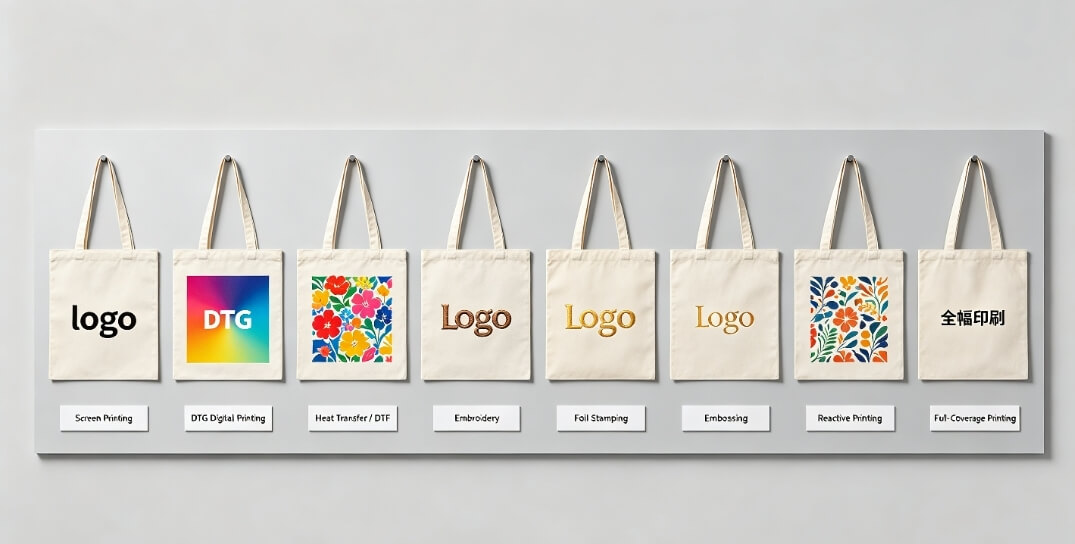
Many buyers assume that ‘printing a logo’ means screen printing. In reality, the supply chain offers far more options:
- Sewing: The starting point for the bag structure, determining its strength and feel.
- Screen printing: The main choice for bold 1–4 color logos.
- Embossing: An ink-free textured finish for a subtle, premium look.
- Foil stamping: A metallic finish suited to beauty, gifting, and luxury brands.
- Digital printing: Ideal for full-color artwork, gradients, illustrations, and small batches.
- Embroidery: Adds a raised, dimensional look and is popular for corporate gifts and premium retail merchandise.
- Reactive printing: Dye penetrates the fibers and resists fading during washing, making it suitable for colored bag customization.
- Full-coverage printing: Creates an integrated visual treatment across the bag body and handles.
Factories with 20 years of experience, such as XINHUI, can complete all eight processes on their own production lines. That means you don’t need to coordinate one supplier for sewing, another for screen printing, and a third for embroidery.
From OEM and ODM services to sample development, fabric and accessory sourcing, sewing, and multiple printing methods, the entire process can be handled through one supply chain.
For buyers, the biggest hidden benefit isn’t necessarily saving a few cents per bag. It’s having a clear line of responsibility. If there’s a printing registration issue or the stitch density fails to meet specifications, you have one supplier responsible for fixing it instead of hearing Factory A blame Factory B.
cotton bag logo Quality Control and Factory Inspection
This is another step that brands often overlook. A reliable factory shouldn’t only accept final random inspections. It should also allow customers to conduct scheduled in-process inspections during production.
At key stages of sewing and printing, customers can schedule a process inspection to check:
- Whether stitch density meets the required standard
- Whether handle reinforcement has been properly completed
- Whether print registration is accurate
- Whether bag dimensions and fabric weight match the approved sample
Any issues can then be corrected before bulk production is completed, avoiding the nightmare of discovering that thousands of bags were printed incorrectly after the entire order is finished.
XINHUI holds CE, ISO, and BSCI certifications and maintains formal quality-control procedures and records. This means customers conducting a factory audit can review documented evidence rather than relying on a supervisor’s visual inspection.
💡 BSCI (Business Social Compliance Initiative) is particularly important for European customers. It is a key supplier-access requirement for many European retailers. If your custom printed cotton tote bags are ultimately going into European supermarkets or branded retail channels, confirm the supplier’s certification status at the beginning of the sourcing process.
custom printed cotton tote bags and Sustainability
If sustainability is part of your brand story, simply saying ‘100% cotton’ is no longer enough. Buyers increasingly want certifications.
GOTS (Global Organic Textile Standard): Certifies organic textiles throughout the supply chain, from raw materials to finished products. Switching from conventional cotton to GOTS-certified organic cotton can reduce water consumption by 91%. A factory holding GOTS certification can issue a Transaction Certificate (TC) for each bulk order, providing formal proof of organic status.
OEKO-TEX Standard 100: Covers the environmental and safety aspects of inks and dyes, helping ensure there are no harmful chemical residues and that the finished product is safe against the skin.
GRS (Global Recycled Standard): Certification for recycled cotton, recycled polyester, and other recycled materials.
Water-based vs. solvent-based inks: Water-based ink penetrates the cotton fibers and provides a softer hand feel without PVC, phthalates, or heavy metals. Solvent-based ink remains more heavily on the surface and generally creates a stiffer feel.
Wash Care and Durability: Turn ‘Long-Lasting’ Into Data
Don’t simply tell customers that your print is ‘highly washable.’ Give them numbers.
- Screen printing with water-based ink: After proper curing, it can withstand 50+ washes without cracking or significant fading.
- DTF heat transfer: High-quality transfers can withstand approximately 50–100 washes.
- Cotton bag itself: A 6 oz bag may start looking worn after 20–30 machine washes, while 10–12 oz heavyweight canvas can withstand hundreds of washes.
- Care instructions: Turn the bag inside out, wash with cold water, hang dry, and avoid high-heat tumble drying.
FAQ
Q1: Does the Same cotton bag logo Need New Screens for Different Bag Styles?
Yes, you need to create new screens, but you don’t need to redesign the logo.
Vector files such as AI and EPS can be scaled without losing quality, allowing the design to fit different print areas. However, two things need attention.
First, smaller bags, such as a 20 × 15 cm cosmetic pouch, may only have an 8 × 8 cm printable area. Complex logos may need to have some details simplified.
Second, different bag styles have different levels of curvature and surface flatness. For drawstring bags and other curved surfaces, DTF or heat transfer is generally preferable to screen printing because screen printing requires a relatively flat printing surface.
When using the same logo across different bag styles, it’s recommended that each factory produce 1–2 samples for approval before bulk production.
This is one reason why choosing a factory like XINHUI, which offers one-stop OEM/ODM and sample development services, can be advantageous. Instead of coordinating separate suppliers for every bag style, customers can receive physical samples across multiple styles within 3–5 business days and compare them side by side.
Q2: What If My Brand Pantone Color Is Unusual, Such as Fluorescent or Metallic?
There are two ways to handle this.
First, for screen printing, fluorescent colors and metallic colors such as gold and silver can be produced with spot-color inks. Each color requires separate screen preparation and typically incurs an additional setup fee. For cost efficiency, MOQs are usually around 100+ pieces.
Second, four-color CMYK printing, including digital and DTF processes, cannot reproduce every Pantone color with 100% accuracy. The factory will use the closest available CMYK approximation, and you may notice a color difference during sampling.
As suppliers commonly point out: ‘There are many Pantone colours that cannot be accurately matched using CMYK colours.’
For unusual brand colors, it’s therefore better to use spot-color screen printing rather than forcing the design through digital printing.
If the supplier also offers foil stamping and embossing, metallic effects can be produced with foil rather than metallic ink. This can provide a more premium look and better durability.
That’s where the value of XINHUI’s integrated production capabilities becomes clear. Its production line covers screen printing, digital printing, foil stamping, embossing, embroidery, reactive printing, and full-coverage printing, allowing different effects to be handled within the same supply chain.
Q3: How Much More Does Double-Sided Printing Cost and How Does It Affect Lead Time?
Cost generally increases when you add another print position, such as going from one-sided to two-sided printing or adding artwork to both the front and bottom. For screen printing, the additional cost is usually related to extra screens and colors. For DTF, it is mainly based on the additional transfer-film area.
Double-sided printing does not necessarily extend the production schedule. However, if the two sides use different artwork rather than a mirrored design, screen printing requires two separate screens, effectively doubling the screen setup cost. With DTF, different front and back designs can usually be handled digitally, although file preparation may add 1–2 days.
If both sides use the same mirrored design, many factories will either charge nothing extra or add only a small fee.
For orders of 100 pieces or more, double-sided printing can make sense. For small batches, single-sided printing usually offers better value.
Regardless of whether you choose one-sided or two-sided printing, it is still recommended that customers participate in the in-process inspection before bulk production is completed. XINHUI allows customers to schedule production inspections and intervene at key sewing and printing stages, which is far safer than discovering a registration problem after the 30-day production period is over.
Can an easy clean lunch bag Go in the Washing Machine?
Why Is Everyone Carrying Shopping Bags?
Related Article


