
How to Choose the Right A4-Compatible Bag
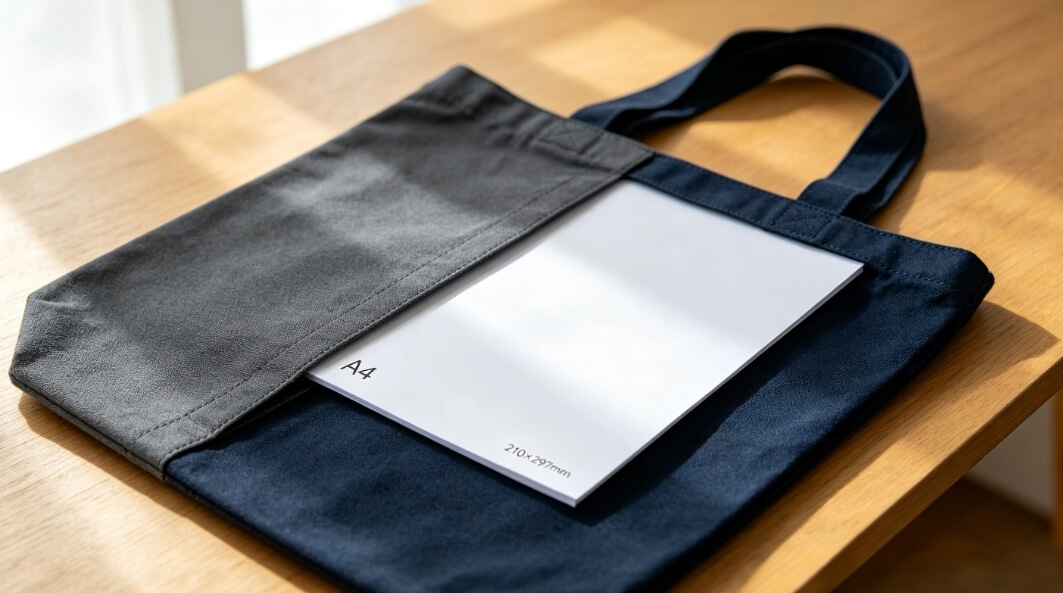
A4 paper measures 210 × 297 mm, as defined by the international ISO 216 standard. But a bag labeled "A4" may have as little as 27 cm of usable interior width.
The gap comes from the fact that sellers often list the "external dimensions." External dimensions include fabric thickness, stitching, zipper tracks, and binding. An A4 file is 21 cm wide, but once you place it inside the bag, stitching and zippers can take up 1-2 cm on each side. That leaves only 27-28 cm of usable width. Force the file in, and both edges can end up creased.
Anyone who carries A4 contracts every day has probably run into the same problem: the product page says "fits A4," but once the bag arrives, the folder cover won't close or the corners of the documents come out with creases.
A bag that can truly hold A4 documents flat, without folding or inserting them at an angle, needs to meet the following minimum interior clearance requirements:
| What you need to carry | Minimum usable interior space (W × H) | Notes |
|---|---|---|
| Loose A4 paper / single-sheet documents | 22 × 31 cm | Standard inner dimensions for document sleeves |
| A4 folder with plastic sleeve | 32 × 24 cm or more | If the interior width is below 32 cm, the corners are likely to deform |
| A4 documents + 13-inch laptop | 34 × 38 cm or more, with 11 cm+ side depth | Typical size for a commuter a4 bag |
| A4 documents + 14-16 inch laptop | Around 38 × 42 cm | Standard corporate A4 tote size |
The first hard-and-fast rule when buying an a4 bag: check the "internal dimensions," not the "external dimensions." Sellers love listing external dimensions because bigger numbers look better.
Three Main a4 bag Styles
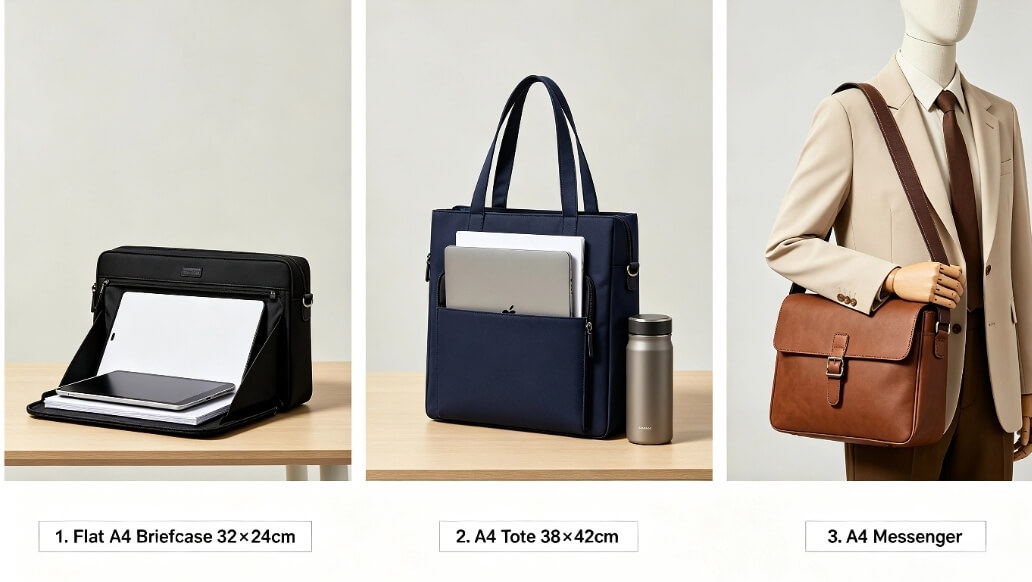
1. A4 Flat Briefcase / Document Bag (about 32 × 24 cm)
Good for: Loose A4 documents, A4 clear folders, tablets
Not good for: Laptops larger than 13 inches or water bottles over 500 ml
Best for: Lawyers heading to court, HR staff bringing resumes to interviews, salespeople handing over contracts to clients
Not ideal for: Daily commuters who need to carry a laptop
2. A4 Tote Bag (30 × 35 cm to 38 × 42 cm)
Small: A 30 × 35 cm cotton-linen tote can carry A4 documents, a tablet, and small personal items, with a load capacity of about 5 kg.
Standard: A 38 × 42 cm corporate tote can carry A4 documents, a laptop, and everyday office essentials.
Material options:
- 8-12 oz organic cotton canvas: supports around 5 kg and can be machine-washed cold
- Nonwoven fabric: 100 gsm polypropylene, with reinforced handles capable of carrying up to 15 kg
- Nylon / polyester: lightweight and water-resistant
- Genuine leather: can hold its shape for three years or more with proper use
Best for: Commuters, university students, and anyone who carries a laptop plus documents every day
3. A4 Messenger Bag / Shoulder Bag
Interior layout: Pen slot, business card pocket, notebook compartment, and a main compartment for A4 documents
Materials: Full-grain leather, ballistic nylon, waxed canvas, or synthetic leather
Best for: Bike commuting, short business trips, and situations where you want to keep both hands free
Not ideal for: People who need to carry laptops larger than 14 inches
What Is an A4 Size Bag?
Before buying an a4 size bag, ask yourself three questions.
What Is the Largest Thing You Carry Every Day?
Measure the actual size of the largest item you carry, including its protective case or cover. The bag's usable interior space should be at least 2 cm larger than that item.
Do You Need to Carry a Laptop Larger Than 13 Inches?
If yes, go straight for an A4 tote measuring at least 38 × 42 cm. Small A4 flat bags can be ruled out immediately.
How Much Weight Do You Carry?
A canvas a4 size bag usually weighs around 500-800 g. Add a 1.5 kg laptop, 500 g of documents, and another 500 g of daily essentials, and you're getting close to 3.5 kg. Once a shoulder bag goes over 3 kg, a backpack is usually the better choice.
The Real Trade-Off of Different Materials
Canvas (8-12 oz Cotton)
The standard choice for affordable A4 totes. It is structured, easy to print logos on, and machine-washable.
The downside is that canvas is not especially lightweight. It also takes a while to dry after getting soaked. Low-quality canvas may shrink or lose its shape after just a couple of washes. Pre-shrunk fabric is the safer choice.
Nonwoven Fabric
The go-to material for promotional giveaway bags. A reinforced 100 gsm version can carry up to 15 kg.
Its biggest advantage is price. The downside is that it feels soft and flimsy. After 20-30 uses, the stitching around the handles can start to come apart, so it is not a great choice for a primary commuting bag.
Nylon / Polyester
Lightweight and water-resistant. Cheap nylon may lose its coating and start pilling after a year of use. Ballistic nylon is the premium option: highly abrasion-resistant, but more expensive.
PU / PVC Leather
Looks like genuine leather but can cost as little as one-tenth the price. In humid southern climates, it may start developing mold, peeling, or cracking within 1-2 years.
Genuine Leather
A full-grain leather bag can easily last five years or more, but prices typically start in the four-figure RMB range.
Two bags can both be labeled "A4 tote" and still perform very differently. A 38 × 42 cm canvas tote with only 2 cm of side depth may actually hold less than a 30 × 35 cm doctor's bag with 15 cm of depth.
When buying an a4 bag, side depth matters more than the headline length and width. It determines whether your bag is basically a "paper sleeve" or a bag that can handle your everyday load.
Choosing an a4 bag for Business Purchasing
When you're sourcing A4 bags for company events, employee onboarding, conference giveaways, or promotional campaigns, the buying logic is completely different from retail shopping.
Retail buyers focus on style. Corporate buyers should focus on four things: sampling speed, delivery reliability, factory compliance, and production capabilities.
A typical process for custom A4 zipper bags is:
Design and specifications (material, size, printing method, quantity) → quotation confirmation → sampling (3-5 days) → mass production (5-10 days) → quality inspection, packing, and shipment (1-2 days).
Standard lead times are generally around 7-18 working days. Corporate orders can take 15-30 working days when they involve custom fabrics, complex production methods, or multiple rounds of inspection.
Chang'an, Dongguan has a highly concentrated raw-material supply chain within a 5 km radius. That local ecosystem is one reason XINHUI says it can develop samples in 3-5 working days and offer lead times of as little as 30 days for some orders.
Sampling and Quotation Response
Once the customer provides the style and logo, XINHUI says it can respond with a quotation and digital rendering within 24 hours, with samples delivered in 3-5 working days.
Compared with the industry's typical pace of 1-2 days for quotation confirmation and 3-5 days for sampling, this can help corporate buyers move from "sample request" to "approval" to "bulk order" within about two weeks.
Production Capabilities and One-Stop Service
XINHUI says its in-house supply chain covers sewing, screen printing, embossing, foil stamping, digital printing, embroidery, reactive printing, and full-surface printing.
Compliance and Quality Control
XINHUI holds BSCI certification and supports customer factory audits and production inspections.
Its quality-control process covers five stages:
- Pre-production material inspection
- In-process inspection
- AQL sampling of finished goods
- Packaging and labeling inspection
- Shipment supervision, if required
For brands shipping to Europe and North America, XINHUI can also provide documentation related to management systems such as ISO 9001 for quality management and ISO 14001 for environmental management.
A4 bag MOQ and Lead Time
XINHUI accepts low-MOQ custom orders, with a recommended standard MOQ of 300 pieces.
Small-batch orders can be delivered in 7-10 working days, while larger orders generally take 15-30 working days.
For first-time customers, it is usually smarter to start with a small trial order and evaluate communication, quality, and execution before placing a larger order. This is a common way to reduce sourcing risk.
Purchasing tip: Once you receive XINHUI's quotation, confirm three things: whether the price includes plate-making, sampling, and shipping fees; whether the BSCI report is still valid; and whether the factory accepts third-party factory audits. Getting these points confirmed early can significantly reduce the risk of problems later.
A4 bag vs. A4 Document Pouch
An A4 document pouch made from plastic or kraft paper is not the same thing as an A4 tote or briefcase.
For a document pouch, an internal size of 220 × 310 mm may be enough. For a proper A4 bag, the interior should be at least 32 × 24 cm to hold a folder flat.
Always state these requirements separately when talking to suppliers. Otherwise, they may give you a document-pouch specification and present it as a full-size bag.
What Should an a4 size bag Really Fit?
A few simple checks can save you from buying the wrong bag.
First, measure the largest item you carry every day, including its sleeve, cover, or protective case.
Second, when shopping online, look only at the "internal dimensions." Ignore the external dimensions. A truly A4-compatible bag should have at least 32 cm of usable interior width and 31 cm of usable height.
Third, choose the style based on your use case:
- Daily commuting with a laptop → 38 × 42 cm canvas tote
- Client meetings and contract delivery → 32 × 24 cm flat document bag
- Short business trips → A4 messenger bag
- Corporate customization → a BSCI-certified manufacturer with a complete production chain, such as a supplier like XINHUI with 20 years of bag-making experience
The rest is mostly about choosing the material and color you like.
But there is one detail worth looking at more closely: why does one 38 × 42 cm A4 tote lose its shape after three months while another stays structured for three years?
The answer lies in the bottom reinforcement and the way the handles are stitched. Those two details can make a huge difference in a bag's lifespan.
For businesses looking to customize A4 totes, XINHUI can also provide digital mockups and quotations based on the preferred style, budget, and logo file.
FAQ
Q1: I Bought a Handbag Labeled "A4," but My A4 Folder Won't Fit. Is the Bag Defective?
Not necessarily.
A4 paper itself measures 210 × 297 mm, but once you add the plastic sleeve of a document folder, the actual required width often exceeds 31 cm. If the bag's interior width is below 32 cm, the folder's corners can easily get squeezed and deformed.
Before buying, ask customer service two simple questions:
"How wide is the usable interior at the bottom?"
"How high is the usable interior?"
For a genuinely A4-compatible bag, you want at least 32 cm of interior width and 31 cm of interior height.
For corporate orders, ask the supplier to produce a physical sample first, then use calipers to measure the actual interior clearance before approving the bulk order. This is the "sample approval" stage used by manufacturers such as XINHUI, and samples can be produced in 3-5 working days.
Q2: I Want to Order Custom A4 Totes With Our Company Logo as Employee Onboarding Gifts. What Should I Watch Out For?
There are six key points:
- Confirm whether the factory has BSCI or a similar social-compliance certification, especially if the products are for European or North American markets.
- Confirm the MOQ. Flexible factories often accept around 100-300 pieces.
- Confirm the sampling time. A standard turnaround is about 3-5 working days.
- Check whether screen printing, digital printing, and embroidery can all be done in-house.
- Confirm whether the quotation includes plate-making and shipping fees.
- Ask whether the factory accepts third-party audits and production inspections.
A 20-year bag manufacturer such as XINHUI says it can provide quotations and digital mockups within 24 hours, accepts orders starting from 300 pieces, and can offer lead times as short as 30 days for some projects. Its production capabilities include sewing, screen printing, digital printing, embroidery, foil stamping, and other processes.
Q3: What Is an A4 Size Bag Compared With a U.S. Letter-Size Bag?
A4 paper is 210 × 297 mm, while U.S. Letter is 216 × 279 mm. Letter is 6 mm wider but 18 mm shorter.
An A4 bag with at least 32 × 24 cm of usable interior space can easily hold Letter-size documents as well.
The reverse is not always true. If a Letter-size bag has only 28 cm of interior height, an A4 document may stick out slightly.
For students or professionals moving to the U.S., buying an A4 tote with at least 32 cm of interior width and 31 cm of interior height is the safer option. It will comfortably handle both A4 and Letter documents.
For businesses exporting to the U.S., a manufacturer such as XINHUI, with BSCI certification and OEM/ODM capabilities, can provide one-stop production from fabric sourcing through printing and other finishing processes, helping maintain more consistent delivery.
Bottom line: when you ask what is an a4 size bag, don't start with the label on the product page. Start with the actual usable interior dimensions, the depth, and the items you need to carry. A bag that merely says "A4" is not necessarily large enough for a real A4 folder.
Could a halloween bag Make Halloween Safer?
Is Your Laptop Bag Size Really Right for Your Laptop?
Related Article


